
Reviewed by the Actax India compliance team, which has helped 150+ businesses register and stay compliant.
Every founder asks the same question first: which business structure fits my idea? A Limited Liability Partnership (LLP) is often first on the list.
The LLP advantages and disadvantages are easy to summarise. You get limited liability, light compliance, and flexible management. You give up easy equity funding and pay a higher tax rate than a company.
The rules have changed since 2023. The Income-tax Act, 2025 took effect on 1 April 2026, and a Corporate Laws (Amendment) Bill, 2026 proposes LLP Act changes.
Below are the benefits of LLP structures, the disadvantages of LLP structures, and our honest view on who should choose one.

What Are the LLP Advantages and Disadvantages in 2026?
Here is a quick scorecard of the LLP advantages and disadvantages before we go deeper.
Factor | Verdict | What it means for you |
Personal liability | Advantage | Risk is limited to your agreed contribution |
Minimum capital | Advantage | None required |
Compliance | Advantage | Two annual forms; no AGM or board meetings |
Management | Advantage | Run the business as per your LLP agreement |
Equity funding | Disadvantage | LLPs cannot issue shares |
Tax rate | Disadvantage | 30% flat, plus surcharge and cess |
Audit | Depends | Above ₹40 lakh turnover or ₹25 lakh contribution |
Late fees | Disadvantage | ₹100 per day per form, with no cap |
What Are the Advantages of LLP in India? Key LLP Benefits
These advantages of LLP structures explain why professionals and small businesses choose them.
- Limited liability. Partners risk only their agreed contribution. A partner stays liable for their own fraud or wrongful acts.
- Separate legal entity. The LLP owns assets, signs contracts, and sues or is sued in its own name.
- Perpetual succession. Changes in partners do not disturb the business.
- Flexible management. The LLP agreement decides roles, profit share and decisions. Ownership moves only with partner consent.
- Light compliance. Two annual forms, against several for a private limited company.
- Lower entry cost. There is no minimum capital. A “Small LLP” (contribution up to ₹25 lakh, turnover up to ₹40 lakh) pays about half the late fee of other LLPs. A partner’s profit share is not taxed again in their hands.
What Are the Disadvantages of LLP in India?
Weigh these disadvantages of LLP registration honestly before you commit.
- No equity funding. LLPs cannot raise capital by issuing shares. Capital comes from partners and loans.
- Slower decisions. Several partners and a weak agreement lead to deadlocks.
- Higher tax rate. The flat 30% plus 4% cess gives an effective 31.2% up to ₹1 crore. Above ₹1 crore, a 12% surcharge lifts it to about 34.94%. Alternative Minimum Tax at 18.5% of adjusted total income may also apply. A company under the concessional regime pays about 25.17% (22% base, 10% surcharge, 4% cess). Dividend distribution tax was abolished in 2020, so its absence is no longer a drawback.
- Audit burden. A Chartered Accountant must audit the LLP if turnover exceeds ₹40 lakh or contribution exceeds ₹25 lakh.
- Uncapped late fees. ₹100 per day per form. Missing both forms for one year costs about ₹73,000, even with zero business.
- Weak investor appeal. No shares and no standard ESOPs put off most venture investors.
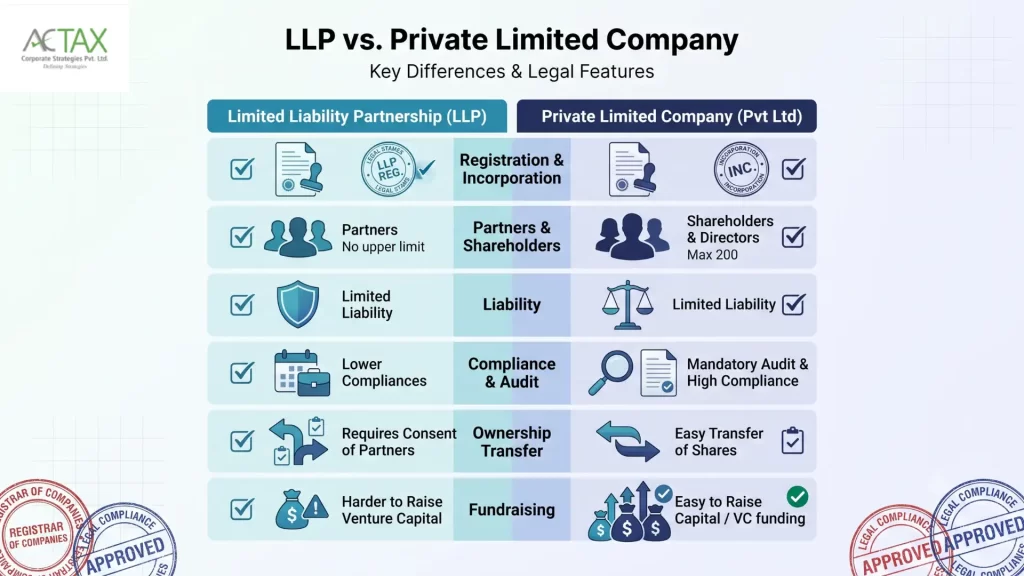
LLP vs Private Limited Company: Which Has Better Advantages and Disadvantages?
Most founders compare an LLP with a private limited company, so here is the side-by-side view.
Parameter | LLP | Private Limited Company |
Governing law | Companies Act, 2013 | |
Can issue shares | No | Yes |
Income tax rate | 30% plus surcharge and cess | 22% base under the concessional regime, plus surcharge and cess |
Audit | Only above ₹40 lakh turnover or ₹25 lakh contribution | Always mandatory |
Annual forms | Form 11 and Form 8 | AOC-4, MGT-7, ADT-1 and others |
Best for | Professionals, consultancies, family businesses | Startups seeking investors |
Our Take: When Do the Benefits of LLP Outweigh the Disadvantages?
This is our view after helping 150+ businesses register.
- Choose an LLP for control and cost, not tax savings. Entity tax rate is a poor tiebreaker. Company profits paid as dividends are taxed again in shareholders’ hands, so compare the full picture.
- LLPs suit professionals and bootstrapped firms. Consultants, agencies and family businesses gain most from light compliance.
- Skip the LLP if you expect funding within 12 to 18 months. Investors expect shares, and converting later costs time and money.
- The LLP agreement matters more than the registration. A copy-pasted agreement is the biggest hidden risk we see.
What Are the Common Myths About LLPs?
Several wrong assumptions distort how people judge the benefits of LLP structures.
Myth | Reality |
Limited liability means zero personal risk | You remain liable for your own fraud or wrongful acts |
LLPs cannot take foreign investment | Allowed in sectors with 100% FDI under the automatic route |
A dormant LLP needs no filings | Form 11 and Form 8 are due even with nil business |
LLPs pay no tax | The LLP pays 30% plus surcharge and cess |
What Changed in 2026 for LLP Advantages and Disadvantages?
The Income-tax Act, 2025 replaced the 1961 Act from 1 April 2026. The 30% LLP rate is unchanged. Tax year 2026-27 is the first under the new law.
The Corporate Laws (Amendment) Bill, 2026 was introduced on 23 March 2026 and referred to a Joint Parliamentary Committee. It is a proposal, not law, as per the latest reports we reviewed. Check its status before you act.
Proposed change | Likely impact on LLPs |
Trust-to-LLP conversion framework | New restructuring route |
Specified IFSC LLPs (GIFT City) | Dedicated framework, foreign currency contributions |
Suo moto adjudication of penalties | Faster closure of filing defaults |
E-adjudication of minor offences | Monetary penalties instead of court cases |
Our view: the Bill eases penalties but does not fix the funding gap, so the core LLP vs company choice stays the same.
What Are the LLP Annual Compliance Due Dates in 2026?
Missing these dates is the most common way an LLP turns its benefits into penalties.
Filing | Due date | Who files |
Form 11 (Annual Return) | 30 May | All LLPs |
ITR-5 (no tax audit) | 31 July | All LLPs |
30 September | Every DPIN holder | |
Form 8 (Statement of Account and Solvency) | 30 October | All LLPs |
ITR-5 (tax audit cases) | 31 October | LLPs with tax audit |
Form 8 for FY 2025-26 is due on 30 October 2026. Finalise accounts and any audit now.
Is LLP Registration Compulsory? Under Which Act is LLP Registered?
LLP registration is not mandatory, but it offers several benefits. LLPs are registered under the Limited Liability Partnership Act, 2008.
The process covers a Digital Signature Certificate (DSC), a Designated Partner Identification Number (DPIN), name reservation, the FiLLiP incorporation filing, the Certificate of Incorporation and the LLP agreement. See the documents required for LLP registration and the LLP registration process.
Is an LLP a Better Business Type to Raise Funds from Private Investors?
Usually not. An LLP cannot issue shares or attract equity investment. Many founders start as an LLP and convert to a private limited company when funding is near.
An LLP can still raise money from these sources:
- Partner contributions and partner loans
- Bank term loans and working capital
- Foreign investment in sectors with 100% FDI under the automatic route
Venture investors usually invest through equity or convertible instruments, which is why they prefer companies.
Our advice: decide before the first investor meeting, not after the term sheet. Converting to a private limited company means fresh filings, updated licences, GST and bank records, and a check of the tax impact. Add a conversion clause to your LLP agreement now, so partners already agree on the process.
How Much Does It Cost to Register an LLP in India?
Registration is a one-time cost, but recurring compliance is the bigger spend over time. Here is what drives the total. For a full breakdown, see LLP Registration Cost.
Cost item | One-time or yearly | What decides the amount |
Digital Signature Certificates | One-time, renewed on expiry | Number of partners |
Name reservation and incorporation filing | One-time | Government fee, linked to partner contribution |
LLP agreement stamp duty | One-time | State of registration |
Professional fees | One-time | Scope and number of partners |
Form 11, Form 8 and ITR-5 filing | Yearly | Volume of transactions |
Audit | Yearly, only above the thresholds | Turnover and contribution |
In our experience, founders budget for incorporation and forget years two and three. Plan for annual compliance from day one.
So, Is an LLP Right for You?
LLP registration in India balances benefits and challenges. The main advantages of LLP are limited liability, flexible management and light compliance. The main disadvantages of LLP are limited funding, a higher tax rate and audit and penalty exposure. Weigh the LLP advantages and disadvantages, track the 2026 changes, and take professional advice before you decide.








Comments are closed.