
Introduction to OPC Registration in Bangalore
For entrepreneurs in Bangalore, OPC Registration in Bangalore holds significant importance when it comes to starting a business and establishing a legal entity. One Person Company (OPC) registration offers solo entrepreneurs a distinct opportunity to enjoy limited liability and create a corporate structure for their business. In this comprehensive guide, we will provide a step-by-step walkthrough of the OPC registration process in Bangalore, along with information on key steps, eligibility criteria, advantages, compliance requirements, and frequently asked questions.
What is One Person Company (OPC) in Bangalore?
One Person Company (OPC) is a type of business entity where a single individual can incorporate a company with limited liability. The concept of OPC was introduced in the Companies Act, of 2013, to provide a favourable business environment for solo entrepreneurs. OPCs allow individuals to operate as a separate legal entities, offering limited liability protection where personal assets are separate from business liabilities.
OPCs have perpetual existence, ensuring business continuity even in the event of the owner’s death or incapacitation. They also enjoy legal recognition as distinct legal entities, facilitating easier access to loans, funding, and contracts.
As of the Companies (Incorporation) Second Amendment Rules, 2021, there is no longer a mandatory turnover or paid-up capital threshold that forces an OPC to convert into a Private Limited Company. Earlier rules required conversion once turnover crossed ₹2 crore or paid-up capital crossed ₹50 lakh that requirement has been removed. An OPC can now voluntarily convert to a Private Limited Company at any time, once it has completed two years from incorporation, but it’s no longer forced to.
When Should an OPC Consider Converting to Private Limited?
Even though conversion is no longer mandatory, most OPCs still convert once they outgrow the structure in practice typically when they want to bring in a co-founder, raise external funding (OPCs can’t issue shares to multiple investors), or need the credibility of a multi-member board for larger contracts. Conversion is voluntary and can happen anytime after two years from incorporation, subject to a special resolution and the standard MCA filing process.
Why should an OPC monitor turnover?
OPCs get some genuine compliance relief compared to a Private Limited Company, which is one of the reasons solo founders pick this structure:
- Board meetings: Only one director is required, so the usual quorum requirements that apply to multi-director companies don’t apply the same way.
- Cash flow statement: OPCs are exempt from including a cash flow statement as part of their annual financial statements.
- Annual filings: Still mandatory annual return and financial statements must be filed with the ROC every year, same deadlines as other companies.
- Auditor appointment: Still required, same as any registered company.
- Tax compliance: OPCs are taxed as a company (not at individual slab rates), so the 22-25% corporate tax rate applies regardless of the founder’s personal income level.
Register your OPC Company in Bangalore
Advantages of One-Person Company Registration
Registering as a One Person Company (OPC) in Bangalore offers several advantages:
- Limited Liability: The primary advantage of OPC registration is that it offers limited liability protection to the sole proprietor. This means that the personal assets of the owner are separate from the liabilities of the business. By registering as an OPC, the owner’s liability is limited to the amount invested in the company, and their personal assets are not at risk.
- Legal Recognition: An OPC is a distinct legal entity with its rights and liabilities. It is considered a private company under the Companies Act, 2013. This legal recognition provides credibility and enhances the reputation of the business. As a private company, an OPC has easier access to loans, funding, and contracts. Other businesses, financial institutions, and individuals are more inclined to engage in transactions and partnerships with a registered OPC due to its recognized legal status as a private company.
- Perpetual Existence: Unlike a sole proprietorship, an OPC has perpetual existence. It means that the company’s existence is not affected by the death or incapacitation of the owner. The OPC continues to exist as a separate legal entity, ensuring business continuity. This feature is beneficial for businesses with long-term plans, as the company can carry on its operations seamlessly even if there are changes in ownership or management.
By combining the benefits of limited liability, legal recognition as a private company, and perpetual existence, registering as a One Person Company provides a favorable business environment for solo entrepreneurs in Bangalore. It allows them to operate as a separate legal entity while enjoying the advantages associated with being a private company. These advantages make OPC an attractive option for solo entrepreneurs who want to establish a separate legal identity for their business while enjoying the benefits of limited liability.
Eligibility Criteria for OPC Registration
To register an OPC in Bangalore, certain eligibility criteria must be met:

- Only Indian residents can incorporate an OPC. The owner of the OPC must be a resident of India, meaning an Indian citizen or a person who has stayed in India for a minimum period.
- The OPC must have a minimum of one director and one nominee. The owner of the OPC can act as both the director and the nominee, or they can appoint another person as the nominee.
- The director and nominee must be Indian residents and individuals. Non-resident Indians (NRIs) or foreign nationals cannot be directors or nominees of an OPC.
- An individual can incorporate only one OPC at a time. A person can be a director in multiple companies, but they can incorporate only one OPC.
Meeting these eligibility criteria is essential to proceed with the registration of an OPC in India. Learn more about the documents required for company registration.
Step-by-Step Process of One-Person Company Registration in Bangalore
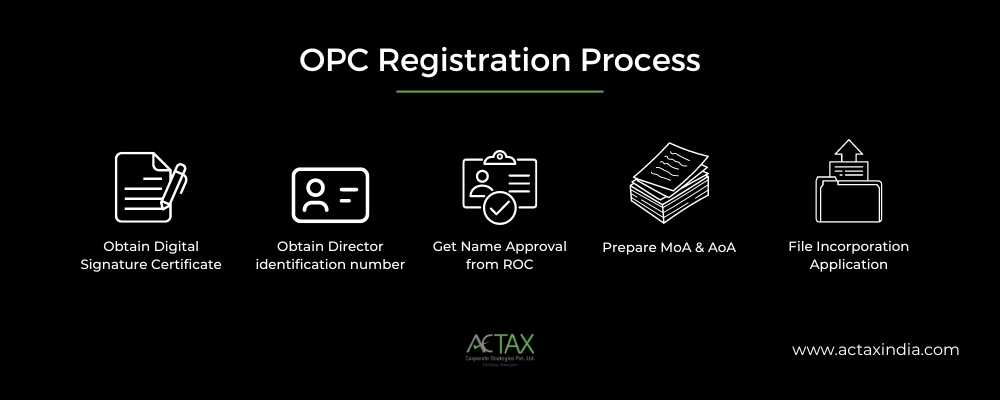
The process of registering a One Person Company (OPC) in Bangalore involves the following steps:
- Obtaining Digital Signature Certificate (DSC)
- Obtaining Director Identification Number (DIN)
- Name Reservation
- Drafting Memorandum of Association (MoA) and Articles of Association (AoA)
- Filing the Incorporation Application
- Obtaining the Certificate of Incorporation
It is essential to follow these steps carefully and submit all the required documents and information accurately to ensure a smooth registration process for your OPC. Click here to know more about Company Registration Process.
Compliance Requirements for OPC Post Registration!
After the registration of your OPC, it is crucial to fulfill certain compliance requirements to maintain its legal status. Here are some essential compliance obligations:
- Appointment of Auditor
- Annual Filings
- Board Meetings
- Statutory Registers
- Tax Compliance
Adhering to these compliance requirements is essential to ensure the proper functioning and legal compliance of your OPC.
OPC Registration Fees in Bangalore
Item | Typical Cost |
Government incorporation fee | Scales with authorized capital |
Karnataka stamp duty (MoA/AoA) | Confirm current rate on IGR Karnataka |
DSC (per director/nominee) | Nominal, one-time |
OPC vs Private Limited and Which Should a Solo Founder Pick?
Factor | OPC | Private Limited |
Founders needed | 1 | 2 minimum |
Fundraising | Harder and can’t issue shares to multiple investors easily | Easier and built for outside investment |
Compliance | Slightly lighter | Full ROC compliance |
Conversion | Mandatory conversion to Pvt Ltd above certain turnover/capital | N/A |
Conclusion
Whether you’re considering One Person Company (OPC) registration in Bangalore or Company Registration in Mumbai, both options provide beneficial structures for solo entrepreneurs to establish a separate legal entity and enjoy limited liability. By understanding the advantages, eligibility criteria, registration process, compliance requirements, and frequently asked questions related to OPCs, you can make informed decisions and smoothly navigate the OPC registration process.
Get Started with OPC registration in Bangalore!
Frequently Asked Questions
Not directly in its OPC form most founders convert to Private Limited once they plan to raise outside capital.
Government and stamp duty costs are broadly similar; the real savings in OPC come from lighter ongoing compliance, not the registration fee itself.
Not unless your paid-up capital crosses ₹10 crore below that, OPCs aren’t required to appoint a whole-time company secretary, which is one more area where compliance is lighter than a Pvt Ltd.
No, an OPC by definition has one member, though you can appoint additional directors for operational purposes. To bring on a second shareholder or co-founder, you’d need to convert to a Private Limited Company.