
You’ve picked a brand name, now you want to protect it. The first question is always the same: what will it cost?
Here’s the quick answer. The online filing fee is ₹4,500 for applicants who qualify as individuals, startups, or small enterprises. For other applicants, it’s ₹9,000. Both amounts are per mark, per class. That covers the government side of the trademark registration cost. Your real budget also depends on professional help, objections, opposition, and renewal.
Our trademark team at Actax India works with this fee schedule every day, and the same budgeting mistakes show up in almost every first consultation. In this guide, you’ll see the full cost of trademark registration, not just the first payment.
Trademark Registration Cost in India: The Government Fee
All trademark government fees come from the schedule published by IP India under the Trade Marks Rules, 2017. You pay the main fee when you file Form TM-A.
Applicant category | Online | Physical |
Individual, startup or small enterprise | ₹4,500 | ₹5,000 |
All other applicants | ₹9,000 | ₹10,000 |
The category depends on whether you meet the eligibility conditions, not on your legal structure alone. A company or LLP that qualifies as a recognised startup or small enterprise can use the lower fee. Online filing costs less, so most applicants should file online.
These are your trademark filing fees. Everything else in this guide builds on them.
Trademark Registration Fees for Proprietorship, MSME and DPIIT-Recognised Startups
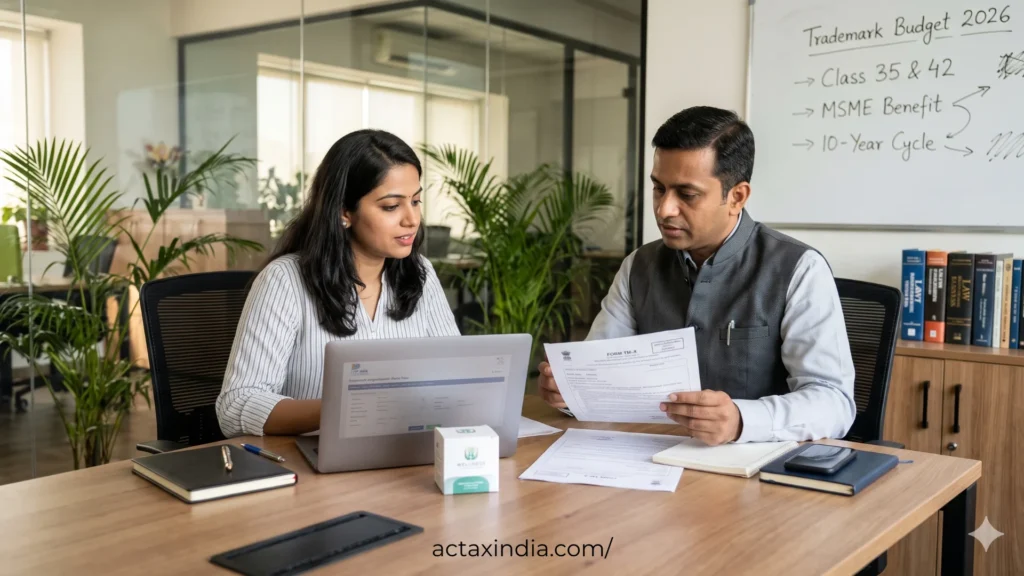
Sole proprietors: A proprietor usually files in their own name as an individual, so the online fee is ₹4,500. Earning revenue doesn’t push you into the ₹9,000 bracket. This is what the trademark registration fees for proprietorship question comes down to.
MSMEs: If you hold a valid Udyam-registered MSME certificate and meet the small enterprise criteria, the trademark registration fees for MSME applicants are ₹4,500 online. You can check or get your certificate on the official Udyam portal.
Startups: A DPIIT-recognised startup can claim the same rate. Keep your recognition certificate ready and check the process on the Startup India portal. The discount is 50% of the standard fee.
Everyone else: If you don’t meet any of these conditions, you pay ₹9,000 per mark, per class.
Professional Fees and Government Filing Fees: What Your Total Cost Includes
Most people budget for one number. A realistic budget has four parts, and each has a different source.
Cost part | Who sets it | Fixed or variable |
Government fees | IP India schedule | Fixed |
Professional fees and government filing fees (the lawyer or agent part) | The provider | Varies by scope |
GST on professional services | Tax law, charged on the provider’s invoice | Applies to the service fee, not to the government fee |
Later proceedings (objection work, hearings, opposition) | Depends on your case | Unpredictable |
Keep the first two apart in every quote. The government fee never changes with the provider. The professional fee does. Before you hire anyone, ask:
- Is the government fee inside the quote or added on top?
- Does the price cover one class or more?
- Does it include a proper search before filing?
- Who handles an examination objection, and what does that cost?
- Is GST shown as a separate line on the invoice?
A cheap package that leaves out objection replies can cost more in the end than a fuller one.
Cost of Trademark Registration: A 10-Year Example for Three Applicants
Here’s the same brand filed by three kinds of applicants. Each protects a brand name and a logo, one class each, filed online. That means two filings per applicant. All figures are government fees only.
Sole proprietor | Eligible startup | Company that doesn’t qualify | |
Filing (2 marks × 1 class) | ₹9,000 | ₹9,000 | ₹18,000 |
Renewal after the first term (2 × ₹9,000) | ₹18,000 | ₹18,000 | ₹18,000 |
Total across the cycle | ₹27,000 | ₹27,000 | ₹36,000 |
Trademark Opposition Cost: What If Someone Objects?
There are two different events here, and they cost different amounts.
An examination objection comes from the Registry itself. IP India’s schedule lists no separate government fee for replying to an examination report. The cost is the work of drafting the reply and, if needed, attending a hearing. That’s where professional help matters.
A trademark opposition comes from a third party. After your mark appears in the Trade Marks Journal, others get four months to oppose it. The schedule uses the same ₹2,700 online fee (₹3,000 on paper) per class for both sides, but each side pays for its own filing:
- The opponent pays ₹2,700 per class for the notice of opposition.
- You, as the applicant, pay ₹2,700 per class for your counterstatement.
So defending one class costs you ₹4,500 (filing) + ₹2,700 (your counterstatement) = ₹7,200 in government fees, before any lawyer charges.
Also, watch the deadline. You generally have two months from receiving the notice to file your counterstatement. If you miss it, the Registry can treat your application as abandoned, and the filing fee is lost.
Expert insight from Vivek Bhat (CA), Founder, Actax India: “Most founders ask me about the filing fee. The better question is what happens if the Registry objects. The government fee is fixed, but the work of replying and attending a hearing isn’t. And since filing fees aren’t refunded on refusal, I tell clients to spend a little on a proper search first. It’s far cheaper than losing the fee.”
Trademark Filing and Renewal: The 10-Year Registration Cycle
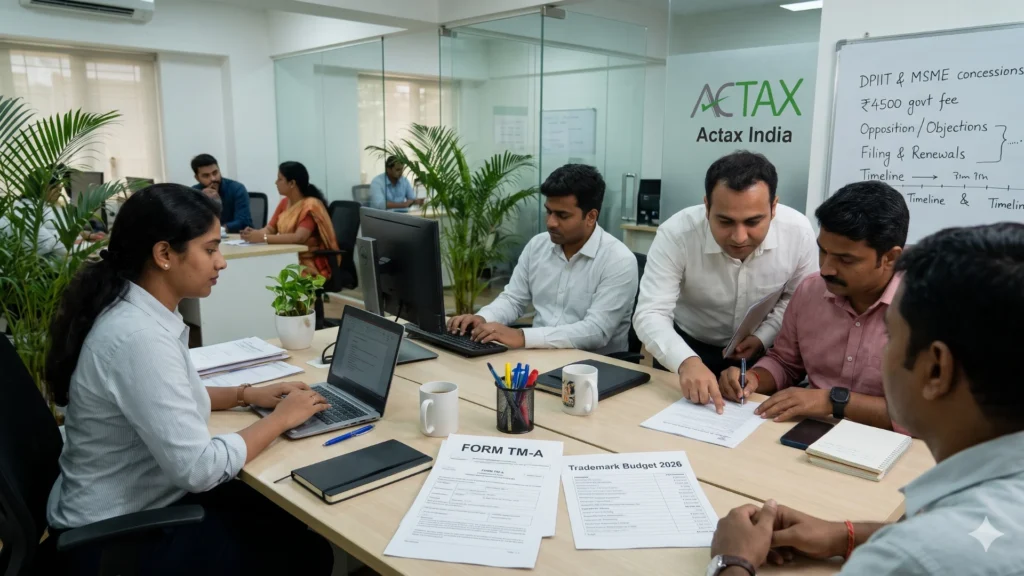
A registered mark lasts ten years, then you renew it. Under the Trade Marks Act, 1999, the registration is treated as effective from the date you filed the application. So your renewal date counts from your filing date, not from the day the certificate arrives. If your application takes 18 months, you’ll have already used up that time when the certificate lands.
That makes trademark renewal and restoration easy to miss. Here are the costs, per class, online:
Step | Government fee |
Standard renewal (Form TM-R) | ₹9,000 |
Renewal with surcharge (late, within six months of expiry) | ₹9,000 + ₹4,500 |
Restoration and renewal (after removal from the register) | ₹9,000 + ₹9,000 |
Set a calendar reminder on the day you file. Also keep your address on record current, because reminder notices go there.
Trademark Registration Mistakes That Raise Your Cost
- Filing in the wrong owner’s name: Say a founder files personally and later wants the company to own the mark. Transferring it means a subsequent-proprietor application (TM-P), which costs ₹9,000 online. Decide the owner before you file.
- Claiming the wrong category: Claim the lower fee without valid proof, and you risk trouble. Claim the higher fee when you qualify, and you overpay ₹4,500 per class.
- Fixing errors later: A correction request on a pending application (TM-M) costs ₹900 online. It’s small, but it also slows you down.
Also remember that filing fees are generally not refundable if an application is refused. IP India recently issued a notice about refunds for duplicate payments in trademark applications. You can find it under News & Updates on the IP India website. That covers duplicate payments, not refused applications.
When Expedited Examination Is Worth Considering
You can ask the Registry to move your application faster. Under Rule 34, the online fee is ₹20,000 per class for individuals, startups and small enterprises, and ₹40,000 per class for other applicants. That’s on top of the filing fee.
It’s a request for faster processing. It doesn’t promise a registration date or a favourable decision. Consider it if you’re launching soon or facing a copycat. If you’re not in a hurry, standard processing is usually enough.
Trademark Registration Cost by Number of Marks and Classes
You file in the classes that match what you sell or plan to sell soon. There are 45 classes in total.
Example | Eligible applicant | Other applicant |
1 mark, 1 class | ₹4,500 | ₹9,000 |
1 mark, 2 classes | ₹9,000 | ₹18,000 |
Name + logo, 1 class each | ₹9,000 | ₹18,000 |
Name + logo, 2 classes each | ₹18,000 | ₹36,000 |
Build your own estimate: (marks × classes × filing fee) + counterstatement fee if opposed + (marks × classes × ₹9,000) for the first renewal. Keep the professional fee and GST as a separate line.
One cost-saver: if the Registry objects in only one class, you can divide the application (₹1,800 online) so the other classes move ahead.
What’s New in 2026: IP India, Trade Marks Rules, 2017 and Draft Guidelines
The Trade Marks Act, 1999 and the Trade Marks Rules, 2017 still govern registration. The filing fees on the official schedule are unchanged. Two draft documents are worth knowing about, and neither is law yet:
- Draft Manual: IP India has published a draft Manual of Trademarks Practice and Procedure for public comments. It explains how filing, hearings, and opposition should run. You can see the latest version on the IP India manuals page.
- Draft AI guidelines: On 17 October 2026, IP India listed draft guidelines on the use and misuse of AI in trademark proceedings. Read the draft text before you rely on any clause.
Whatever the final rules say, have a person prepare and check your affidavits and evidence.
Actax India’s Practical Tips to Keep Your Trademark Cost Low
We file trademarks for founders and small business owners, and the same budget leaks keep showing up. Here’s how to avoid them:
- Search first: Run the official IP India trademark search before you pay anything. Check spelling variations and similar-sounding names too. Look-alike names are a common reason for objections.
- Pick classes honestly: Every extra class adds at least ₹4,500. File only where you trade now or soon will.
- Keep your proof active: Your Udyam or DPIIT certificate must be valid on filing day, or you lose the lower fee.
- Get the scope in writing: Ask for the professional fee, GST, and objection-handling terms upfront. A cheap quote that skips objection replies rarely stays cheap.
One more thing: decide who owns the brand before you file. Fixing it later costs extra. If you’re also setting up the business, we handle company registration in Bangalore, so ownership is right from day one. You can read how Startup India registration works too.
Plan Your Trademark Budget with Actax India
Budget in three parts: the filing fee, the work if someone objects or opposes, and renewal. That gives you a number you can plan around.
Want help with your own brand? Talk to the trademark team at Actax India. Tell us your brand, your classes, and your applicant type, and we’ll walk you through the filing and what it will cost.