What Does “Outgrowing DIY Payroll” Actually Mean?
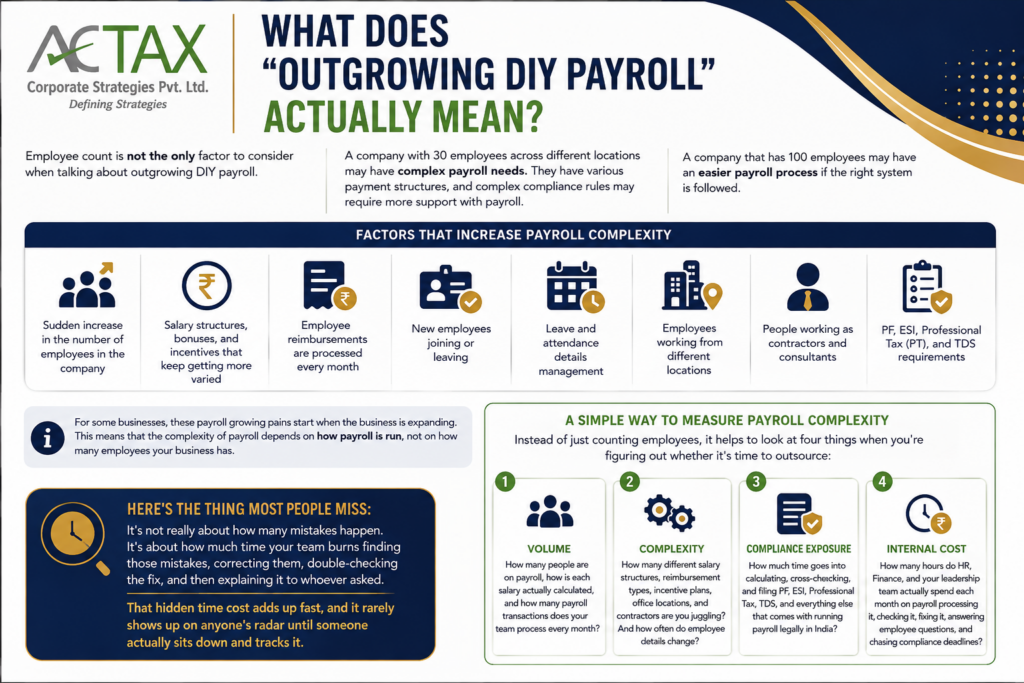
Employee count is not the only factor to consider when talking about outgrowing DIY payroll. A company with 20 employees can have two different complexities.
For example, even a company with just 30 employees across different locations may have complex payroll needs. They have various payment structures, and complex compliance rules may require more support with payroll. But a company that has 100 employees may have an easier payroll process if the right system is followed.
The following factors increase payroll complexity:
- Sudden increase in the number of employees in the company.
- Salary structures, bonuses, and incentives that keep getting more varied
- Employee reimbursements are processed every month.
- New employees joining or leaving.
- Leave and attendance details management.
- Employees working from different locations
- People working as contractors and consultants
- PF, ESI, Professional Tax (PT), and TDS requirements
For some businesses, these payroll growing pains start when the business is expanding. This means that the complexity of payroll depends on how payroll is run, not on how many employees your business has.
A Simple Way to Measure Payroll Complexity
Instead of just counting employees, it helps to look at four things when you’re figuring out whether it’s time to outsource:
- Volume: How many people are on payroll, how is each salary actually calculated, and how many payroll transactions does your team process every month?
- Complexity: How many different salary structures, reimbursement types, incentive plans, office locations, and contractors are you juggling? And how often do employee details change?
- Compliance Exposure: How much time goes into calculating, cross-checking, and filing PF, ESI, Professional Tax, TDS, and everything else that comes with running payroll legally in India?
- Internal Cost: How many hours do HR, Finance, and your leadership team actually spend each month on payroll processing it, checking it, fixing it, answering employee questions, and chasing compliance deadlines?
Here’s the thing most people miss: it’s not really about how many mistakes happen. It’s about how much time your team burns finding those mistakes, correcting them, double-checking the fix, and then explaining it to whoever asked. That hidden time cost adds up fast, and it rarely shows up on anyone’s radar until someone actually sits down and tracks it.
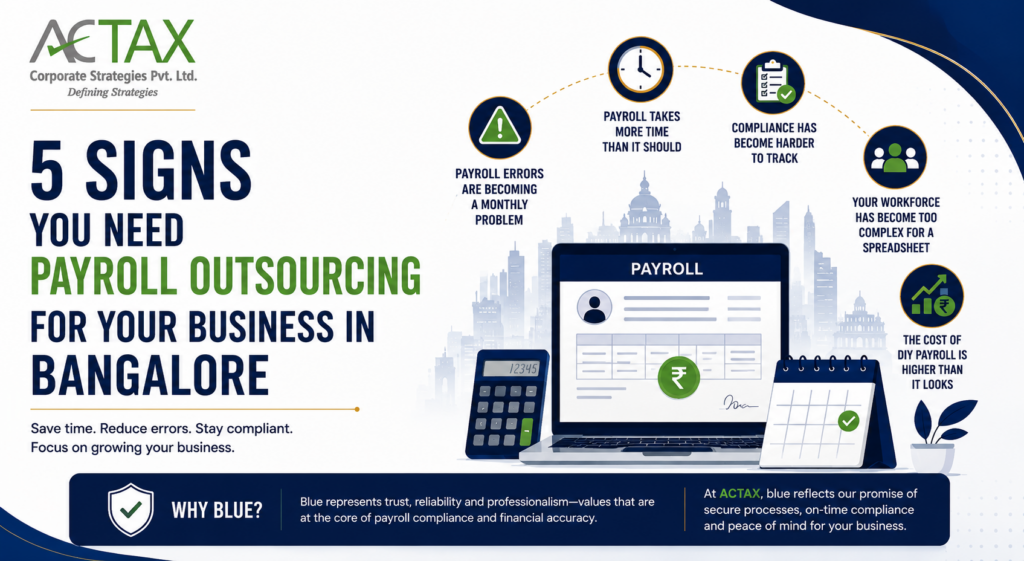
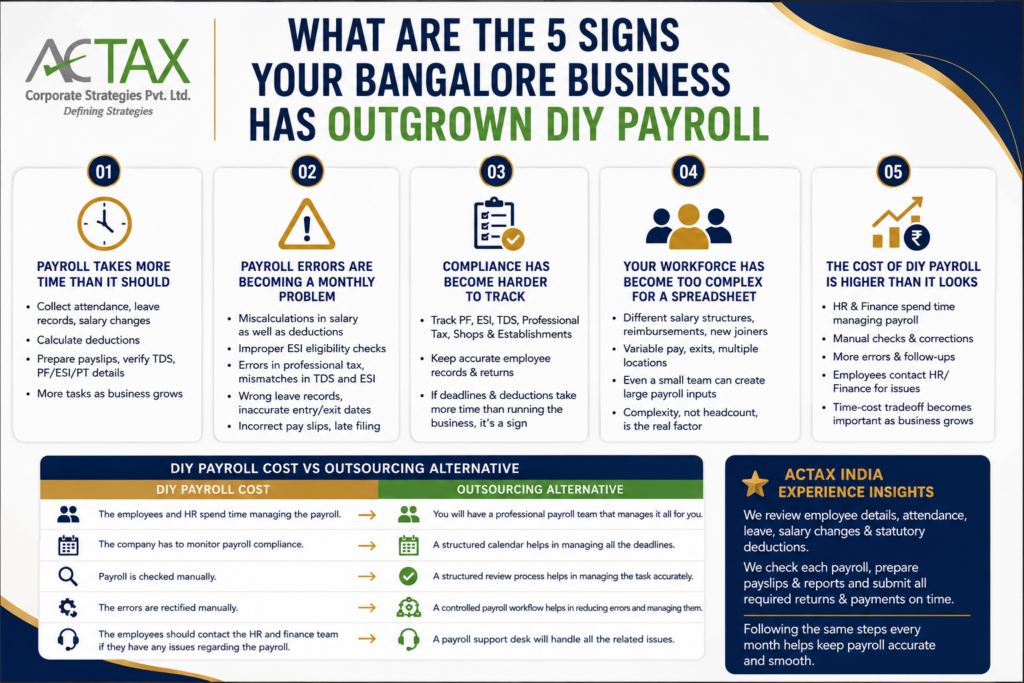
What Are The 5 Signs Your Bangalore Business Has Outgrown DIY Payroll
Payroll Takes More Time Than It Should
Sometimes Payroll seems like an uncomplicated process that only takes a few hours to complete. However, a closer look reveals that it takes more time than necessary, leading the team to wonder why they are still finalizing payroll processing activities.
Each month, the number of payroll tasks increases as the business grows. They may have to collect the attendance of employees, check out leave records, update changes to salaries, and even calculate deductions. They also have to prepare payslips, verify TDS, and prepare PF/ESI/PT details.
Actax India Experience Insights
A growing company may not have a large workforce but can still experience payroll complexity when it has multiple salary structures, monthly reimbursements, and statutory deductions. In these situations, the issue is not only the headcount itself. At Actax India, we often see founders move from using simple spreadsheets to a proper payroll system as their team grows. We have seen that as the business grows, the hiring process also increases, and the salary structure also changes. At the management level, PF, ESI, and TDS become tough to handle. So we help businesses with payroll management services, where we manage everything from payroll errors to handling PF, ESI, and TDS calculations.
Payroll Errors Are Becoming a Monthly Problem
There are various common errors seen in outgrown DIY Payroll processes that include
- Miscalculations in salary as well as deductions
- Improper ESI eligibility checks
- Errors in professional tax,
- Mismatches in TDS and ESI,
- Issues of having wrong leave records and attendance,
- Inaccurate entry or exit dates,
- Late filing or compliance,
- Issues related to incorrect pay slips.
A single mistake can create a multitude of problems:
An incorrect payroll input can lead to a wrong payroll calculation, which can lead to incorrect deductions, employee claims for miscalculations, additional accounting corrections and, in some rare cases, a compliance audit, which could turn out to be expensive.
This is also why businesses should not only look at how many errors happen. They should look at how much time the team spends finding, correcting, checking, and explaining those errors every month.
Compliance Has Become Harder to Track
In Karnataka, companies have to stay on top of PF, ESI, TDS, Professional Tax, and Shops & Establishments regulations and keep accurate employee records to support all the returns that go along with them.
For the latest requirements, it’s always worth checking directly with EPFO, ESIC, the Income Tax Department, and Karnataka’s Professional Tax authorities, since rules do shift from time to time.
If your HR or finance team spends more time tracking deadlines and statutory deductions than actually running the business, that’s usually one of the clearer signs you need payroll outsourcing.
One thing worth keeping in mind: outsourcing payroll doesn’t mean handing off all responsibility. It takes the administrative load off your plate and gives you a more structured, reliable process, but as the employer, you still hold the statutory responsibility at the end of the day.
Your Workforce Has Become Too Complex for a Spreadsheet
When discussing issues relating to payroll, it is easy to concentrate only on the number of employees involved.
However, payroll becomes more complicated when businesses have different salaries, reimbursements, and new employees joining at times. This creates additional work, resulting in increased payroll growing pains.
Payroll complexity is not a result of business growth in this case. Companies should not rely on the number of employees to decide when to outsource payroll. They have to take into account the level of complexity.
Actax India Experience Insights
From our experience managing payroll processes for growing businesses, payroll growing pains are the result of several factors that increase at the same time. It happens because in companies, employee changes, attendance data inputs, and management become difficult.
For example, a growing Bangalore business may have employees with different salary structures, monthly reimbursements, variable pay, new joiners, exits, and employees working from different locations. In this situation, even a relatively small team can create a large number of payroll inputs that need to be checked every month.
The Cost of DIY Payroll Is Higher Than It Looks
| DIY payroll cost | Outsourcing alternative |
| The employees and HR spend time managing the payroll. | You will have a professional payroll team that manages it all for you. |
| The company has to monitor payroll compliance. | A structured calendar helps in managing all the deadlines. |
| Payroll is checked manually. | A structured review process helps in managing the task accurately. |
| The errors are rectified manually. | A controlled payroll workflow helps in reducing errors and managing them. |
| The employees should contact the HR and finance team if they have any issues regarding the payroll. | A payroll support desk will handle all the related issues. |
The time-cost tradeoff becomes important as your business grows. When the total internal cost keeps increasing, it may be one of the strongest signs that you need payroll outsourcing.
A simple way to calculate the internal cost is to add the monthly hours spent by HR, Finance, and Management on payroll processing, corrections, compliance follow-ups, employee queries, and reporting. This gives a better comparison than looking only at the cost of payroll software.
Actax India Experience Insights
As we provide outsourcing payroll services, we help companies reduce mistakes during the payroll process. But we still check everything every month. We review the employee details, attendance, leave, salary changes, and statutory deductions. We check each payroll, prepare payslips and reports, and submit all required returns and payments on time. Following the same steps every month helps keep payroll accurate and smooth.
The Payroll Outsourcing Framework
Many businesses benefit from payroll outsourcing when these four factors start increasing, such as payroll volume, complexity, compliance exposure, and internal costs.
1. Volume
How many employees are there in the company, how are their salaries calculated, and how are other payroll transactions processed each month?
2. Complexity
What will be the salary structure, how will the reimbursement be processed, and what are the locations of people who are hired on a contract basis?
3. Risks of Compliance
What is the level of PF, ESI, Professional Tax, TDS, and other payroll-related filings that will take time to calculate and evaluate?
4. Internal Cost
What is the total time that HR, Finance, and Management spend each month on payroll processing?
As these four factors increase, payroll outsourcing becomes an important consideration for businesses.
A Quick Payroll Outsourcing Readiness Check
Ask these questions before making a decision:
- Does payroll take more time every month than it used to?
- Are payroll corrections becoming frequent?
- Are salary structures, incentives, or reimbursements becoming more complicated?
- Are new employees joining or leaving frequently?
- Does your team manage employees across different locations?
- Are contractors or consultants part of the payroll process?
- Does HR or Finance spend significant time checking PF, ESI, PT, or TDS?
- Are payroll deadlines difficult to track?
- Do employees regularly contact HR about salary or payslip issues?
- Does payroll depend heavily on one person?
If several of these are becoming regular problems, the business may have reached the point where outsourcing payroll should be evaluated.
What Changes When You Bring in a Payroll Partner?
A Payroll Partner can reduce the team workload, from handling salary calculations and payslip generation to handling PF, ESI, and TDS. They help you simplify payroll processing and reduce time on last-minute spreadsheets.
The advantage of using a payroll provider is that it does not simply do the necessary salary calculations. But a reliable payroll provider will stick to a system in the course of its work.
A payroll partner will gather the information and then verify it. After this, they process the payroll and complete a quality check before the payment. Once the approval is given by the authorized manager, the payment is transferred and recorded.
A payroll provider can simplify payroll processing and reduce the time you spend on last-minute spreadsheets.
What Should You Check Before Choosing a Payroll Provider?
Before choosing a payroll outsourcing partner, businesses should not only compare the service price. They should also check how the provider manages the actual payroll process.
Some important questions include:
- Does the provider handle PF, ESI, Professional Tax, and TDS requirements?
- Is there a proper payroll review and approval process?
- How are payroll errors identified and corrected?
- How are employee records and payroll information protected?
- Who handles employee payroll queries?
- How are statutory deadlines tracked?
- What reports will the business receive every month?
- What happens when employees join or leave?
- How is the payroll process transitioned from the existing system?
- Who is responsible for reviewing and approving the final payroll?
The right payroll provider should not only process salaries. It should provide a structured process that makes payroll easier to manage every month.
Conclusion
Is payroll taking too much time from your team’s work? Are you also noticing signs that you need payroll outsourcing for your company? The workforce is becoming more complicated, and doing payroll on your own is costing you more than you think.
If your company is growing faster, you can experience payroll growing pains. At that time, you have to think about whether you should have your payroll handled by professionals instead of doing it yourself. Actax India is here to understand your needs and provide professional payroll services in Bangalore.