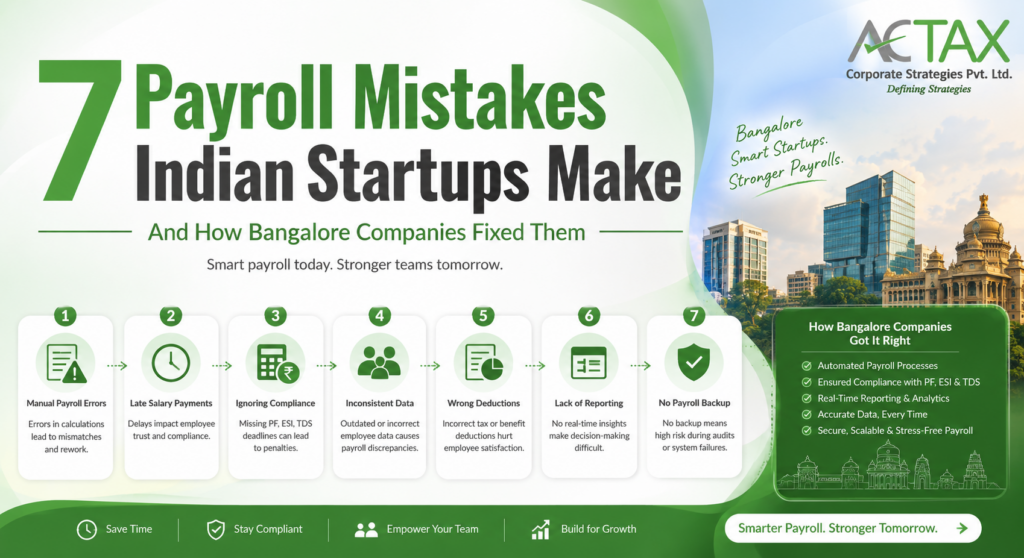
1. Missing the PF Deadline Every Month
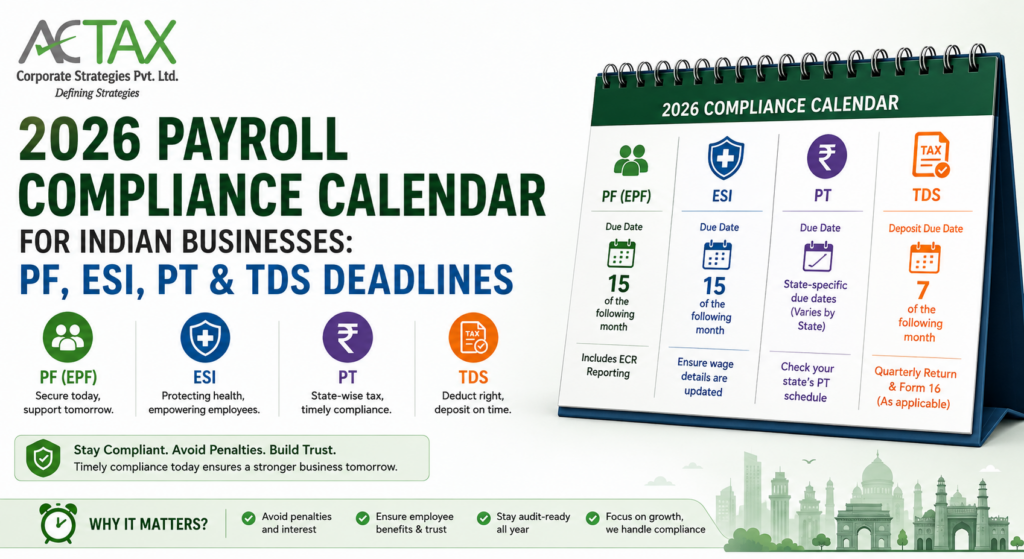
Employees’ Provident Fund contributions are due by the 15th of the month following the salary month. There is no grace period. A delay of even a few days activates penalties under two separate provisions:
-
- Section 7Q interest. A fixed rate of 12% per annum, calculated from the due date until the date of actual payment. This rate is not subject to reduction, even where the delay is due to a genuine cash flow issue.
- Section 14B damages. A separate penalty based on the length of the delay.
| Delay period | Section 14B damage rate |
| Up to 2 months | 5% |
| 2 to 4 months | 10% |
| 4 to 6 months | 15% |
| Beyond 6 months | 25% |
For example, on a delayed contribution of Rs. 1,00,000, an eight-month late PF payment adds approximately Rs. 8,000 in interest alone before damages are calculated.
How did a Bangalore company resolve it: The 22-member fintech startup had been considering PF as a variable expense and paid only when it was feasible. Once the EPFO notice arrived, it started maintaining a deadline of the 10th day of each month – five days before the statutory due date and has never failed to meet it since.
2. Getting the PF Wage Base Wrong
This is one of the most damaging mistakes because it can remain undetected for years. PF contribution is calculated on a specific wage base. This is typically basic pay plus dearness allowance, capped at Rs. 15,000 for mandatory coverage. Some startups structure salaries to keep the basic component artificially low. The assumption is that this reduces PF liability.
This assumption is often incorrect. EPFO has consistently held that allowances paid universally and regularly form part of wages for PF purposes, regardless of how they are labelled.
A pattern we’ve seen during payroll processing: An IT firm having 85 workers has been able to conduct its payroll processing smoothly for three years and then got an EPFO demand notice. For the previous 14 months, there was a deficit due to wrong wage calculation, and it took six months to settle the matter.
Recommended action: Have your salary structure reviewed against current PF wage rules before crossing 20 employees, not after.
3. Ignoring ESI Until It Becomes Necessary
ESI registration (Employees’ State Insurance) is mandatory beyond 10 employees (20 in certain states) in an organization, with coverage for every single employee whose salary is up to Rs. 21,000 per month in gross salary, which includes contractual workers and interns too. The problem is that new companies don’t pay attention to headcounts and think that ESI is applicable only for the manufacturing sector and not for IT and BPO.
Contributions of 3.25% of the employer and 0.75% of the employee must be paid within the first 15 days of the following month. In case of failure, it might result in fines, and at worst, imprisonment under Section 85 of the ESI Act.
How a Bangalore company resolved it: An e-commerce brand hired people beyond 12 people and did not register for ESI for four months. It registered, paid the backdated contributions with interest, and started checking headcount every quarter.
Quick Payroll Health Check
-
- Is your headcount still within the PF and ESI thresholds
- Has every salary structure been reviewed
- Are PAN and bank details on file for new joiners
- Is attendance data ready before payroll runs
- Are statutory due dates already on the company calendar
A “no” to any of these is worth fixing before the next salary cycle.
4. TDS Filing Errors That Lead to Compliance Penalties
TDS on salary is procedurally simple, but three errors recur:
-
- Incorrect or missing PAN details, which create a mismatch when returns are processed
- Under-deduction, often because tax was estimated without accounting for a mid-year salary revision or a new joiner’s prior employer income
- Late filing, which now attracts a late fee of Rs. 200 per day of default, capped at the total TDS amount deductible, along with a separate penalty of Rs. 10,000 to Rs. 1,00,000 for non-filing or incorrect filing
These payroll errors India businesses commonly make are rarely visible immediately. They surface months later, as a notice, once the return is processed.
Recommended action: Reconcile PAN and salary data every quarter rather than once a year during Form 16 preparation.
5. Misclassifying Employees to Avoid Compliance
Just because someone is called a consultant or an intern doesn’t automatically exclude them from PF and ESI. What really counts is how the relationship actually is in practice – fixed hours, supervision, and exclusivity matter more than labels.
This is one of the most serious payroll mistakes Bangalore startups can make. If EPFO or ESIC finds that classification was used to dodge statutory contributions, liability applies retroactively, and directors can face personal penalties, including imprisonment in serious cases. Genuine independent contractors invoicing under their own GST registration are unaffected; employees functionally treated as such under a different label are not.
6. Running Payroll on Spreadsheets Without Attendance Integration
Spreadsheet-based payroll is where most calculation errors originate. Without attendance and leave data flowing in automatically, salary figures drift through a missed leave deduction, an incorrect overtime entry, or a transcription error. These individually small errors accumulate into disputes and erode employee trust.
It is common for founders to spend six to eight hours every month manually reconciling attendance against salary. With proper integration, that task takes a fraction of the time.
7. No Audit Trail
This payroll mistake does not create an immediate problem. It creates a problem the day a number needs to be defended, to an employee, an auditor, or an investor. Without documented calculation logic or a record of corrections, resolving that dispute becomes significantly harder.
This matters more as a startup grows. Investors increasingly request PF and ESI challans, TDS returns, and salary registers going back two to three years as part of financial due diligence. Startups that treated payroll informally early on often spend weeks reconstructing records later, precisely when time is limited.

What Are Karnataka’s Minimum Wage and VDA Rules?
Karnataka has a Minimum Wage law of its own, which is distinct from the laws of PF, ESI, and TDS, and which keeps getting reviewed from time to time owing to increased cost. Under the Minimum Wages Act of 1948, Karnataka has classified the wages on the basis of zones and skills. Rates include Variable Dearness Allowance (VDA), revised periodically based on inflation. The legal minimum wage is basic pay plus VDA, not basic pay alone.
This is where startups get caught out: a salary that met the minimum wage last cycle can fall short in the next, simply because VDA moved and payroll wasn’t updated.
A pattern seen during a routine labour inspection: A Bengaluru employer with around 80 employees across different zones kept using an old VDA figure even after it had changed. A labour inspector caught the shortfall during a routine check. Because the error had run for a while, the company owed back pay across the whole team, adding up to several lakhs for just one month.
Employers who underpay can be fined per employee, per day, on top of having to pay the wage difference.
What to do: Check the VDA rate every time it is revised. Do not treat it as a one-time setup. Make sure your payroll system updates automatically, so no one has to remember to change it by hand.
Payroll Compliance at a Glance
| Requirement | Applies at | Wage ceiling | Due date |
| EPF | 20+ employees | Rs. 15,000 (mandatory coverage) | 15th of following month |
| ESI | 10+ employees (20 in some states) | Rs. 21,000 | 15th of following month |
| TDS on salary | All employers | No ceiling | Monthly deposit, quarterly return |
| Professional Tax | State-specific | Varies by state | Monthly, state-wise |
According to EPFO, millions of employers and employees depend on timely monthly filings for provident fund compliance. Even a short delay can affect employee records while also exposing employers to statutory interest and damages. For growing startups, consistency is far more valuable than trying to optimise payroll costs through shortcuts.
How Bangalore Startups Can Prevent Payroll Mistakes – Actax India Perspective
Each of these payroll mistakes Bangalore startups face traces back to the same root cause: payroll gets treated as an accounting task, not a compliance function with legal consequences. It rarely comes from carelessness. It comes from assuming that payroll, once set up correctly, keeps running correctly on its own. That assumption doesn’t hold. Wage codes get revised, thresholds get crossed mid-year, and VDA rates change annually. Payroll needs the same recurring attention as GST or income tax filings, not more, but not less either.
Startups that manage this well aren’t always the ones with the largest finance teams. They’re the ones with a defined process, an internal calendar, a documented checklist, or a payroll partner standing between them and the 15th of every month.
That’s the gap we work to close. Actax India runs monthly payroll, PF and ESI filings, TDS, and Karnataka’s VDA updates for startups across Bangalore, so these deadlines don’t depend on someone remembering them.
Conclusion
The seven payroll mistakes Bangalore startups make come from a single bad decision. They build up from small gaps, a missed date, a wrong wage figure, a classification nobody revisited. Left alone, each one gets more expensive the longer it runs.
Caught early, most are a quick fix.
If you’re unsure where your payroll stands today, that’s the right time to check, not after a notice arrives.
Contact Actax India today to schedule a consultation.