What Is a Payroll Compliance Calendar?
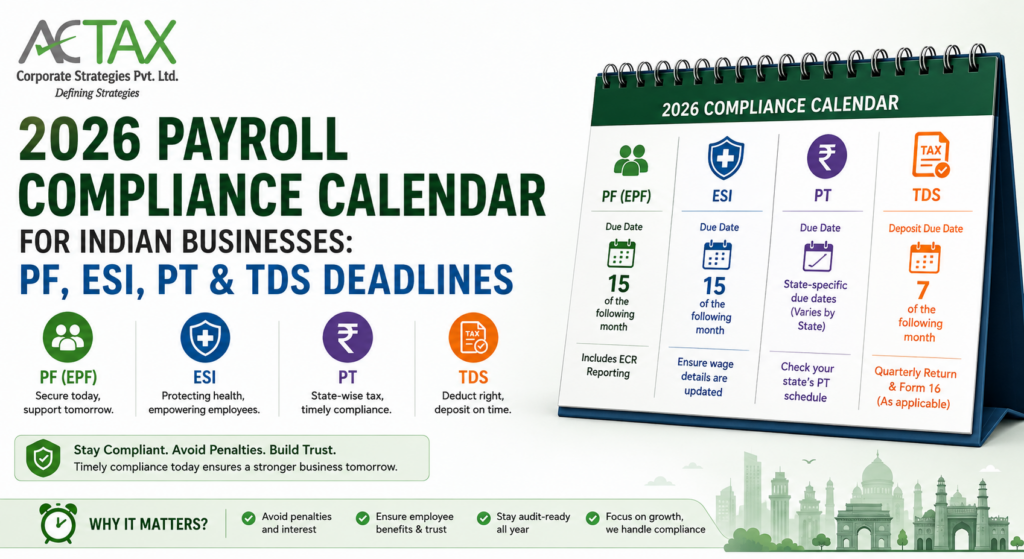
A payroll compliance calendar is essentially a month-by-month listing of all payroll-related due dates. Related to PF, ESI, PT, TDS, and other statutory filings.
Consider it a basic calendar that shows you all of your payroll due dates each month, all in one spot. You only follow one calendar and remain ahead of all the things instead of tracking PF, ESI, TDS and Professional Tax individually.
Why Every Employer Needs One?
A compliance calendar can help you do the following:
- Keep due dates together.
- Don’t leave payroll until the last minute.
- Reduce the risk of mistakes in filings.
- Keep HR & finance teams organised.
- Be ready for audits and don’t panic.
Benefits of Keeping an Organized Payroll Compliance Calendar in Bangalore
The following are some of the actual benefits:
- Effective monthly planning rather than reacting to situations.
- No deadlines or penalties overlooked.
- Precise statutory deductions.
- Easy teamwork.
- Cleaner records for audits and inspections.
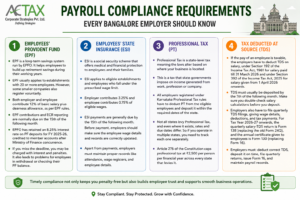
Payroll Compliance Requirements Every Bangalore Employer Should Know
While in India, payroll compliance regulations are universal, in other countries they are state-specific or based on employee eligibility.
That said, there are four main areas that every employer should always keep a watch on and these are EPF, ESI, Professional Tax and TDS.
Employees’ Provident Fund (EPF)
EPF is a long-term savings system run by EPFO. It helps employees to build up retirement savings during their working years.
Applicability
EPF usually applies to establishments with 20 or more employees. However, some smaller companies also register voluntarily.
Contribution
Both employer and employee contribute 12% of basic salary plus dearness allowance, as per EPF rules.
PF due dates 2026
EPF contributions and ECR reporting are normally due on the 15th of the following month. So for salary in April, payment is often required by 15 May.
Interest rate
EPFO has retained an 8.25% interest rate on PF deposits for FY 2025-26, credited to member accounts after Ministry of Finance concurrence.
Penalties
If you miss the deadline, you may be charged with interest and penalties. It also leads to problems for employees in withdrawal or checking their PF balance.
Employees’ State Insurance (ESI)
ESI is a social security scheme that offers medical and financial protection to employees and their families. Run by ESIC. These include benefits for medical care, maternity support, sickness benefit and compensation for work-related injuries.
Eligibility
ESI applies to eligible establishments and employees who fall under the prescribed wage limit.
Contribution
Employer contributes 3.25% and employee contributes 0.75% of eligible wages.
ESI due dates
ESI payments are generally due by the 15th of the following month. Before payment, employers should make sure the employee wage details and records are correctly updated.
Filing Requirements
Apart from payments, employers must maintain proper records like attendance, wage registers, and employee details.
Professional Tax (PT)
Professional Tax is a state-level tax meaning the laws alter based on where your business is located. For instance, companies in Bangalore follow Karnataka rules, whereas other states have their own systems. Article 276 of the Constitution caps professional tax at ₹2,500 per person per financial year across every state that levies it.
What Is Professional Tax?
This is a tax that state governments impose on income generated from work, profession or company. Employers deduct it from paychecks and send it to the state government.
Which Employers Must Deduct PT?
All employers registered under Karnataka Professional Tax rules have to deduct PT from the eligible employees and deposit it within the required dates of the state.
State-Wise Applicability
Not all states levy Professional Tax, and even where it exists, rates and due dates differ. So if you operate in multiple states, you need to track each one separately.
Tax Deducted at Source (TDS)
If the pay of an employee is taxable, the employers have to deduct TDS on salary, under Section 192 of the Income Tax Act, 1961 for salary paid till 31 March 2026 and under Section 392 of the Income Tax Act, 2025 for salary given from 1 April 2026 onwards.
Monthly Deposit
TDS must usually be deposited by the 7th of the following month. Make sure you double-check salary calculations before you deposit. You don’t want to have a mismatch later.
Filing of TDS return
Employers also have to file quarterly TDS filings, giving wage details, deductions, and tax payments. For Tax Year 2026-27 onwards, the quarterly salary-TDS return is Form 138 (replacing the old Form 24Q), and the annual certificate given to employees is Form 130 (replacing Form 16).
Employer Responsibilities
Employers must:
- Deduct correct TDS.
- Deposit it on time.
- File quarterly returns.
- Issue Form 16.
- Maintain payroll records.
2026 Payroll Compliance Calendar in Bangalore (Month-wise Due Dates)
Here’s a simple month-wise view of key deadlines for 2026.
Month | PF due dates 2026 | ESI due dates | Professional Tax | TDS on salary | Other Compliance |
January | By 15 February | By 15 February | As per Karnataka schedule | By 7 February | Payroll reconciliation |
February | By 15 March | By 15 March | As per Karnataka schedule | By 7 March | Employee record review |
March | By 15 April | By 15 April | As per Karnataka schedule | By 7 April | Year-end payroll closure |
April | By 15 May | By 15 May | As per Karnataka schedule | By 7 May | New financial year updates |
May | By 15 June | By 15 June | As per Karnataka schedule | By 7 June | Employee declarations check |
June | By 15 July | By 15 July | As per Karnataka schedule | By 7 July | Quarterly payroll review |
July | By 15 August | By 15 August | As per Karnataka schedule | By 7 August | TDS return filing (Q1) |
August | By 15 September | By 15 September | As per Karnataka schedule | By 7 September | Payroll audit |
September | By 15 October | By 15 October | As per Karnataka schedule | By 7 October | Compliance review |
October | By 15 November | By 15 November | As per Karnataka schedule | By 7 November | Payroll reconciliation |
November | By 15 December | By 15 December | As per Karnataka schedule | By 7 December | Year-end planning |
December | By 15 January | By 15 January | As per Karnataka schedule | By 7 January | Annual documentation |
If the 15th or 7th falls on a weekend or public holiday, deadlines are typically pushed to the next working day; always confirm on the EPFO Unified Portal or Income Tax e-Filing Portal before assuming an extension applies.
What Are The Karnataka Professional Tax Rates & Due Dates?
Professional Tax is a small state-level tax deducted from salaries in Karnataka. If you’re running payroll in Bangalore, this is something you cannot ignore.
Karnataka PT Rates (FY 2026-27)
The amount is based on monthly salary, revised under the Karnataka Tax on Professions, Trades, Callings and Employments (Amendment) Act, 2025, effective 1 April 2025.
Monthly Gross Salary | PT Amount | What it means |
Up to ₹24,999 | Nil | No deduction |
₹25,000 and above | ₹200 per month (₹300 in February) | Deducted every month |
PT Due Dates in Bangalore
Here is the exact breakdown of the deadlines you need to know:
If you’re an employer (PTRC holder):
- If you deduct Professional Tax from your employees’ salaries, you need to deposit it by the 20th of the following month. For example, if you deduct PT from June salaries, the payment should be made by 20 July.
- There is one exception to remember. The Professional Tax deduction for February is ₹300, while it’s ₹200 per month for the other applicable months.
- After the financial year ends, you also need to file Form 5. The annual return is due by 30 April.
If you are a self-employed professional or business (PTEC holder):
- If you are a Professional Tax Enrolment Certificate (PTEC) holder such as doctors, lawyers, consultants, freelancers or firms entitled to pay Professional Tax, then you need to pay the tax once in a year.
- The annual Professional Tax payment must be made on or before 30 April for the relevant financial year.
All PTRC and PTEC registration, returns and payments in Karnataka are handled by the state’s official e-Prerana portal.
What Are the Penalties for Missing Payroll Compliance Deadlines?
Missing payroll deadlines is expensive but they are avoidable.
Compliance | What can go wrong |
EPF | Interest + penalties |
ESI | Late fees + penalties |
Professional Tax | Interest + notices |
TDS | Interest, late fees, and in serious cases, prosecution. |
Expert Insight: Almost none of the penalty cases we’ve reviewed in 2026 came from a business genuinely refusing to pay PF, ESI, or TDS. They came from a gap between what the law now says and what the payroll software was still doing, an ECR filed correctly but a month late, a Form 16 issued when Form 130 was required, or an employee who crossed the ESI wage ceiling mid-year without anyone updating the record. The compliance math is the easy part. The part that actually catches employers out in 2026 is knowing that the form, the section number, or the portal underneath that math has changed. Our advice to every client this year has been the same: don’t just check whether you paid on time, check whether you paid on the right form, under the right section.
The ACTAX Payroll Compliance Health Check
Most compliance calendars tell you when something is due. They don’t tell you whether your payroll is actually in a defensible state if an inspector or auditor walks in tomorrow. Here’s a five-point health check we use with clients to answer that question in under ten minutes:
- Form currency test: Are you issuing Form 130 (not Form 16) and filing Form 138 (not Form 24Q) for any salary paid on or after 1 April 2026? If your payroll software still auto-generates the old forms for current-year transactions, that’s a live compliance gap, not a paperwork preference.
- Enrolment gap test: Do you have any employee who joined between April 2009 and March 2026 without a UAN or PF enrolment? If yes, the Employees’ Enrolment Campaign, 2026 window (open until 31 October 2026) is your lowest-friction way to fix it before it surfaces in an inspection.
- Wage ceiling drift test: Has anyone crossed the ₹21,000 ESI ceiling or the ₹25,000 Karnataka PT exemption threshold mid-year without a corresponding payroll update? Salary revisions are the single most common trigger for silent non-compliance.
- Deposit-to-deduction gap test: Is there ever a lag between the month you deduct PF/ESI/PT/TDS from an employee’s salary and the month you actually remit it? Even a short lag, repeated monthly, compounds into real interest exposure under Section 7Q and Section 14B.
- Documentation trail test: Can you produce, for any given month in the last 12, the wage register, the ECR/challan, the ESI contribution record, and the TDS challan together within an hour? If assembling that takes a day of digging through inboxes, your records are the actual risk.
Expert Insight: We run this exact five-point check with every new client before we touch their monthly filings, because it tells you in minutes where the real exposure sits, usually it’s not the current month’s payroll, it’s a stale form template or an unenrolled employee from two years ago that nobody flagged.
Common Payroll Compliance Mistakes Employers Should Avoid
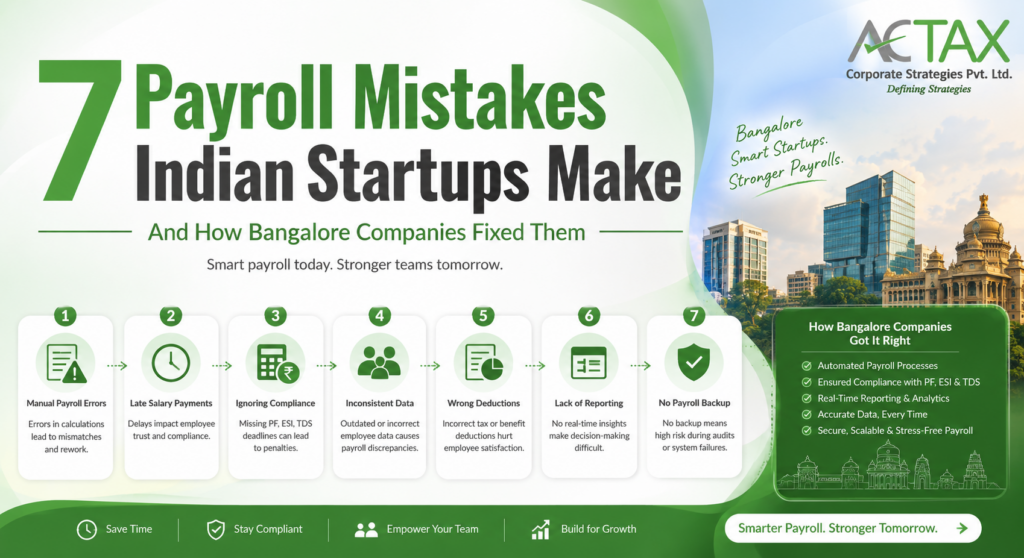
Here are some common ones:
- Missing monthly statutory deadlines.
- Wrong calculation of PF, ESI, or TDS.
- Relying on old wage or employee information.
- Ignoring state specific restrictions like Professional Tax.
- Delaying monthly reconciliation.
- Poor or incomplete record-keeping.
Stay Compliant with a Payroll Compliance Calendar in Bangalore | How ACTAX India Can Help
Payroll is one of those things that looks simple on the outside, but anyone who has handled it knows how quickly it can get complicated. With statutory filings and ongoing changes between the due dates, it can be easy to overlook something if you’re not careful. That’s why a right payroll compliance calendar in Bangalore makes a difference.
If you need help with this, ACTAX India makes payroll compliance easy and stress-free for enterprises. They keep you compliant. Whether it’s tracking your filings or ensuring that everything is completed on time, without the looming threat of missing a deadline.