Before Payroll: Decide Who Is an Employee and Who Is a Contractor
Before you issue an invoice or payslip, ask yourself.
Is the individual an employee or an independent contractor? This difference will help you analyze how you pay them, what the tax deduction will be, and apply employment-related compliance.
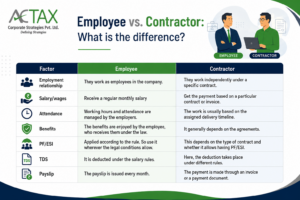
Employee vs. Contractor: What is the difference?
| Factor | Employee | Contractor |
| Employment relationship | They work as employees in the company. | They work independently under a specific contract. |
| Salary/wages | Receive a regular monthly salary | Get the payment based on a particular contract or invoice. |
| Attendance | Working hours and attendance are managed by the employers. | The work is usually based on the assigned delivery timeline. |
| Benefits | The benefits are enjoyed by the employee, who receives them under the law. | It generally depends on the agreements. |
| PF/ESI | Applied according to the rule. So use it wherever the legal conditions allow. | This depends on the type of contract and whether it allows having PF/ESI. |
| TDS | It is deducted under the salary rules. | Here, the deduction takes place under different rules. |
| Payslip | The payslip is issued every month. | The payment is made through an invoice or a payment document. |
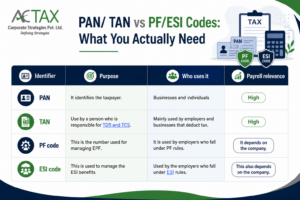
PAN/ TAN vs PF/ESI Codes: What You Actually Need
| Identifier | Purpose | Who uses it | Payroll relevance |
| PAN | It identifies the taxpayer. | Businesses and individuals | High |
| TAN | Use by a person who is responsible for TDS and TCS | Mainly used by employers and businesses that deduct tax. | High |
| PF code | This is the number used for managing EPF. | It is used by employers who fall under PF rules. | It depends on the company. |
| ESI code | This is used to manage the ESI benefits | Used by the employers who fall under ESI rules. | This also depends on the company. |
Check Whether PF, ESI, PT and TDS Apply to You
Is your company eligible to apply for PF?
The regulations of EPFO do not merely imply that the law applies to every organization that employs 20 or more individuals. Whether the company is applicable depends on the classification of the organization and the number of employees within that organization.
Is your company eligible to apply for ESI?
ESI is applicable to all the non-seasonal factories that have ten or more employees. As per the ESI officials, the monthly wage limit for employees is Rs. 21000 per month. In the case of disabled employees, this limit is Rs. 25000.
Actax India Expert Opinion
As we have worked with many startups and small businesses. After seeing the hustle, we now advise every growing company to file for its PF and ESI requirements on time. Many companies make the mistake of postponing the registration, and then they suffer penalties. At Actax India, we make sure that your company’s PF and ESI registration process is easy and hassle-free.
Professional Tax (Karnataka)
Employers falling under the category of Karnataka’s Professional Tax law must register for professional tax, deduct the tax from the salaries of employees, and send money to the government. This process is carried out using the Karnataka Professional Tax portal.
Key Takeaway
The professional tax rules and tax slabs in different states may differ, and one should not apply the Karnataka rules in other states without confirming.
TDS on salary
TDS on an employee’s salary does not depend only on the percentage of basic pay. The payroll department has to determine the approximate tax amount payable by the employee for the financial year. Based on this amount, the deductible amount of TDS from the employee’s salary may also be determined.
This process will help prevent over- or under-deduction of TDS and mistakes in the Form 16 issued at the end of the year.
Choose a Pay Cycle and Run Your First Payroll
Verify the employee records
Before you start the pay cycle, make sure that all the details about the employees are correct. Check for PAN, bank account, joining date, salary, Provident Fund (PF)/Universal Account Number (UAN), ESI, and tax information.
Add attendance and leave data
Make sure you have all the attendance and approved leave of employees for the month.
Calculate the salaries
Calculate the individual salary of every employee. In case the employee has joined or is quitting during the month, calculate the salary only for the days that were actually worked.
Identify deductions
Calculate the deductions such as PF, ESI, taxes, etc., wherever it is necessary.
Calculate the net salary
Deduct the total amount from the total payment to get the net salary. This is the total amount that will be received by the employee.
Run the payroll approval and payment workflow
The employee records are checked by HR. The calculations are being verified by the finance team. The management gives approval for the salary payments. And then the payments are released.
Create payroll records
Prepare the payslips and payroll register.
For most small firms in India, payroll every month is a tedious task, as it takes a lot of time and effort.
Actax India Expert Opinion
When we were working with early-stage businesses, we often came across three payroll problems. The first was that the employee data is often stored in many worksheets instead of a single sheet. Second, when the payroll registration is done at the time of setting up the company, no effort is made to check if all activities are up to date and maintained. Third, payroll is approved without verifying the information against existing records. But when the payroll process starts, there is no single place where all the information is compiled together. So we at Actax India suggest that they invest in a single platform for payroll management.
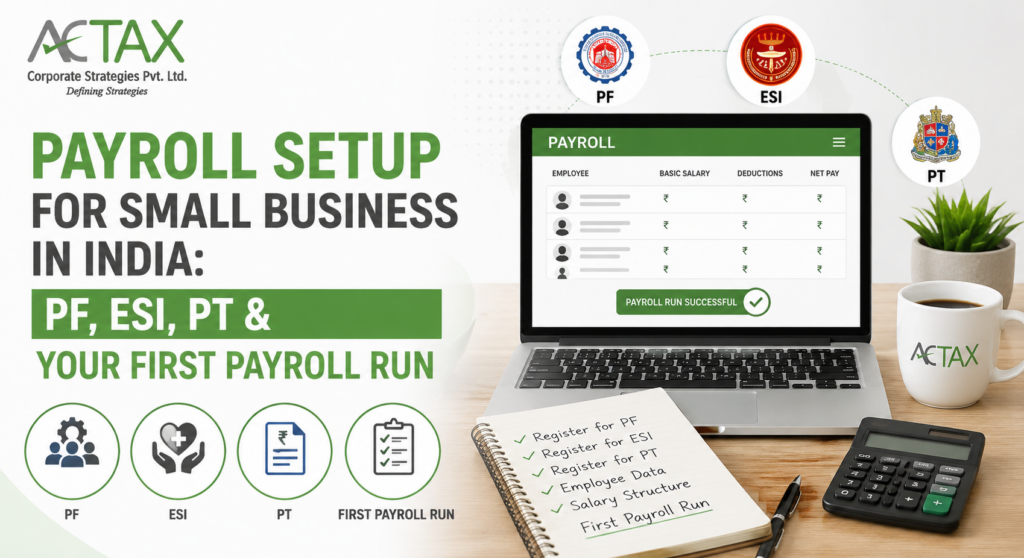
First Payroll Run Checklist for a Small Business
Running payroll for the first time is not only about calculating salaries, but it also requires completing the process of employer registration as well as collecting documents from employees. Use this first payroll run checklist to make sure that everything is in place before running payroll for the first time.
Employer setup
- Is PAN accessible?
- Is TAN acquired as necessary?
- Is PF applicable and established?
- Is ESI applicable?
- Is PT applicability in Karnataka valid?
- Have all essential registrations been done?
- Have payroll account/payment methods been confirmed?
Employee setup
- Has employee agreement/appointment documentation been arranged?
- Is a PAN obtained?
- Is the bank information verified?
- Is the joining date settled?
- Is the salary structure authorized?
- Are PF/UAN details verified?
- Is ESI information collected/noted?
Payment processing
- Attendance entered
- Leave taken accounted for
- New hires assessed
- Departures accounted for
- Total compensation determined
- Mandatory deductions taken out
- Withholding tax calculated
- Take-home pay computed
Final approval
- Payroll log checked
- Bank transfer confirmed
- Pay stubs produced
- Management approval obtained
- Payment made through bank transfer
- Compliance calendar updated
- Payroll documents secured
Expert Opinion
Payroll does not become ready just after the first salary is paid to the employees. It actually becomes ready when the company starts running its payroll properly every month, verifies the details, maintains records, and complies with the law as its employees begin to grow in number.
How Actax India Helps Small Businesses in India
Are you unsure of which registrations you need to complete? Want to get payroll set up for a small business in India, which will help you with evaluation before your first payroll run?
Once you get your payroll right for your first several employees, set up a simple process that you can use to scale your payroll process.
Actax India helps businesses in Bangalore to manage payroll by providing services from employee onboarding and PF/ESI registration process to professional Tax, TDS, payroll processing, and continuous compliance.
Talk to Actax India about your PF, ESI, PT, and payroll compliance requirements.