What Is Multi-State Payroll Compliance in India?
Payroll compliance in India runs on two tracks at once: central and state.
Central compliances apply the same way everywhere in the country: EPF, ESI, TDS, gratuity, and bonus where applicable.
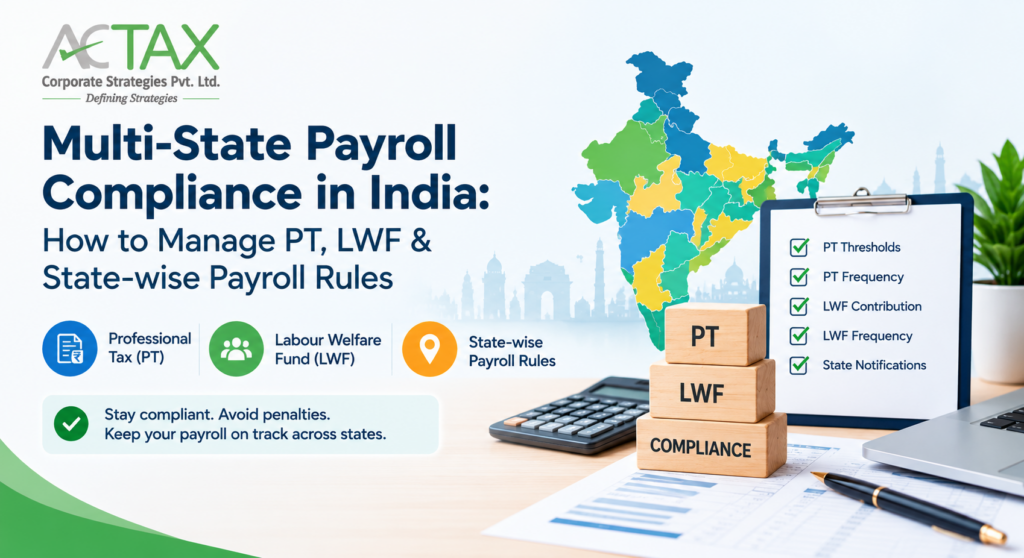
State-level compliances are where the real variance sits: Professional Tax, Labour Welfare Fund, minimum wages, Shops & Establishments registration, state-specific leave rules, and the registers and returns each state expects. This guide focuses specifically on PT and LWF, since these are the two deductions that trip up multi-state payroll teams most often, while also flagging the wider state obligations (minimum wages, Shops & Establishments) worth reviewing alongside them.
Professional Tax and Labour Welfare Fund sit under the State List of the Constitution (Entry 60, List II, Seventh Schedule), which is exactly why there’s no single national rate for either. PT specifically is capped by Article 276 of the Constitution at Rs 2,500 per person per year.
Every PT-levying state has to design its slabs within that ceiling, but nothing stops them from redesigning the slabs, thresholds, and exemptions inside it, which they do fairly often.
Centralised Payroll Does Not Mean Centralised Compliance
Worth separating clearly, because businesses often combine the two.
A company can have one payroll team, one payroll software, one salary date, and one HR platform, all centralised. That’s operational centralisation. It says nothing about whether the compliance rules applied to each employee are actually correct.
Say a business runs payroll for Bengaluru, Ahmedabad, and Kolkata employees out of its Mumbai head office. The process is centralised. For a company with employees across multiple states, centralised payroll should mean one payroll engine applying state-specific compliance rules correctly, not one national rule set copied everywhere. A Bengaluru employee’s applicable PT rules shouldn’t be assumed to be Mumbai’s simply because payroll runs from Mumbai.
Which State’s Rule Actually Applies to an Employee?
This is the question that trips up more businesses than the rates themselves, so it’s worth settling before getting into PT and LWF specifics.
Registered office, branch location, employee’s actual work location, residential address, and payroll processing location can all point to different states, and they’re not interchangeable. As a general working principle, statutory liability follows the employee’s actual place of work or the establishment they’re attached to, not the employer’s head office and not necessarily their home address.
- Employee lives in one state, works from another: The work location generally drives PT and LWF, not the home address. Don’t assume residence settles it.
- Remote employees: If someone works from home in a state where the company has no registered branch, that’s still a work location that can trigger PT and LWF liability there. It’s worth treating a remote hire’s state the same way you’d treat opening a small branch.
- Branch transfers: The employee’s rule set changes from the transfer date, not retroactively and not automatically at year-end. More on this below.
- Business travel: A short trip isn’t the same as a change in work location. The distinction matters and genuinely gets confused often, so when in doubt, treat a stay beyond a normal short visit as worth reassessing.
Case Study: What Actually Changes When an Employee Transfers States
Take a concrete example. An employee moves from your Mumbai branch to your Bengaluru branch, effective 15 July.
Before the transfer: Maharashtra PT rules apply. Maharashtra LWF cycle applies (half-yearly, June/December windows, Maharashtra Labour Welfare Board).
From 15 July: Karnataka PT rules apply, different slab, different due date. Karnataka LWF rules apply, different cycle, different registration.
What actually needs to change in the system on that date: the employee’s work-state field, their branch code, the PT rule applied to their next payslip, their LWF applicability going forward, and a note in the audit trail explaining why the change happened and when.
If the transfer happens mid-month, the safest approach is to apply the new state’s rule from the payroll cycle in which the transfer takes effect, and keep the transfer letter or HR order as evidence for that date. This is a small operational moment that, if missed, quietly compounds into months of wrong deductions before anyone notices.
Professional Tax: Why It Creates Variance
Professional Tax is a state-level tax on income from employment, trade, or profession, capped at Rs 2,500 a year under Article 276. States that levy PT design their own slabs, thresholds, and exemptions within that ceiling.
Take Karnataka, since it’s been amended twice recently. Under the Karnataka Tax on Professions, Trades, Callings and Employments (Amendment) Act, 2025, the exemption threshold moved from Rs 15,000 to Rs 25,000 a month.
- The exact rule: Rs 25,000/month exemption threshold
- Rs 200/month for eleven months, Rs 300 in February (Rs 2,500/year total)
- Effective: 1 April 2025
- Source: Notification No. DPAL 08 SHASANA 2025, dated 15.04.2025, published by the Karnataka Commercial Taxes Department – ptax.karnataka.gov.in
- Last verified: September 2026
The department’s notifications page also lists a further Amendment Act, 2026 (No. 22 of 2026, dated 27 March 2026). If your payroll is still running on last year’s understanding of the slab, pull the current notification from that page directly rather than relying on any single article, including this one.
This is exactly why PT state-wise tracking can’t be a one-time setup. It needs a review date attached to it.
PTEC vs PTRC
Employers frequently mix these two up.
- PTEC (Enrolment Certificate): the tax the business itself pays as an entity, usually a flat annual amount.
- PTRC (Registration Certificate): what lets an employer deduct PT from employee salaries and deposit it with the state. If you have even one employee in a PT state, you need a PTRC there, separate from your PTEC.
A business with staff across four PT states needs PTRC and PTEC in each, a stack of eight registrations, not one.
A Quick Decision Checklist for PT
| Question | What to determine |
| Does the employee’s work state levy PT? | Check the current state schedule |
| Is the employee’s income above the exemption threshold? | Threshold varies and gets revised (Karnataka’s changed twice recently) |
| Which state applies — work location or registered office? | Almost always work location |
| Who deducts and remits? | Employer, via PTRC |
| What’s the filing cycle? | Monthly, half-yearly, or annual depending on state |
| What evidence gets retained? | Challan, acknowledgement, return copy |
Common PT Mistakes
- Applying the head office’s PT rules to every branch.
- Running on an outdated slab.
- Getting an employee’s work state wrong in the system.
- Skipping registration in a new state.
- Forgetting a February-style annual adjustment where one applies.
- Assuming that a state with no PT means nothing else to check there, which brings us to LWF.
Labour Welfare Fund: The Other Source of Variance
LWF funds state-run welfare initiatives for workers, healthcare support, education assistance, and recreational facilities. It runs through individual state Welfare Fund Acts, not one national law, so applicability, contribution amounts, frequency, and due dates differ by state.
Expert Insight (Vivek Bhat, Actax India): In our experience, most multi-state payroll gaps we uncover aren’t wrong rates; they’re missing registrations nobody flagged when the company crossed a new state’s employee threshold. A business set up for its first office rarely revisits PT or LWF applicability as it grows, until a second branch quietly falls out of scope. That review should happen at every headcount milestone, not just at incorporation.
Two verified examples worth anchoring on:
Maharashtra is the cleanest example to anchor on:
- The exact rule: Rs 25 (employee) + Rs 75 (employer) per half-year
- Deductions on 30 June & 31 December
- Returns due 15 July & 15 January
- Effective: under the Maharashtra Labour Welfare Fund (Amendment) Act, 2024
- Source: Maharashtra Labour Welfare Board, public.mlwb.in, and the Department of Labour, mahakamgar.maharashtra.gov.in
- Last verified: September 2026
The earlier wage-based slabs (Rs 6/Rs 12 depending on salary) were removed; one flat rate now applies regardless of wage.
Karnataka revised its LWF structure too, with an annual contribution and a lower applicability threshold, down from 50 employees to 10, which pulled a lot of smaller establishments into scope for the first time. Details and forms are published on the Karnataka Labour Welfare Board’s site.
A word of caution on every other state: treat any rupee figure you read online as a starting point to verify against that state’s own Labour Welfare Board notification, not a number to configure payroll against directly. LWF rates get revised without the press coverage a GST or income-tax change gets, so the safest habit is checking the state board’s page each cycle rather than trusting a cached number, including the figures in the matrix below.
Monthly vs Half-Yearly vs Annual
| Frequency | What payroll must manage |
| Monthly | Deduction and remittance every month. |
| Half-yearly | A correct six-month period and its own deadline (Maharashtra runs this way). |
| Annual | Employee eligibility checked once a year, one payment. |
A payroll system built only around the monthly salary cycle will naturally forget about half-yearly or annual LWF windows. That’s precisely why it gets missed more than PT does: the smaller the deduction, the easier it is to deprioritise, until it’s missed across enough employees and enough cycles that the shortfall is no longer small.
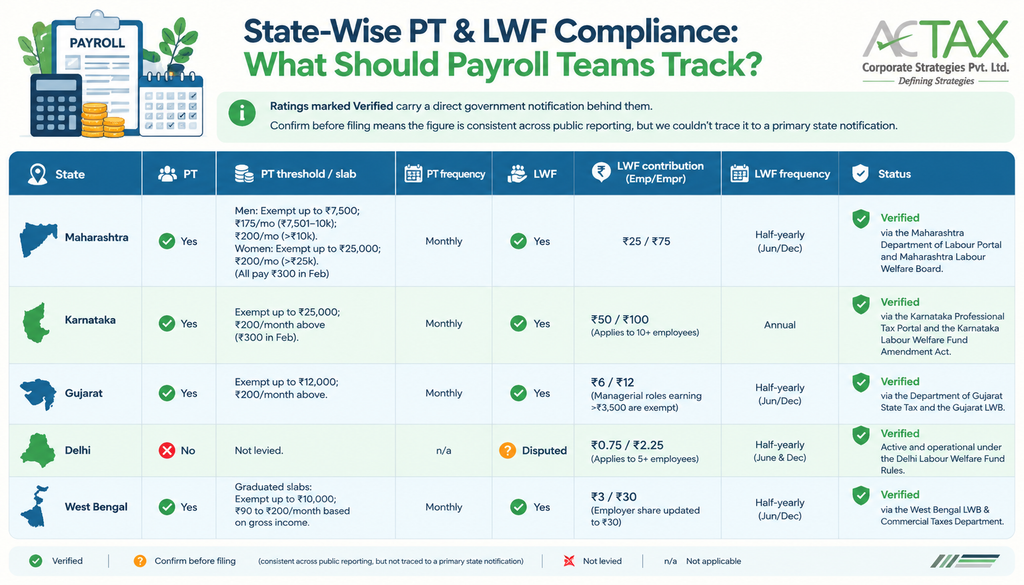
State-Wise PT & LWF Compliance: What Should Payroll Teams Track?
Ratings marked Verified carry a direct government notification behind them. Confirm before filing means the figure is consistent across public reporting, but we couldn’t trace it to a primary state notification.
| State | PT | PT threshold / slab | PT frequency | LWF | LWF contribution (Emp/Empr) | LWF frequency | Status |
| Maharashtra | Yes | Men: Exempt up to Rs 7,500; Rs 175/mo (Rs 7,501–10k); Rs 200/mo (>Rs 10k).Women: Exempt up to Rs 25,000; Rs 200/mo (>Rs 25k).(All pay Rs 300 in Feb) | Monthly | Yes | Rs 25 / Rs 75 | Half-yearly (Jun/Dec) | Verified via the Maharashtra Department of Labour Portal and Maharashtra Labour Welfare Board |
| Karnataka | Yes | Exempt up to Rs 25,000;Rs 200/month above (Rs 300 in Feb) | Monthly | Yes | Rs 50 / Rs 100(Applies to 10+ employees) | Annual | Verified via the Karnataka Professional Tax Portal and the Karnataka Labour Welfare Fund Amendment Act |
| Gujarat | Yes | Exempt up to Rs 12,000;Rs 200/month above. | Monthly | Yes | Rs 6 / Rs 12(Managerial roles earning >Rs 3,500 are exempt) | Half-yearly (Jun/Dec) | Verified via the Department of Gujarat State Tax and the Gujarat LWB |
| Delhi | No | Not levied. | n/a | Disputed | Rs 0.75 / Rs 2.25(Applies to 5+ employees) | Half-yearly(June & Dec) | Verified; active and operational under the Delhi Labour Welfare Fund Rules |
| West Bengal | Yes | Graduated slabs:Exempt up to Rs 10,000; Rs 90 to Rs 200/month based on gross income. | Monthly | Yes | Rs 3 / Rs 30(Employer share updated to Rs 30) | Half-yearly (Jun/Dec) | Verified via the West Bengal LWB & Commercial Taxes Department |
This is your state-wise payroll compliance checklist.
Expert Insight (Vivek Bhat, Actax India): One thing surprises founders every time: a labour department inspection rarely starts with the head office. It usually starts with one employee complaint at one branch, and once inspectors are in, they tend to ask for records across every state you operate in. Treat every branch’s compliance as visible to every other branch, because in practice, it is.
What Happens to PT & LWF When a Business Restructures?
This is a scenario most people skip entirely, and it’s one advisory firms see regularly: a company closes a branch, merges two entities, or converts from a partnership to a private limited company.
Each of these events resets your PT and LWF obligations in that state, and it’s easy to assume compliance simply carries over.
- Closing a branch: you still owe a final PT return and LWF settlement up to the closure date, and you need to formally surrender the PTRC/PTEC in that state. Leaving it dormant on the books, rather than surrendering it, is how businesses end up with notices years later for a location they stopped operating in.
- Merging two entities or changing legal structure (say, an LLP converting to a Pvt Ltd): PT and LWF registrations are typically tied to the PAN and legal entity, not the business activity. A new entity generally needs fresh PTRC/PTEC and LWF registration in every state it operates in. The old entity’s registrations don’t automatically transfer.
- Acquiring a company with its own branch network: you’re inheriting whatever PT/LWF compliance gaps existed before the deal, not starting clean. A basic compliance check across PT and LWF registrations, in every state the target operates, is worth doing before the deal closes, not after.
If your business is going through any of this, it’s worth treating it as a registration event in its own right, with its own checklist, rather than folding it into the regular monthly payroll cycle.
The Actax 6-Step Framework for Multi-State Payroll Compliance
Actax India’s compliance desk works through the same six steps on every multi-state engagement, regardless of the client’s size:
- Build an employee-location master: Work location, branch, state, and PT/LWF applicability against each employee.
- Build the state compliance matrix: PT, LWF, minimum wages and registrations, with a source and an owner for every row.
- Configure payroll rules along the chain: employee ? location ? rule ? calculation ? deduction ? filing.
- Run the calendar by cadence, not by month: Monthly: employee movement, PT validation, reconciliation. Quarterly: registration and location audits. Half-yearly: LWF cycles like Maharashtra’s June/December window. Annually: full slab and registration revalidation.
- Reconcile every cycle: deduction against liability, liability against challan, challan against return.
- Keep the audit trail current: Employee master, PT records, LWF records, and governance notes; the same four checks (correct state and category; PT applicability through to filing; LWF applicability through to records; and a current, reviewed matrix) should hold true at any point someone asks to see them, not just at year-end.
Miss a step anywhere in that chain, for even one employee, and it shows up eventually. Usually at the worst possible time, during an inspection or an audit.
Common Mistakes in Multi-State Payroll Compliance in India
- Applying head-office rules to every branch.
- Maintaining PT diligently while forgetting LWF exists.
- Running one compliance calendar for every state.
- Treating an employee’s home address as the only thing that matters.
- Not updating payroll after a state notification.
- Relying on a spreadsheet with no named owner.
- Assuming a small deduction means small risk.
- Not keeping proof of remittance.
- Not reconfiguring payroll the day an employee transfers between states, rather than the month after.
- Leaving old registrations dormant after closing a branch instead of formally surrendering them.
Multi-State Payroll Compliance India: Getting It Right, One State at a Time
Multi-state payroll compliance in India isn’t a one-time setup; it’s a habit. States revise PT and LWF rules on their own schedule, not yours, and businesses that stay ahead treat this as ongoing governance, not a checklist ticked once a year. A spreadsheet works fine until the third branch opens; after that, someone needs to own the mapping.
Actax India‘s compliance desk works through exactly this kind of state-by-state payroll mapping for growing businesses. Get the mapping right once, and payroll stops throwing monthly surprises.
Request a Multi-State Payroll Compliance Review Today