Labour Codes 2026: What’s Actually in Force
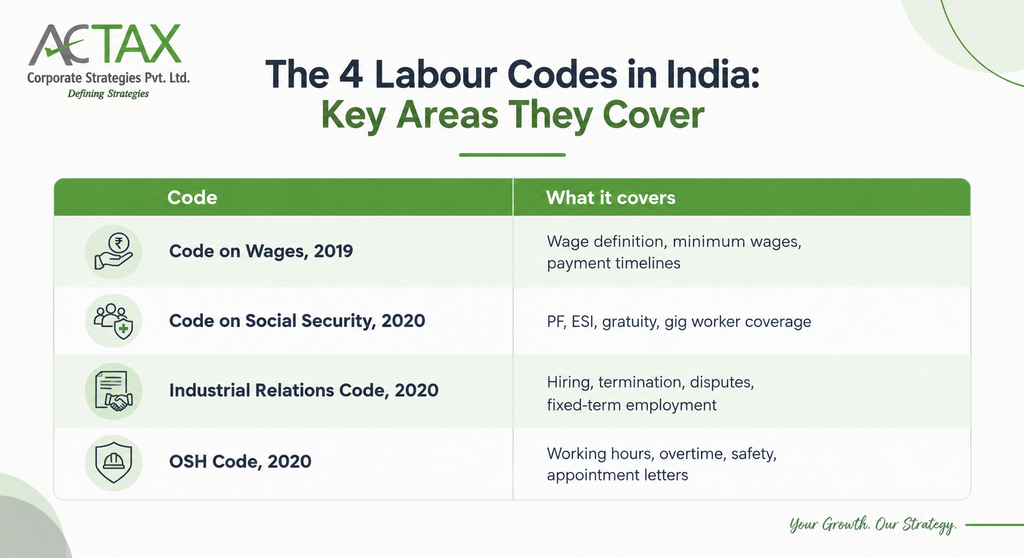
Labour Codes India 2026 is not one law. It’s four codes that replaced 29 older labour laws:
| Code | What it covers |
| Code on Wages, 2019 | Wage definition, minimum wages, payment timelines |
| Code on Social Security, 2020 | PF, ESI, gratuity, gig worker coverage |
| Industrial Relations Code, 2020 | Hiring, termination, disputes, fixed-term employment |
| OSH Code, 2020 | Working hours, overtime, safety, appointment letters. |
All four codes came into force on 21 November 2025, per the Ministry of Labour & Employment’s official notification. That’s the Code on Wages implementation date you’ll see referenced everywhere. But “in force nationally” doesn’t mean “identical everywhere.” Labour is a concurrent subject, so states notify their own procedural rules on their own timelines. The Ministry’s official FAQs on the Labour Codes are the most reliable running reference; bookmark them.
The practical question for your payroll team isn’t “are the Codes in force?” It’s: which provisions apply to this establishment, in this state, for this category of employee?
The Wage Definition Change That Actually Moves Your Numbers
Forget the four codes for a second. This one definition is what changes your payroll math.
Under the old system, employers could split salary into dozens of allowances and keep “basic pay” artificially low. Lower basic meant lower PF, lower gratuity, lower statutory cost. That loophole is now closed, but not in the way most articles describe it.
Does Basic Pay Really Need to Be 50% of CTC?
Not quite. Here’s the actual mechanism, straight from the Ministry’s Additional FAQs on the Labour Codes (March 2026): “wages” includes basic pay, dearness allowance, and retaining allowance. If allowances and other excluded components together exceed 50% of an employee’s total remuneration, the excess amount is added back into wages for statutory calculation purposes. It’s an add-back rule, not a flat instruction that basic salary must literally equal half the CTC.
This is the new wage code 50% CTC rule in plain terms, and getting this wage definition change right matters. Describe it as “basic must be 50%” to your HR team, and they’ll build the wrong salary structure.
Simplified Add-Back Illustration
This example illustrates the statutory wage calculation; it does not mean that employers are required to restructure Basic Pay to exactly 50% of CTC.
| Component | Amount |
| Total remuneration | Rs. 8,00,000 |
| Basic + DA (as currently structured) | Rs. 2,80,000 (35%) |
| Allowances above the 50% threshold | Rs. 1,20,000 excess |
| Revised wage base after add-back | Rs. 4,00,000 (50%) |
The excess amount does not disappear from CTC. Instead, it is added back into wages for the relevant statutory calculations.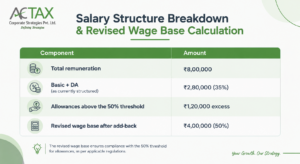
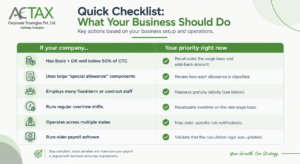
Check These First: A Quick Employer Filter
| If your company | Your priority right now |
| Has Basic + DA well below 50% of CTC | Recalculate the wage base and add-back amount. |
| Uses large “special allowance” components | Review how each allowance is classified |
| Employs many fixed-term or contract staff | Reassess gratuity liability (see below) |
| Runs regular overtime shifts | Recalculate overtime on the new wage base. |
| Operates across multiple states | Map state-specific rule notifications |
| Runs older payroll software | Validate that the calculation logic was updated |
How Should Employers Restructure CTC Under the New Labour Codes?
Which Salary Components Should You Review?
Basic pay, DA, HRA, special allowance, other allowances, employer PF, gratuity, and bonus: remap each against the new wage definition, not just basic pay.
How Does the 50% Wage Rule Affect CTC?
Same add-back rule as before: if allowances exceed 50% of remuneration, the excess is added back into “wages.” That raises the base on which PF, gratuity, and bonus are calculated; total CTC doesn’t have to change.
CTC Before vs After: A ?12 Lakh Illustrative Example
| Component | Existing | Revised |
| Basic + DA | ?3,60,000 | ?6,00,000 |
| Allowances | ?7,20,000 | ?4,80,000 |
| Employer PF (12%) | ?43,200 | ?72,000 |
| Gratuity provision (approx.) | ?17,314 | ?28,860 |
| Total CTC | ?12,00,000 | ?12,00,000 |
| Wage base | ?3,60,000 | ?6,00,000 |
| Take-home (monthly, approx.) | ?87,800 | ?86,100 |
Will CTC Increase or Will Take-Home Salary Decrease?
CTC doesn’t have to rise; restructuring shifts money from allowances into wages. But the wider wage base raises statutory PF and gratuity contributions, trimming take-home slightly while building larger long-term benefits.
Labour Codes 2026 India Payroll Changes to PF, Gratuity And Overtime
PF contribution: Since PF is calculated on wages, and the wage base just grew for employees whose basic pay was previously under-weighted, employer PF contribution rises correspondingly for those employees, even without any change to gross CTC. This is directional, not universal: statutory PF ceilings and specific exemptions still apply; check current rates and thresholds on the official EPFO website, so don’t assume every employee’s contribution rises by the same proportion. Run the calculation per employee, not as a blanket estimate.
Gratuity (the one-year rule): This is where terminology matters. Permanent employees still need 5 years of continuous service to become eligible for gratuity. What’s changed is specific to fixed-term employees: under the Code on Social Security, an employee engaged on a fixed-term contract becomes eligible for gratuity after completing the service period specified in that contract, paid on a pro-rata basis, per the Ministry’s clarification on fixed-term gratuity eligibility, commonly summarised as the gratuity eligibility 1-year new labour code rule. Don’t conflate this with “contract employees” generally; workers engaged through a contractor are a separate legal category with different obligations. If you run a fixed-term-heavy workforce (common in IT, BPO, and manufacturing), this changes your liability provisioning now.
Overtime (double pay, no exceptions): The overtime double-wage rule in India applies uniformly under the OSH Code: 2x the ordinary rate of wages for hours worked beyond the prescribed daily or weekly limit. Overtime is calculated on the ordinary wage rate (basic + DA), and since that base just expanded under the 50% rule, your overtime payouts expand with it. Recompute this now if your operation runs routine shifts.
What This Means Beyond Payroll: The Industrial Relations Code
The Industrial Relations Code’s impact on employers isn’t limited to legal teams. It affects HR directly:
- Standing-order requirements now apply at 300+ workers, up from 100 under the old Industrial Disputes Act.
- Fixed-term employees are formally entitled to the same benefits as permanent staff doing comparable work.
- Termination and retrenchment notice requirements have been revised.
- Dispute-resolution timelines have changed.
If your appointment letters still cite the old 100-worker threshold, update them alongside payroll, not after. States continue to notify their own procedural rules under these codes, so it’s worth tracking the Ministry’s state-wise implementation status for every location where you have registered establishments.
“What we typically see in payroll audits: the issue is rarely that a company deliberately set basic pay low to cut costs. More often, allowances were never mapped against the new statutory wage definition in the first place, so PF, gratuity, and overtime end up being calculated on three different wage bases inside the same payroll run. That mismatch is what triggers compliance flags, not the underlying salary philosophy.”
Will Labour Codes Increase Your Payroll Cost? Not Necessarily
It depends entirely on your existing salary architecture. Those employers who already have a statutory wage base close to the appropriate 50% threshold as part of their existing salary structures may be less affected. Employers whose excluded allowances exceed the allowable proportion may have a higher statutory wage base due to the add-back mechanism. There’s no single percentage that applies to every company; treat any claim that it does with suspicion.
The Retrospective Gap Most Employers Are Missing
Here’s a question almost no Labour Code article asks: what about payroll runs you’ve already processed since 21 November 2025?
Every guide you see on the internet talks about restructuring CTC “going forward.” Almost none address the employers who kept running payroll on their old wage structure through the transition, either because they didn’t know the rules had changed, or because their software wasn’t updated in time. If that’s you, there’s a retrospective exposure sitting quietly in your payroll history right now:
- PF shortfall: If wages were under-calculated for any month since November 2025, the employer contribution for those months is technically short, and shortfalls can attract interest and penalties under EPFO rules, not just a correction going forward.
- Gratuity provisioning gaps: Fixed-term employees who crossed their one-year mark during this window may already be eligible for a payout your books haven’t provisioned for.
- Full & Final settlements processed in error. Anyone who exited the company after November 2025 but was settled on the old wage base may have a valid claim to a corrected F&F.
What to do about it: run a lookback audit for every payroll cycle since 21 November 2025, not just your current structure. Flag any month where the wage base was under-calculated, quantify the PF/gratuity shortfall, and correct it before an EPFO inspection or an employee’s exit does it for you. Fixing this, on your own timeline, costs far less than fixing it under scrutiny.
ACTAX Labour Code Payroll Readiness Score
This is an ACTAX internal assessment framework intended to identify areas requiring review; it is not a statutory compliance rating. Score each item as 0 (not reviewed), 1 (in progress), 2 (validated):
- Wage definition mapping: Are all allowances classified using the new definition?
- PF/ESI Recalculation: Has the new wage base been applied for all employees?
- Fixed term exposure modeled on pro-rata basis for gratuity liability?
- Overtime reasoning: Has your payroll software been validated on the new wage base?
- State/jurisdiction check: Have all necessary state notifications been checked at each location?
0-4: high risk, you need an audit now. 5-7: review in progress. 8-10: structurally ready, validate with your compliance team before signing off.
Preparing for Labour Codes 2026 India Payroll and Compliance Changes
The new labour law payroll changes in India are active compliance obligations. Map your wage components correctly, recalculate PF and gratuity on the revised base, update fixed-term contracts and appointment letters, and confirm your state-specific requirements. Do it in that order.
If you’d rather have this audited by someone who does it daily than reconstruct the calculations in-house, ACTAX India’s payroll and compliance team can review your salary structures, statutory wage mapping, and payroll configuration against the current rules. Get in touch, and we’ll walk through it with you