What Is ESI and Why Does It Matter to Employers?
How does the Employees’ State Insurance (ESI) Scheme help?
ESI is a system meant for social security and offers various social security benefits like treatment for the medical ailments of the employee, sick benefits, maternity benefits, accidental death benefits, disability benefits, and benefits for family members.
Which authority supervises the ESI in India?
The Employees’ State Insurance Corporation is the body organizing the ESI scheme in India and operates under the Ministry of Labor & Employment.
Employers must register eligible employees and pay employer/employee ESI contributions. Employees are entitled to ESI benefits when they meet special eligibility conditions.
Actax India Experience Insight
In our payroll and compliance reviews, we have found that ESI errors often originate before the contribution is calculated. It happens when employers misclassify ESI wages, overlook newly eligible employees, or fail to update eligibility after salary revisions.
An employer might know what rates are correct. Our ESI review has three simple steps. First, we check whether the business comes under ESI rules. Second, we check that the employees are eligible and which wages are covered. Finally, we match the employee and employer contributions with the payroll records. We follow this order because if we calculate the 0.75% employee contribution and 3.25% employer contribution correctly, the calculation will still be wrong if the employee eligibility or wages are incorrect.
ESI Applicability in India: When Does an Employer Have to Register?
Section 46 of the Employees’ State Insurance (ESI) Act enables eligible employees to access medical and other types of social security benefits.
Businesses are required to register for an ESI number if they satisfy conditions like:
- The organization falls under the ESI Act, such as factories and some other establishments.
- The organization has 10 or more employees. However, ESI applicability thresholds vary based on the states and the types of establishment.
- Employees whose wages fall into the required income bracket are covered under the ESI Act.
Once the ESI Act is applicable, the employer must register with ESIC, enroll eligible employees, and make necessary employer/employee ESI contributions.
In other words, if your organization is covered by the ESI Act and has eligible employees, you have to register. It is not optional.
Actax India Expert Insights
One of the common mistakes businesses commit when it comes to compliance with ESI is that they only consider the number of employees in an establishment and conclude whether ESI applies. However, counting the number of employees is only the starting point, as the actual decision of whether ESI applies to a particular establishment involves several factors.
First of all, one should determine whether the establishment is covered under ESI. Next, one should go through the relevant regulations and notifications. After this, one must identify the employees who come under the scope of ESI, compute their ESI wages, and find out if their wages fall within the prescribed wage ceiling. The status of the contribution period should also be known before computing the actual contribution for ESI.
This framework allows us to differentiate between the ESI applicability of the establishment and the eligibility for ESI of individual employees.
ESI Wage Limit in 2026: Who Is Covered?
What is the wage limit according to ESI?
The ESI wage limit is Rs. 21,000 a month. However, it is Rs. 25,000 a month according to ESI for employees suffering from any kind of disability.
Is the ESI eligibility based on the CTC?
No. The eligibility for ESI is not based on the CTC of the employee. Employers should focus on the wages that are considered to be ESI wages as per law in deciding the eligibility.
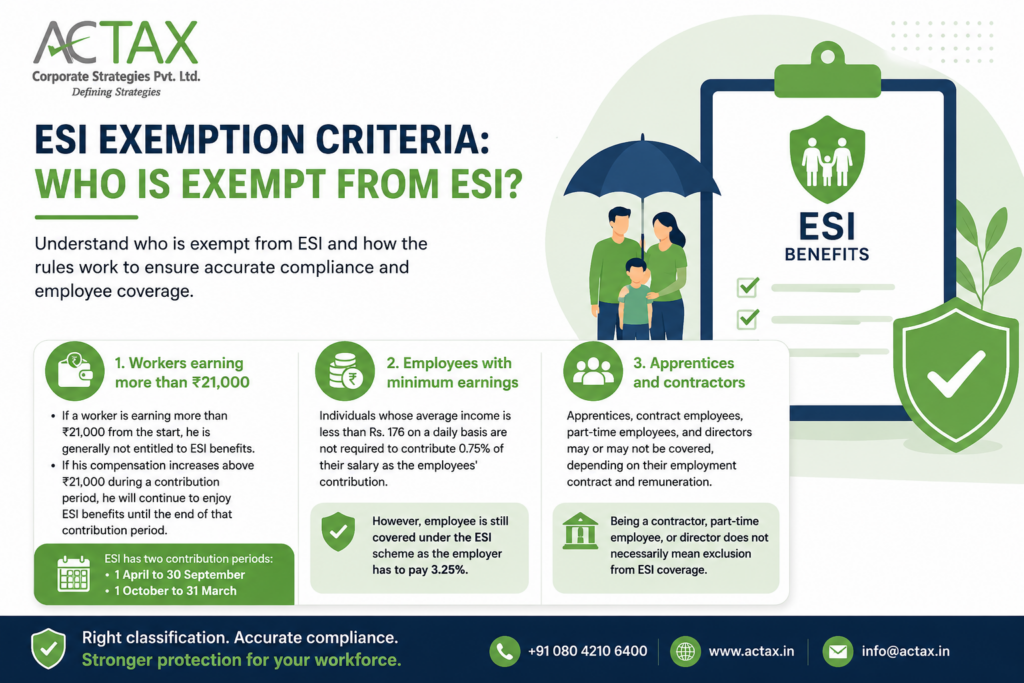
ESI Exemption Criteria: Who Is Exempt From ESI?
Workers earning more than ?21,000
There are two cases to understand:
- If a worker is earning more than Rs. 21,000 from the start, he is generally not entitled to ESI benefits.
- If he is covered under ESI and then his compensation increases above Rs. 21,000 during a contribution period, he will continue to enjoy ESI benefits until the end of that contribution period.
ESI has two contribution periods:
- From 1 April to 30 September
- From 1 October to 31 March
This means that even if the remuneration in the middle of a period goes above ?21,000, ESI contributions would not stop immediately.
Employees with minimum earnings
Individuals whose average income is less than Rs. 176 on a daily basis are not required to contribute 0.75% of their salary as the employees’ contribution. However, it does not imply that the employer does not have to pay the employer’s contribution of 3.25%.
Therefore, although the employee does not have to pay the contribution, he is still covered by the ESI scheme.
Apprentices and contractors
Apprentices are treated differently from regular employees and trainees under the ESI Act. Contract employees and part-time employees are not excluded from coverage merely because they are contract or part-time employees.
As for the directors, they may be either covered or not, depending on their employment contract and remuneration.
In summary, being a contractor, part-time employee, or director does not necessarily mean that the person is excluded from coverage under the ESI scheme.
ESI Contribution Rate in 2026
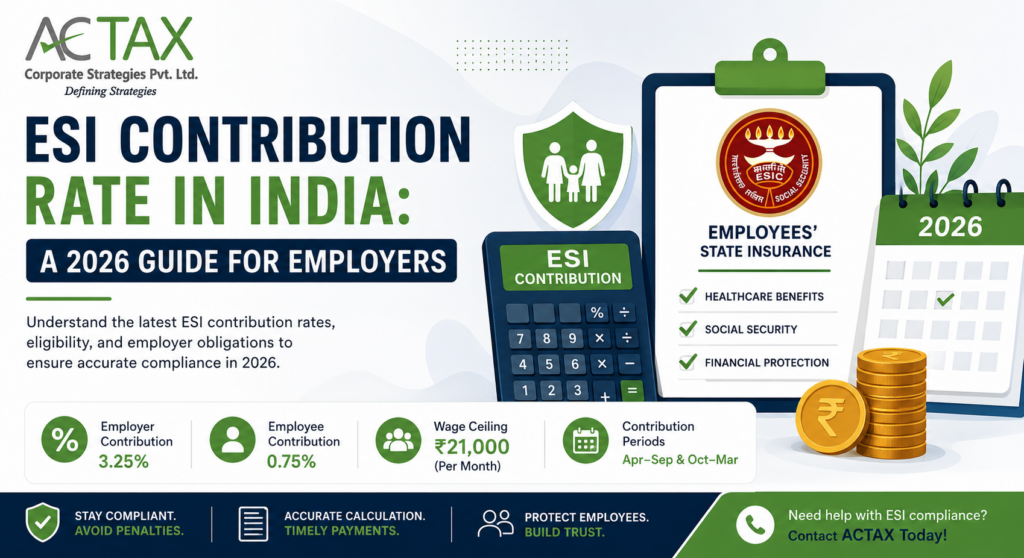
The ESI contribution rate consists of both the employer and employee contributions. Understanding the employer/employee ESI contribution helps businesses calculate their monthly payroll liability correctly.
| Item | 2026 Position |
| Employee ESI contribution | 0.75% |
| Employer ESI contribution | 3.25% |
| Combined contribution | 4% |
| General wage ceiling | Rs. 21,000/month |
| Disability wage ceiling | Rs. 25,000/month |
| Low-wage employee contribution exemption | Average daily wage up to Rs. 176 |
| Payment deadline | 15th of the following month |
| Contribution periods | Apr–Sep and Oct–Mar |
How to Calculate ESI Deduction From Salary
The ESI amount is determined by the eligible ESI wages of the employee.
- Employee Contribution is 0.75% of ESI wages
- Employer Contribution is 3.25% of ESI wages
- Total ESI Contribution is 4% of ESI wages
1. If the Salary is Rs.18,000
The employee contribution is equal to Rs. 135
Employer contribution is Rs. 585
= Total ESI is Rs. 720
2. Pay raises surpassing Rs. 21,000 during the ESI term
Let’s assume an employee gets paid Rs. 19,000 and their pay suddenly becomes Rs. 22,000 in November.
When the employee is already enrolled for ESI, the employee is eligible for ESI until March 31. It continues until that date, and the contribution does not end immediately when his pay exceeds Rs. 21,000.
3. If the startup has 15 employees
Let’s say there is a startup in Bangalore with 15 employees, and 11 out of them are enrolled under ESI.
In this case, if the total ESI wages amount to Rs. 1,98,000 for these 11 employees monthly:
Employee contribution = Rs. 1,485
Employer contribution = Rs. 6,435
Total ESI contribution amount for the month is = Rs. 7,920
ESI Calculator
The use of an ESI calculator simplifies payroll calculations.
Enter monthly ESI wages, then get employee contribution and employer contribution, and get the total ESI amount.
This can greatly help payroll departments in calculating the ESI contribution rate every month.
ESI Payment Due Date and Employer Compliance
Employers are expected to make the ESI payment by the 15th of every month. This means that the payment of ESI for the salary of July should be completed by 15th August. There may be penalties attached in case the payment is delayed. The late payment may result in problems matching payroll with ESI records.
The following steps can be taken to make the payment.
- Check if your employees are covered under ESI and whether the ESI applicability threshold has been met.
- Check the salary of your employees and the applicable ESI wage limit.
- Calculate the contributions for ESI, which are 0.75% for the employee and 3.25% for the employer.
- Match the payroll information with the ESI record.
- Generate the ESI challan.
- Make the payment by the 15th.
- Save all records related to salaries and payments made.
ESI Benefits: What Does the Employee Actually Get?
The ESI program provides important benefits to employees in the form of Medical treatment, sick and maternity benefits. It also provides disability benefits and dependents’ benefits.
It’s essential for employers to communicate these benefits to their employees so that they understand the reasons behind the ESI deductions and what they gain from the deductions.
Actax India Expert Opinion
ESI compliance can become harder when a business is hiring new employees, increasing salaries, or changing employee salary structures. For growing companies, we conduct an ESI eligibility review for every new appointment, revised salary, change in employee status, or change in establishment. Maintaining a simple employee-wise ESI compliance sheet can help in tracking these changes and avoid using old eligibility status for the new payroll. The important thing is to understand that ESI is a continuous process that needs to be reviewed due to changes in employees as well as salaries.
Conclusion
When it comes to managing ESI compliance, businesses need to be aware that just making the payments on time is not enough. They also need to make sure that the right ESI contribution rates have been calculated correctly, and all by-law payments and paperwork have been maintained in an appropriate manner. A single mistake in the payroll can create problems later down the road.
If your business in Bangalore is going through a process of growth, constantly hiring new employees, restructuring salaries, or managing staff payroll manually, it is high time you turned your attention to ESI compliance issues.
Actax India may provide you with help regarding your ESI compliance and payroll management.
Don’t wait for an ESI mismatch or compliance notice to expose gaps in your payroll. Contact Actax India today to review your payroll and ESI processes and keep your business compliant with confidence.