1. Record vs. Interpretation: The Primary Difference between Bookkeeping and Accounting
If you consider your business to be a vibrant marketplace, then bookkeeping refers to the phenomenon of capturing the ripples of every business transaction, including every expense and sale. In simple terms, bookkeeping is record keeping. It refers to the process of systematic classification and recording of natural financial transactions of any given business.
Similarly, if you want to conduct a vivid analysis of the record that is being kept, then that phenomenon would amount to accounting. Precisely speaking, accounting involves the extraction of raw data, from the transactions that have been recorded in bookkeeping, to transform them into meaningful insights.
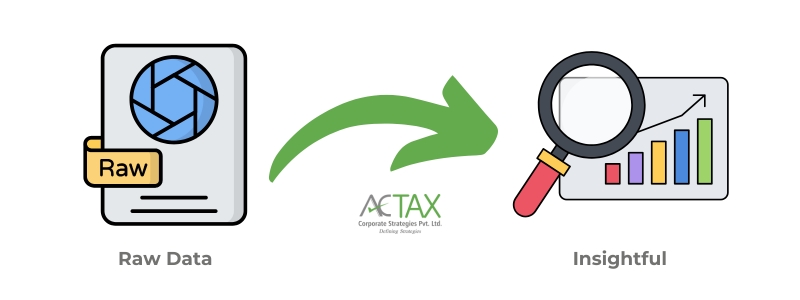
So, in simple terms, it is a process of interpretation. It not only guides decision-making but also ensures the credibility of a business. Through accounting, the financial health of a business gets analyzed, categorized, and eventually summarized, in the form of business statements and balance sheets. So, this can be deduced as the most important difference between bookkeeping and accounting. Learn More About Accounting Services Feature
2. The Procedural Differences between Bookkeeping and Accounting
To describe the procedural differences between bookkeeping and accounting, the processes of both these phenomena have been bisected in a stepwise manner.
Step 1: The process of bookkeeping starts with the identification of a financial transaction
Step 2: This is followed by the recording of such transactions.
Step 3: In the next step, a ledger account is usually prepared,
Step 4: Which subsequently followed by the preparation of a trial balance.
On the other hand, accounting is followed in cyclic steps,
Step 1: Starts with the records of bookkeeping
Step 2: Followed by the preparation of journal entries
Step 3: In the next step, all of these get posted to the general ledger.
Step 4: After that, all the unadjusted balance reports are generated
Step 5: Then for the further preparation of worksheets
Step 6: In the upcoming step, the entries get adjusted, and
Step 7: The financial statements get generated subsequently
Step 8: To close the books
In this regard, it should be mentioned that Actax India follows all these steps to ensure sound bookkeeping and accounting. Learn More here – 5 Most Critical problem with Accounting for Small Businesses
3. Compliance vs. Strategic Decision-Making: The Core Functional Difference
The core functional difference between bookkeeping and accounting lies in the fact that the former is usually leveraged to ensure regulatory compliance and subsequently avoid all tax-related legal burdens.
On the other hand, the latter is usually utilized to understand the financial trends of the business, and its profitability quotient and sales revenue, to make strategic decisions.
Both are equally important and valuable for running businesses. Actax India understands the functional differences between bookkeeping and accounting, hence providing their customers with comprehensive bookkeeping and accounting services, tailored to their specific demands, needs, and requirements.
4. Bookkeeper vs. Accountant: Person Involved – Bookkeeping and Accounting
Another basic difference between bookkeeping and accounting lies in the fact that they are managed by different individuals. As the name suggests, a bookkeeper is responsible for bookkeeping, and an accountant is responsible for accounting. However, in small organizations, an accountant performs both of these functions. But, in large organizations, these two functional entities are kept separate.
To be precise, the bookkeeper is responsible for recording and subsequently maintaining business transactions like purchases, sales revenue, expenses, invoices, and all payments. On the other hand, the key function of an accountant is to maintain and analyze financial business records, along with keeping track of tax liabilities and expenditures. Most important to know – Top Objectives of Accounting You Should Not Ignore [For Small Businesses]
5. Types of Bookkeeping and Accounting: Yet Another Difference
There typically exist two types of bookkeeping services, that are single-entry bookkeeping and double-entry bookkeeping. The former involves a straightforward method of bookkeeping, wherein each transaction is recorded through a single entry. Actax India offers both these services to their clients.
On the other hand, financial accounting, cost accounting, tax accounting, and auditing are the core accounting types of a business. To know more about them click here, wherein all these services have been elaborated (as they offer these services as well).






Comments are closed.