It’s the 20th of the month. Your bank balance doesn’t match your records, a GST deadline is close, and you still don’t know last month’s profit.
This is usually when founders ask: What is outsourced accounting, and will it fix this?
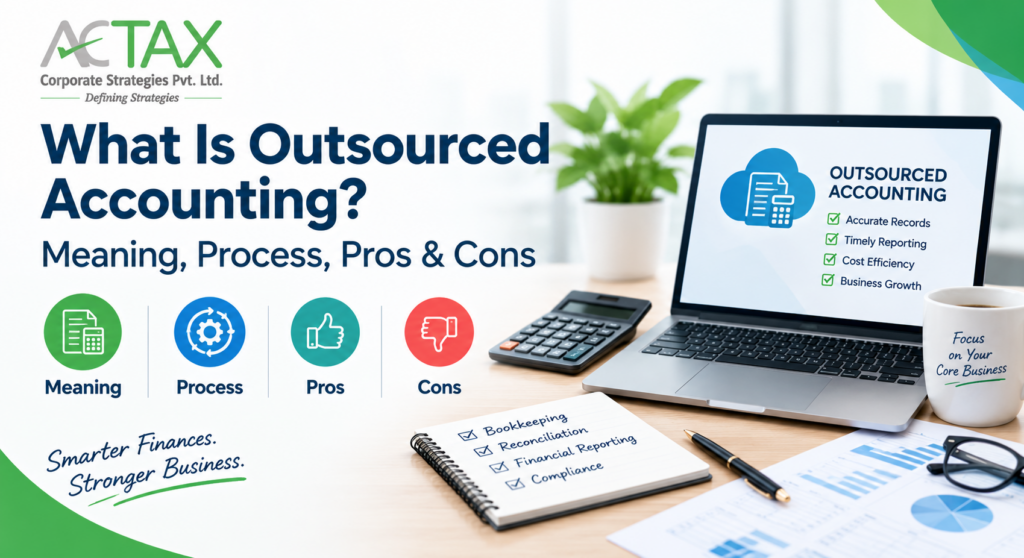
Outsourced accounting means you hire an outside firm to run some or all of your finance work. That includes bookkeeping, payables, receivables, payroll, reporting and tax support. You don’t build a team. You rent one.
This guide explains what outsourced accounting includes, how it works, what it costs, and what changed in India, the UK and the USA in 2026.
In short: Outsourced accounting means an outside firm runs some or all of your bookkeeping, payables, receivables, payroll accounting, reporting and tax support on cloud software, under a written scope. You pay a monthly or project fee, plus 18% GST in India, and you still own your filings and your legal responsibility.
What Is Outsourced Accounting? A Simple Definition
Outsourced accounting is when an external firm handles your financial tasks. The team works on cloud software, follows an agreed schedule and sends you reports every month.
You can outsource a little, like bookkeeping only. Or you can outsource the whole finance function, up to virtual CFO support. Firms usually work in one of two models. In a fully outsourced model, the firm runs your accounts end to end, like a virtual finance department. In a co-sourced model, your own team keeps part of the work, such as approvals or payroll sign-off, and the firm handles the rest.
Two things it is not:
- It isn’t a part-time bookkeeper. You get a team with review layers, not one person.
- It doesn’t move your legal duty. Your business still owns its filings and answers to the tax office.
One more point. Bookkeeping records transactions. Accounting reads them, reports on them and helps you decide. Outsourced accounting usually covers both.
What Services Does Outsourced Accounting Include?
Most firms offer:
- Bookkeeping and bank reconciliation.
- Accounts payable (paying vendors) and accounts receivable (chasing customers).
- Payroll accounting (payroll management if you want the full payroll run).
- Month-end close and financial statements.
- GST, TDS, VAT or sales tax accounting support (GST filing).
- Budgeting, cash flow forecasting, and MIS reports.
- Controller and virtual CFO support.
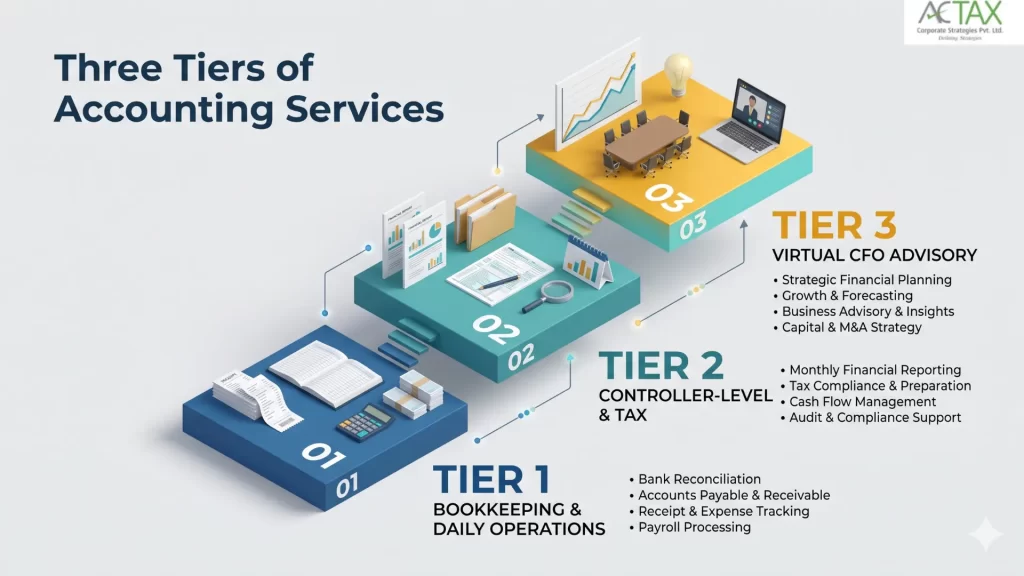
A simple way to picture the scope is three tiers.
- Tier 1, bookkeeping: daily entries, reconciliations, payables and receivables.
- Tier 2, controller-level: month-end close, financial statements, payroll accounting and tax support.
- Tier 3, virtual CFO: budgeting, cash flow forecasting and investor or lender reporting. Many businesses start at Tier 1 and move up as they grow.
How Does Outsourced Accounting Work?
The process is simple:
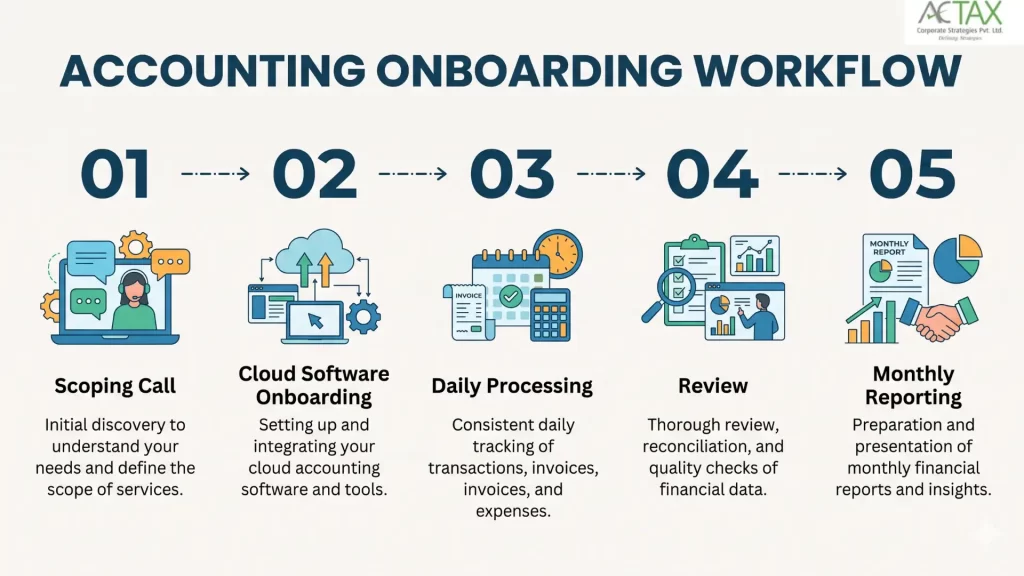
- Scoping call. You and the firm agree on tasks, deadlines and fees.
- Onboarding. You share invoices, bank statements and opening balances. The firm sets up Zoho Books, Tally, QuickBooks or Xero.
- Daily processing. The team records transactions, matches bank entries and handles payables and receivables.
- Review. A senior accountant checks the work and flags errors.
- Monthly reporting. You get a profit and loss statement, balance sheet and cash flow report. Most firms add a short review call.
How Much Do Outsourced Accounting Services Cost?
Most firms charge a fixed monthly fee, an hourly rate, or a project fee. Your price depends on how many transactions you have, how many GST registrations you hold, your payroll headcount, how often you want reports, and how much work you hand over.
Here’s what Indian businesses typically pay each month in 2026 (indicative):
- Startups and proprietorships: ₹8,000 to ₹15,000. Basic bookkeeping, single-state GST filing, and monthly bank reconciliation.
- Growing SMBs and private limited companies: ₹30,000 to ₹1,00,000. Full bookkeeping, payroll, multi-state GST and TDS.
- Large, high-volume companies: ₹1,70,000 to ₹5,50,000+. End-to-end finance work, custom MIS, tax advisory, and controller oversight.
One-off cleanup or backlog work usually runs ₹650 to ₹1,200 an hour. Add 18% GST on top of every fee.
Why fees differ: a bookkeeping-only plan covers entries and reconciliation. A full-service plan adds payroll, multi-state GST, TDS, and reporting, which needs more people and more review time.
Who Does What? A Simple Split of Responsibilities
Most people don’t know this. It’s where most disputes start.
Task | The firm does | You do |
Recording transactions | Enters and categorises them | Send bills and bank statements on time |
Bank reconciliation | Matches and flags differences | Explain unknown entries |
Vendor payments | Prepares the payment list | Approve and release payments |
GST and TDS returns | Prepares and files, if in scope | Review figures before filing |
Payroll | Calculates salaries and dues | Approve the final payroll |
Monthly reports | Prepares and explains them | Read them and act |

What You Should Receive Every Month ?
A good provider usually sends you these:
- Reconciled bank and credit card statements.
- Aged receivables (who owes you, and for how long).
- Payables due in the next 30 days.
- Profit and loss statement and balance sheet.
- Cash flow summary.
- GST and TDS payment status.
- A short list of open issues and missing documents.
If your provider sends only a P&L, ask for the rest.
Why Businesses Choose to Outsource Their Accounting?
The main reasons why startups choose to outsource accounting are due to resource gaps, access to expertise in accounting & top talent, and real-time insights for decision-making, adapting to new & changing accounting technology while keeping their spending on the accounting team low.
If you find that managing financial operations is taking time away from your core functions, your business is growing rapidly, or you need expert guidance to maintain compliance and financial accuracy, outsourcing may be a strategic solution. Here’s a complete guide on Pros & Cons of outsourcing accounting services.
Most businesses outsource for the same handful of reasons: they don’t have the internal expertise, they want access to senior-level accounting talent without a full-time hire, and they need real-time financial data to make decisions. Here’s a full breakdown of the pros and cons of outsourcing accounting services, and if you want to see what this looks like in practice for a Bangalore-based team, our accounting services page covers the full scope
The Pros and Cons of Outsourcing Your Accounting
Outsourcing isn’t the right call for every business at every stage. Here’s a balanced look before you decide.
Pros of Outsourcing Accounting
Advantage | What It Means for You |
Lower overhead | No salary, PF, benefits, or software licensing costs for an in-house hire |
Specialist expertise | Access to a team of CA-level professionals instead of relying on one generalist |
Scalability | Easily add or reduce support as your transaction volume changes |
Technology access | Use cloud accounting tools like Zoho, Tally, and QuickBooks without setup costs |
Risk mitigation | Reduce the risk of compliance errors and missed deadlines |
Cons of Outsourcing Accounting
Concern | How to Manage It |
Data confidentiality | Choose a firm with documented data-security practices and signed NDAs |
Communication gaps | Establish a fixed weekly or monthly check-in cadence upfront |
Dependency on a vendor | Maintain read access to your own books and accounting software at all times |
Inconsistent quality | Evaluate the firm’s track record and request client references |
Cultural/language friction | Rare with India-based firms serving India; more relevant for cross-border offshore setups |
When You Should Choose To Outsource Your Accounting Tasks?
Outsourced accounting and bookkeeping services can be a game-changer for businesses, offering numerous advantages. Here are five indicators that shows you the need for outsourced accounting services.
1. Limited In-House Expertise
Small businesses often lack the in-house expertise to manage complex financial transactions and compliance. When your financial operations become too challenging to handle internally, it’s time to seek professional help.
Outsourced accounting experts can ensure that your financial records are accurate and compliant with relevant regulations.
2. Accelerate The Growth Of Your Business With Outsourced Accounting Services.
Rapid business growth can strain your financial operations. Outsourced services can ensure that your economic infrastructure scales seamlessly if you’re expanding. As your business grows, your accounting needs become more complex.
Outsourced experts are well-equipped to handle this complexity, providing the support you need to sustain and manage growth effectively.
3. Unlocking the Cost Efficiency of Outsourced Accounting Services
Outsourcing is often more cost-effective than hiring and maintaining a full-time accounting team. If you want actual numbers, here’s a 2026 benchmark on what outsourced accounting costs in India.
Outsourcing makes sense if you want to reduce overheads and focus resources on core functions. You pay for the services you need, reducing the financial burden of hiring and retaining full-time employees.
4. Focus On Core Activities
Small business owners wear many hats, making it challenging to dedicate time to bookkeeping and accounting. Outsourcing these tasks allows you to concentrate on strategic initiatives that drive growth. It frees up your time to focus on what you do best – running and growing your business.
5. Optimize Tax Compliance With Outsourced Accounting Services
Tax laws are intricate and ever-changing. Outsourced experts can keep you compliant, ensuring you take full advantage of available deductions and credits. Tax compliance is critical to avoid legal issues and to optimize your financial position.
Outsourced professionals stay up-to-date with tax regulations and can help you navigate complex tax matters.
Should You Outsource, Hire or Mix Both?
- Outsource if your work is mostly routine entries, filings, and reports, and you have no finance lead.
- Hire in-house if you need someone on site daily or handle sensitive internal workflows with constant approvals.
- Go hybrid if you have a finance lead who can approve and decide, but want a firm to do the routine work.
The trade-off: outsourcing gives you skills and flexibility, but less daily oversight. A hybrid keeps control, but you pay for both.
Quick self-check. Give yourself one point for each “yes”:
- You have no finance lead who can approve entries and payments.
- Most of your work is routine: entries, reconciliations, filings, reports.
- Missed or late filings are a recurring problem.
- You don’t need someone on site every day.
- You want monthly MIS, not just returns.
4–5 points: outsourcing is likely to fit.
2–3 points: consider a hybrid, with your finance lead approving and a firm doing the routine work.
0–1 points: hire in-house first and revisit when volume grows. This is a rule of thumb, not a substitute for a scoping call.
Outsourced Accounting Services in India: What Changed in 2026 ?
Income tax: The Income-tax Act, 2025 took over from the 1961 Act on 1 April 2026. “Tax Year” now replaces “Previous Year” and “Assessment Year”, and TDS rules sit in fewer sections. One catch: income earned up to 31 March 2026 is still taxed under the 1961 Act, so returns for AY 2026-27 follow the old law. Your accountant handles both for a while. See the Income Tax Department’s FAQs on the new Act and TDS compliance FAQs.
GST: E-invoicing is compulsory for B2B invoices if your aggregate turnover went above ₹5 crore in any year since 2017-18. Turnover is counted across all GSTINs under one PAN, and some categories are exempt. The QRMP scheme is separate. It lets eligible taxpayers file GSTR-3B quarterly and pay monthly, but only if turnover was up to ₹5 crore in the previous year. Cross ₹5 crore and you move to monthly filing. Details are in the official QRMP circular.
Audit trail: Companies using accounting software must use software that records an audit trail and an edit log of every change, and the trail can’t be switched off. This has applied since 1 April 2023. Ask your provider to show it’s on. The rules are on the MCA website.
Data protection: India notified the DPDP Rules in November 2025. Most business duties, like notices, security safeguards, and breach reporting, start after an 18-month phase-in, around May 2027. You stay responsible for your data even when the accountant handles it, so put security and breach terms in the contract. Read the PIB release.
Fees: Accounting and bookkeeping fees attract 18% GST. Ask for quotes with and without it, and check the current rate on CBIC’s site.
Outsourced Accounting for UK and US Businesses
UK
From 6 April 2026, sole traders and landlords with qualifying income above £50,000 must use Making Tax Digital for Income Tax. Qualifying income means gross income from self-employment and property, checked against your 2024/25 return. Some people are exempt. You keep digital records, send quarterly updates and use compatible software. The limit drops to £30,000 in April 2027 and £20,000 in April 2028. HMRC began signing up eligible people automatically from September 2026. See GOV.UK.
USA
For payments made after 31 December 2025, the 1099-NEC and most 1099-MISC reporting threshold is $2,000, up from $600. It’s counted per payee across the calendar year. It doesn’t apply to every box, and royalties still use a $10 threshold, so check the form instructions on irs.gov. Still collect a W-9 before the first payment. You won’t know in March who crosses $2,000 by December.
How to Choose a Provider (and Red Flags)
Look for:
- Credentials: CA-led in India, CPA or ACCA elsewhere.
- Software fit: They should work with what you use.
- Security: NDA, role-based access, clear data handling.
- Written scope and SLA: Deadlines, deliverables, who approves what.
- Samples and references: A real monthly report and one current client to call.
- Exit terms: You own your records and can take them with you.
Walk away if a firm:
- Promises “zero errors” or “100% compliance”.
- Won’t share a sample report.
- Refuses you admin access to your own books.
- Gives a price with no written scope.
Why Are Outsourced Accounting Services Essential For Small Businesses?

Outsourced accounting matters most for small businesses because it removes the cost of building an in-house team while still giving founders accurate, compliant financial reporting and strategic advisory support. In 2026, this also increasingly means access to AI-augmented reporting tools without having to buy or manage them yourself. For a full look at how this plays out for small businesses, see our detailed breakdown.
Start Your Journey To Find Right Accounting Services in Bangalore
Outsourced accounting lets a founder get expert-level financial management without the overhead of a full in-house team access to specialists, lower costs, and the flexibility to scale as the business grows. It’s increasingly also becoming a source of forward-looking advisory: cash flow forecasting, tax planning, and investor-ready reporting, not just bookkeeping.
If you’re weighing this decision for your own business, see how our accounting services in Bangalore are structured, or talk to one of our accountants directly.