What Is Trademark Registration?
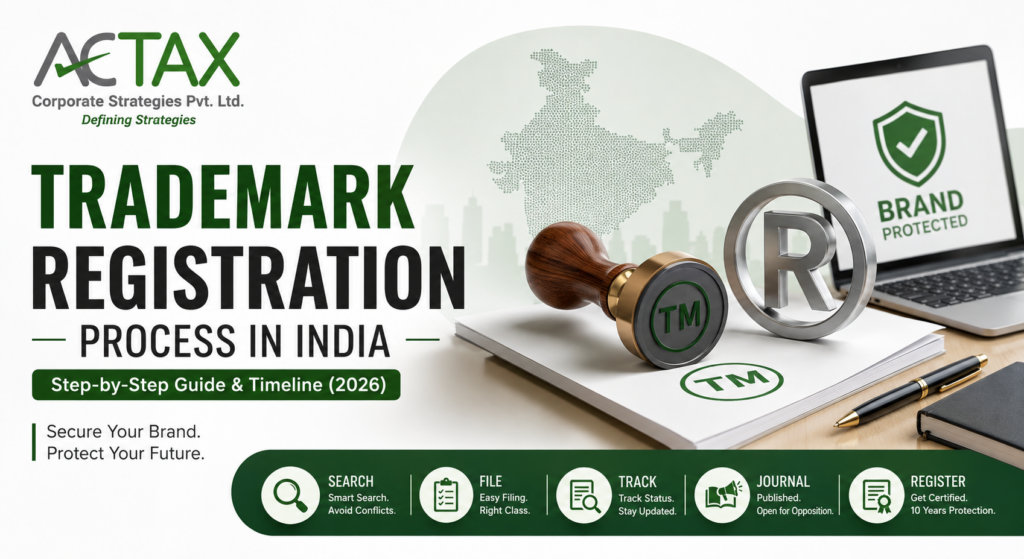
Trademark registration safeguards your trademarked business name, logo, slogan, or other combinations. It also provides protection of your specific goods or services relating to this trademark. Trademark safeguarding does not mean the whole business is protected.
What Are the Things Not Covered By A Trademark?
A trademark will not protect anything related to your business or product by default.
- Domain names must be registered separately.
- Social media accounts must be secured.
- The design of the product can be claimed with design registration.
- New innovations can be claimed through a patent.
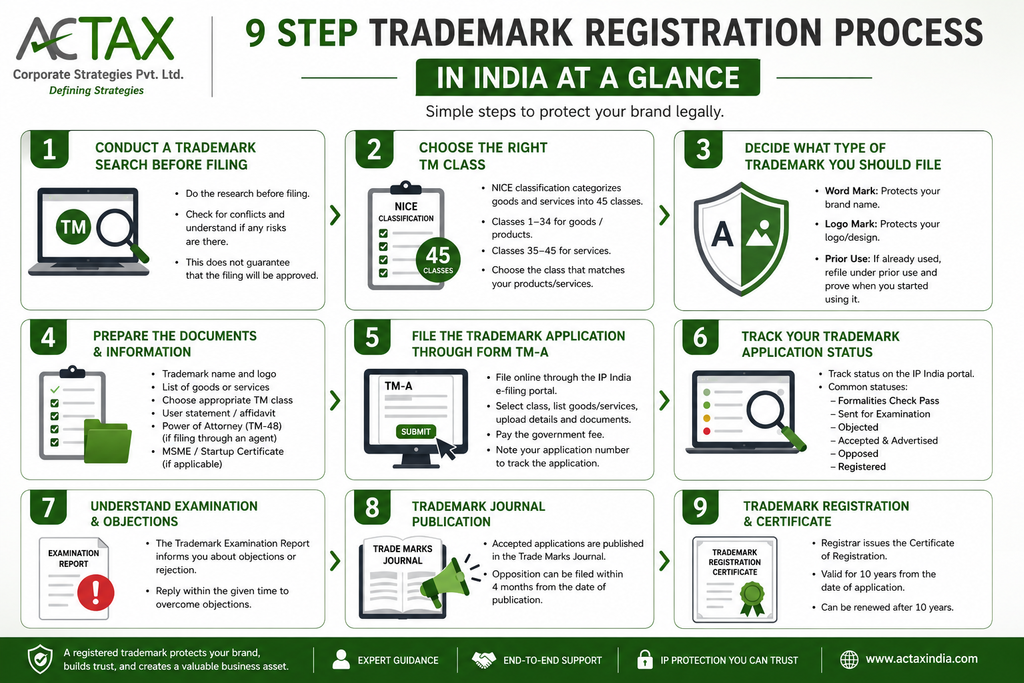
Trademark Registration Process in India at a Glance
Step 1: Conduct a Trademark Search Before Filing
Trademark Search vs Trademark Registration
| Trademark Search | Trademark Registration |
| Do the research before filing. | After filing, the registration is completed. |
| Check for conflicts and understand if any risks are there. | After filing, the applicant wants statutory registration and all the registered rights acquired. |
| This does not guarantee that the filing will be approved | Even after filing, the application can still be examined or opposed by others. |
Actax India Expert Insight:
When conducting a trademark search, it’s important not to just look for exact matches. In our experience, the use of similar-sounding names, similar spellings, and trademarks for related goods and services can also be problematic. Therefore, it is wise to always review the wider search results before concluding that a trademark is safe to file.
Step 2: Understand NICE Trademark Classes Before Filing
NICE classification is a method used to categorize goods and services into a range of 45 classes used in trademark applications across the globe.
In India:
- Classes 1-34 are applicable for goods/products.
- Classes 35-45 are useful for services
The choice of the correct class and an accurate description of the goods or services are important parts of the trademark registration process in India.
How to select the right TM classes for your trademark application?
Select the class that matches the products being sold or planned to be sold. Instead of copying the classes chosen by competitors. Keep the future prospects of your business in mind while making the decision.
Step 3: Decide What Type of Trademark You Should File
A word mark protects your brand name itself. A logomark protects the particular design or photograph of your logo. If you have already used the trademark, you can refile under prior use and prove when you started using it.
Step 4: Prepare the Documents and Information for Trademark Registration
Documents Required for Trademark Registration
Before you apply for trademark registration, make sure that you have the following paperwork collected.
- Trademark name and picture/logo you intend to register.
- The list of goods or services with regard to which the trademark is being registered.
- Choose an appropriate NICE Class or TM classes for your products or services.
- Have a user statement/affidavit.
- If you claim that the trademark is in use by you, provide the necessary documents to support your claim.
- Have a Power of Attorney (Form TM-48). It is required if the trademark agent is to submit the application on your behalf.
- Keep the Startup or MSME Certification.
It is necessary that the name and category of an application must be the same as in the registration papers or Udyam. A slight technical error or discrepancy will lead to problems when it comes to objections or rejections down the line.
Step 5: File the Trademark Application Through Form TM-A
TM-A form is the primary form used for the trademark registration process in India. It helps in registering either a brand name, logo, or both.
You can follow these trademark application steps for registering online:
- Register and log in to the IP India e-filing portal.
- Fill in the details of the applicant.
- Select the appropriate trademark class.
- List relevant information about the products or services.
- Provide required documents and data.
- Make the payment.
- Fill in the application form.
Remember the application number in order to track the trademark later.
Trademark Registration Fees in India in 2026
| Applicant type | E-filing fee (per class) |
| Individual / Startup / MSME | Rs. 4,500 |
| Company / LLP / Partnership / Other | Rs. 9,000 |
This is the government fee under the Trade Marks Rules, 2017 First Schedule. It excludes any professional fee your consultant may charge.
Step 6: Track Your Trademark Application Status
Your application is processed in the order in which it was filed.
Different statuses can be seen on the portal, such as:
- Formalities Check Pass
- Sent for Examination
- Objected
- Accepted and Advertised
- Opposed
- Registered
During the examination stage, checking the portal once every 3–4 weeks is usually enough. After the application is published, check it more often because there is a limited time during which someone can oppose it. Always read the exact status and the document linked to it.
Step 7: Understand Trademark Examination and Objections
The Trademark Examination Report is the official document that informs the applicant about the rejection of his application for trademark registration.
Objections are raised when the examiner discovers any inconsistency in the document itself or with respect to the requirements for trademark registration.
Step 8: Trademark Journal Publication
The Trade Marks Journal is a weekly official publication of IP India that provides the details of the accepted trademark applications. An opposition can be filed within a period of four months after the publication of the trademark in the Trade Marks Journal.
Step 9: Trademark Registration and Certificate
The Registrar issues the Trademark Registration Certificate, which serves as proof of the grant of rights to the trademark in the classes under which it is registered.
This registration is valid for 10 years from the date of application under Section 25 of the Trade Marks Act, 1999. After 10 years, it can be renewed.
Handling Trademark Objection: What Businesses Should Do Next
Trademark Objection vs Trademark Opposition
| Action | Objection | Opposition |
| Stage | It comes during the examination process. | It can happen after the application is published. |
| Who Raises It? | The examiner points out the concern. | A third party can object or raise the problem. |
| Response | Then the applicants give a response to the examiner. | The applicants give the answer to the person who objected. |
| Nature | It is related to the examination. | It may affect the rights of the other people who are involved. |
Handling Trademark Opposition in India
Trademark opposition refers to the official dispute brought by an outsider against the trademark application that has been published in the Trademark Journal. There are no requirements for the opponent to be a competitor or a trademark owner.
The opposition period lasts for four months starting from the date of publication of the trademark application in the Trademark Journal. In the event of receiving a trademark opposition, you must respond within the given time frame with a counter-statement. Failing to respond can result in abandonment of the trademark application.
There is no timeline for the completion of a trademark opposition procedure. It takes longer depending on the number of arguments and evidence submitted by both sides.
Common Trademark Registration Mistakes Businesses Make
Some business founders will discover only after filing their trademarks that a similar one already exists. As a result, they may experience challenges.
Your trademark must be filed under the right class. For example, if you are a SaaS company, you must file under Class 42 instead of Class 9, where applicable.
Filing a trademark application is just the first part of the trademark registration process in India. You have to go through all of the steps that lead to registration after filing.
The trademark registration must be renewed every ten years. If you fail to renew your trademark in a timely manner, you will lose your rights.
Final Checklist Before Filing a Trademark Application
- Brand name confirmed
- Complete search conducted.
- Correct classification according to NICE
- Goods/services verified and described
- Decision reached whether to apply for trademark name/logo.
- Confirm that the trademark has not been previously applied.
- All necessary documentation obtained
- Applicant details verified and all accurate
- TM-A form carefully audited
- Fees payable to the government confirmed
- Patently filed
- Registration number noted
Is there a specified timeframe for the trademark registration process?
No specific timeline exists for trademark registration. The completion time of the process mainly depends on events such as oppositions raised against the trademark.
When it comes to planning, trademark registration should be considered a lengthy process with multiple stages rather than something that can be completed in a certain number of days. The application should be filed first, which is only the beginning of the process.
Need Help With Trademark Registration in Bangalore?
Trademark registration is more than just submitting the application. But the real question is, “How long does trademark registration take”?
The correct selection of trademark classes, trademark search, filing of TM-A application, and dealing with oppositions and objections affect the success of trademark application.
Actax India offers complete trademark registration services in Bangalore. Get in touch with us if you need any help with the trademark registration process in India.