Starting a corporation in India may seem easy on paper. The shares are held by a foreign parent, the Indian firm is incorporated, and business starts. But things are less simple once you really start the procedure. You need to look at FDI norms, obtain foreign documents apostilled, fill MCA forms, and finally the investment itself has to be recorded under FEMA.
That’s why wholly owned subsidiary registration in India is more than simply receiving a Certificate of Incorporation. A corporation may be formed yet still have significant foreign investment compliances outstanding.
But it is a process that can be done if you get the order right from the start. This guide explains the process of setting up a wholly owned subsidiary in India, including FDI eligibility, required documentation, MCA registration, FEMA and RBI compliance, fees, timescales, and post-incorporation compliance.
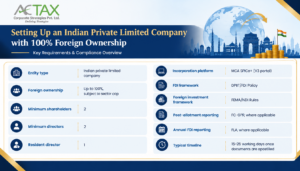
Quick Answer
|
Item |
Requirement |
|
Entity type |
Indian private limited company |
|
Foreign ownership |
Up to 100%, subject to sector cap |
|
Minimum shareholders |
2 |
|
Minimum directors |
2 |
|
Resident director |
1 |
|
Incorporation platform |
MCA SPICe+ (V3 portal) |
|
FDI framework |
DPIIT/FDI Policy |
|
Foreign investment framework |
FEMA/NDI Rules |
|
Post-allotment reporting |
FC-GPR, where applicable |
|
Annual FDI reporting |
FLA, where applicable |
|
Typical timeline |
15-25 working days once documents are apostilled |
What Is a Wholly Owned Subsidiary in India?
A WOS is an Indian private limited company where a foreign parent holds 100% of the shares. Once incorporated under the Companies Act, 2013, the MCA treats it like any Indian company: its own PAN, its own bank account, its own contracts and liabilities, separate from the parent.
Companies pick this over a branch or liaison office because it’s the only structure that lets you hire, invoice, sign contracts, and build a real, lasting presence without operational limits.
Can a Foreign Company Own 100% of an Indian Company?
Yes, in most sectors, through the FDI automatic route, meaning no prior government approval is needed. We’ll be precise here rather than throwing out a round percentage: DPIIT’s Consolidated FDI Policy lists specific sectoral caps and conditions in its sectoral chapter, and any sector not listed there defaults to the 100% automatic route. So the honest answer is “check your specific activity against the current policy,” not a blanket statistic.
Sectors that still need the government route or carry caps: defence beyond 74%, multi-brand retail (51% cap), insurance, telecom, and media.
Land-border investors: what actually changed in 2026
This one gets misreported a lot, so here’s the precise version. Press Note 3 of 2020 requires government approval for any FDI where beneficial ownership traces to a country sharing a land border with India. In March 2026, the Union Cabinet approved a relaxation, and DPIIT formalised it through Press Note 2 of 2026. The amendment took effect on 2 May 2026, once the corresponding change to the FEMA Non-Debt Instruments Rules was notified.
Under it, investors with non-controlling beneficial ownership of up to 10% from a land-border country can now use the automatic route, but only for specific sectors: capital goods, electronic capital goods, electronic components, polysilicon, and solar ingot-wafers. Majority ownership and control from land-border sources still need government approval, full stop. You can track policy updates directly on DPIIT’s official publications page.
What is The Difference Between Automatic Route vs Government Route?
|
Factor |
Automatic Route |
Government Route |
|
Prior approval |
Not needed |
Required from DPIIT |
|
Covers |
Most sectors, plus limited LBC minority stakes (post-May 2026) |
Defence beyond caps, media, multi-brand retail, majority LBC ownership |
|
Speed |
Faster |
Slower, added approval stage |
What is WOS vs Branch Office vs Liaison Office?
|
Feature |
WOS |
Branch Office |
Liaison Office |
|
Separate legal entity |
Yes |
No |
No |
|
Can earn revenue |
Yes |
Limited, permitted activities only |
No |
|
Ownership |
Up to 100% |
N/A |
N/A |
|
Best for |
Long-term operations |
Specific permitted activities |
Market research only |
What Are The Documents Required for Foreign Subsidiary Registration?
- From the foreign parent company: Certificate of Incorporation, constitutional documents (Charter/MOA/AOA or similar), board resolution in support of Indian Subsidiary, authorized signatory’s proof, a letter of consent for trademark use/NOC, and Nominee Shareholder’s KYC.
- From foreign directors/subscribers: Passport, proof of abroad address, photographs, and documentation relating to DSC.
- From any resident director: PAN, address proof, DSC, and DIN.
- For the statutory legal declarations: Form DIR-2 (Consent to act as Director), Form INC-9 (Declaration by Subscribers/Directors) and Ultimate Beneficial Ownership (UBO) Declaration.
- For the registered office: Address proof, a recent utility bill, and a No Objection Certificate or lease agreement if the office isn’t owned by the company.
Apostille Documents: Where Timelines Actually Break
Every foreign document above needs authentication before MCA accepts it. Documents from a Hague Convention country need an apostille and notarisation; documents from a non-Hague country need consularisation through the Indian embassy there instead.
In our own client work, this step, not the MCA filing, is what turns a “15-day” registration into five or six weeks. Apostille processing time sits entirely with the issuing country’s own office, so there’s nothing to speed up on the India side once it’s submitted.
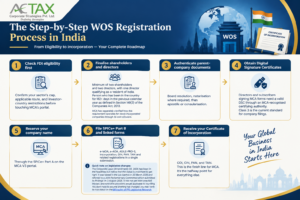
The Step-by-Step WOS Registration Process in India
Step 1: Check FDI eligibility first
Confirm your sector’s cap, applicable route, and investor-country restrictions before touching MCA’s portal.
Step 2: Finalise shareholders and directors
Minimum of two shareholders and two directors, with one director qualifying as a resident of India. Person who has been in the country for 182+ days in the previous calendar year as defined in Section 149(3) of the Companies Act, 2013. MCA has separately clarified how this requirement operates for newly incorporated companies through its own circulars.
Step 3: Authenticate parent-company documents
Board resolution, notarisation where required, then apostille or consularisation.
Step 4: Obtain Digital Signature Certificates
Directors and subscribers signing MCA forms need a valid DSC through an MCA-recognised certifying authority. Class 3 is the current standard for company filings.
Step 5: Reserve your company name
Through the SPICe+ Part A on the MCA V3 portal.
Step 6: File SPICe+ Part B and linked forms
e-MOA, e-AOA, AGILE-PRO-S, incorporation, DIN, PAN, TAN and related registrations in a single submission.
Quick note on legislative changes: The Corporate Laws (Amendment) Bill, 2026 has been in the headlines but notice that the status is important to get right. It was tabled in the Lok Sabha on 23 March 2026 and referred to a Joint Parliamentary Committee which submitted its findings on 3 August 2026. It has not yet been enacted into law, and none of its provisions are yet applicable to your filing. You don’t have to assume anything has changed; you may verify its true status on the bill tracker of PRS Legislative Research.
Step 7: Receive your Certificate of Incorporation
COI, CIN, PAN, and TAN. This is the finish line for MCA. It’s the halfway point for everything else.
What Happens After Incorporation?
Open the Indian bank account, then route the foreign investment through an authorised dealer (AD) bank. Under the FEMA Non-Debt Instruments framework, shares must be allotted to the foreign parent within 60 days of receiving the funds. If you miss it, the money has to be refunded within 15 days.
File Form FC-GPR within 30 days of the allotment date, not from when the money arrived, through RBI’s own FIRMS portal. If you’re late, RBI’s Late Submission Fee framework (established by A.P. (DIR Series) Circular No. 16, and updated periodically since) applies: ₹7,500 plus 0.025% of the investment amount per year of delay, capped at the amount involved.
Beyond three years, or for more serious violations, it can shift to compounding proceedings under FEMA Section 15, with a statutory ceiling of three times the contravention amount. These are separate mechanisms: late filing gets the LSF route; deliberate or repeated non-compliance is where compounding or enforcement comes in.
You’ll also need an annual FLA return with RBI, due 15 July every year you hold foreign investment, and possibly FC-TRS later if shares get transferred.
Expert Insight (Vivek Bhat, Actax India):
Across the foreign-entity setups we’ve supported, the single biggest predictor of a smooth first FC-GPR filing isn’t the incorporation speed. It’s whether the client started their AD bank relationship and share valuation process during incorporation, rather than after receiving the COI. Companies that treat banking as a “step 8” instead of something running in parallel from week one are almost always the ones scrambling near the 30-day FC-GPR deadline.
A Framework Nobody Else Is Giving You: The 4-Stage WOS Readiness Model
In practice, a foreign parent is really managing four overlapping readiness stages at once, and knowing which stage you’re stuck in tells you exactly who to call.
Stage 1: Eligibility. Can your parent legally hold the proposed shareholding in this sector, under this route? This is a DPIIT question, not an MCA one.
Stage 2: Incorporation readiness. Are your directors, shareholders, registered office, and authenticated foreign documents actually ready to file? This is where apostille delays live.
Stage 3: Capitalisation. Is your banking, remittance, and share allotment sequence coordinated so the 60-day allotment window doesn’t slip? This is where AD bank coordination matters more than MCA speed.
Stage 4: Compliance activation. FC-GPR, FLA, GST, transfer pricing, and your ongoing statutory calendar. This is where the company stops being a registration project and starts being a functioning entity.
Most delays we see aren’t incorporation delays at all. They’re Stage 2 or Stage 3 problems disguised as Stage 1 confusion. Knowing which stage you’re actually stuck in saves weeks.
What Are The Other Registrations You Might Also Need?
Depending on business activity and state:
- GST
- Shops and Establishments
- Professional Tax
- EPFO
- ESIC
- IEC for cross-border trade
- Mandatory RBI FIRMS registration (Form FC-GPR) for foreign capital inflow.
Wholly Owned Subsidiary Registration in India Cost: The Real Fees
Wholly Owned Subsidiary Registration in India fees are somewhere between ₹92,000 and ₹3,24,000 (roughly $1,105–$3,890) for the initial setup. Here’s what actually makes up that number:
|
Cost Component |
What Determines It |
Estimated Cost (INR) |
Estimated Cost (USD) |
|
MCA Government Fees |
Scale of your authorized share capital |
₹2,000 – ₹15,000 |
$25 – $180 |
|
Stamp Duty |
State-specific rules (Delhi/Haryana run cheaper; Punjab/Kerala run higher) |
₹2,000 – ₹20,000 |
$25 – $240 |
|
Digital Signatures (DSC) |
Per applicant — usually 2–3 directors/subscribers |
₹3,000 – ₹9,000 |
$35 – $110 |
|
Apostille / Consularisation |
Country of origin + page count of parent-entity documents |
₹15,000 – ₹60,000 |
$180 – $720 |
|
Professional / Advisory Fees |
Provider you choose + complexity of your corporate structure |
₹40,000 – ₹1,25,000 |
$480 – $1,500 |
|
Registered Office Setup |
Physical rent, co-working, or virtual office |
₹15,000 – ₹60,000 (annual for virtual) |
$180 – $720 |
|
Foreign FDI Compliance |
Mandatory RBI Entity Master + Form FC-GPR filing |
₹15,000 – ₹35,000 |
$180 – $420 |
|
Total Initial Estimate |
All core components combined |
₹92,000 – ₹3,24,000 |
$1,105 – $3,890 |
Author’s note: We’ve seen too many founders get quoted a “cheap” number that quietly excludes RBI/FDI compliance, then get hit with a surprise bill mid-process. Ask for the full picture upfront, not just the MCA piece.
As an illustrative professional-service estimate, not a statutory figure, foreign-promoted subsidiaries we’ve supported typically land between ₹3-4 lakh in year one. Treat any fixed number you see online, including ours, as a planning range, not a quote.
What is The Timeline to Register a Subsidiary Company in India?
The timeline to register a subsidiary company in India typically runs 15 to 25 working days once documents are fully apostilled, but that range assumes the paperwork is ready.
The actual bottleneck is almost never MCA’s processing; it’s foreign document authentication abroad, which can add two to five extra weeks depending on the country’s own apostille office. Start that process the day you decide to incorporate.
The Common Mistakes Foreign Companies Make
- Checking FDI eligibility only after incorporation.
- Incorrectly apostilled or notarised documents.
- Forgetting the resident director requirement.
- Treating the COI as the finish line.
- Did not meet the 30-day FC-GPR threshold.
- Sending money without the banking and FEMA formalities.
- Not include transfer pricing on intercompany transactions.
- Assuming GST registration is automatic.
Conclusion
Wholly owned subsidiary registration in India is done on two parallel tracks: MCA incorporation and FEMA/RBI compliance. Get your FDI classification right before filing, start document authentication immediately, and treat the Certificate of Incorporation as the midpoint, not the finish line.
If you’d rather have someone track both tracks alongside you instead of discovering the FC-GPR deadline the hard way, our company registration team at Actax India coordinates the MCA and FEMA sides together for foreign parent clients.
Disclaimer: This article is for general informational purposes only. Please verify current requirements on the official MCA, RBI, and DPIIT websites, or speak with a qualified advisor, before making any incorporation or investment decision.