Form STK 2 for Winding Up Companies in India: Process, Documents, and Cost
You started the company with a plan. Then things changed. Maybe the business never took off, the co-founder walked, or you just moved on. Either way, the company is still sitting on paper doing nothing, and the ROC isn’t letting you forget it.
Most founders don’t realise there’s a clean government process to close it without going near a court. It’s called a voluntary strike-off, and can be achieved by filing MCA Form STK 2 for the company closure process.
At Actax, we’ve helped founders through this, and it’s more manageable than most expect. Here’s the complete guide for founders wishing to close their company voluntarily in India.
What Is Form STK 2 by MCA in India?
Form STK 2 is a legal document that must be filed with the Ministry of Corporate Affairs (MCA) under Section 248(2) of the Companies Act 2013. Private limited companies, OPCs, and unlisted public companies can use it to request the removal of their company names from the Registrar of Companies (ROC) voluntarily, if they have been genuinely inactive.
You’re eligible to file form STK 2 if the company was never operational or has been inactive for two or more consecutive financial years, has zero assets and liabilities, no dues or litigation, and all bank accounts are closed.
Here is what life looks like after a successful strike off:
- No more annual return filings with the RoC
- No more compliance deadlines to stress about
- No more fees or penalties building up
- The company is legally closed, for good.
Also, you must know that the dormant status under Section 455 and the inactive status are legally distinct. STK-2 is still available if you never filed for dormant status, but the conditions differ.
The 3-Month Rule Nobody Talks About: Caution Before Filing Form STK-2
Before filing, look back at the last 3 months. Under the Companies (Removal of Names) Rules 2016, the application is rejected if, during that window, the company changed its name, shifted its registered office, disposed of assets outside its normal business, acted beyond its MOA, or approached a Tribunal.
At Actax India, our advisors audit those 90 days first. Founders forget about old transactions, and it brings the entire application to a halt. This might harm the Form STK-2 filing process & chances are more to get disapproved for the company closure.
Eligibility Criteria for Form STK 2: Who Can Apply for Voluntary Strike Off?
Fees for Form STK-2 are ₹10,000, & it is a non-refundable amount. If the application gets rejected, you will lose the ₹10,000 paid to MCA, which can be an expensive mistake you might do.
- All pending financial statements and annual returns must be filed up to the date of the company closure. Meaning, there must be no due filings under the company name with MCA & ROC.
- A board resolution must specify the reason for strike-off, the cessation date, and the authorised director. Generic resolutions get questioned by the Center for Processing Accelerated Company Exit (C-PACE)
- There must be a written consent from shareholders covering 75% of the paid-up share value.
- You must complete GST, income tax, PF, and ESI, including nil returns.
- Every bank account must be fully closed with a written closure certificate showing the account number, date, and zero balance.
- Every director’s DIN needs to be active, and DIR-3 KYC cannot be pending on the MCA portal.
Documents Required for Form STK 2: Complete Checklist for Company Winding Up
- Form STK-3: All directors must put their signatures on the indemnity bond, printed on non-judicial stamp paper. In case of an NRI Director, NRI or foreign national directors need it apostilled; notarization won’t work
- Form STK-4: Each director should sign this separately, confirming that the company has no liabilities due.
- Statement of Accounts: CA shall sign off within 30 days of filing, and figures must show the position as on the cessation date, not the current date of application. Most CAs get this wrong the first time, hence cross-verify with your CA prior.
- Special Resolution or written consent for company closure from atleast 75% of members.
- Bank Closure Certificate confirming the account is shut.
- Board Resolution authorising a director to file Form STK-2 for company closure.
- Indemnity Bond: It is basically a written declaration that the company has no pending liabilities.
- Affidavit: Each director writes their own affidavit, confirming that the company did no business in the last two years and owes nothing to anyone.
- Company PAN Card: A copy is required as part of the application
- GST Cancellation Certificate: Required if the company was GST-registered
- FEMA Compliance Undertaking: Required only if the company has ever received foreign investment.
Actax India helps companies prepare every document correctly and ensures nothing is missing before the filing goes to the RoC.
The directors must declare in the form that they have obtained 75% of the members’ consent. Our team at Actax prepares every document with this liability in mind, because an incorrect declaration can expose directors even after dissolution.
Step-by-Step Process of Filing Form STK-2 with MCA for Company Closure
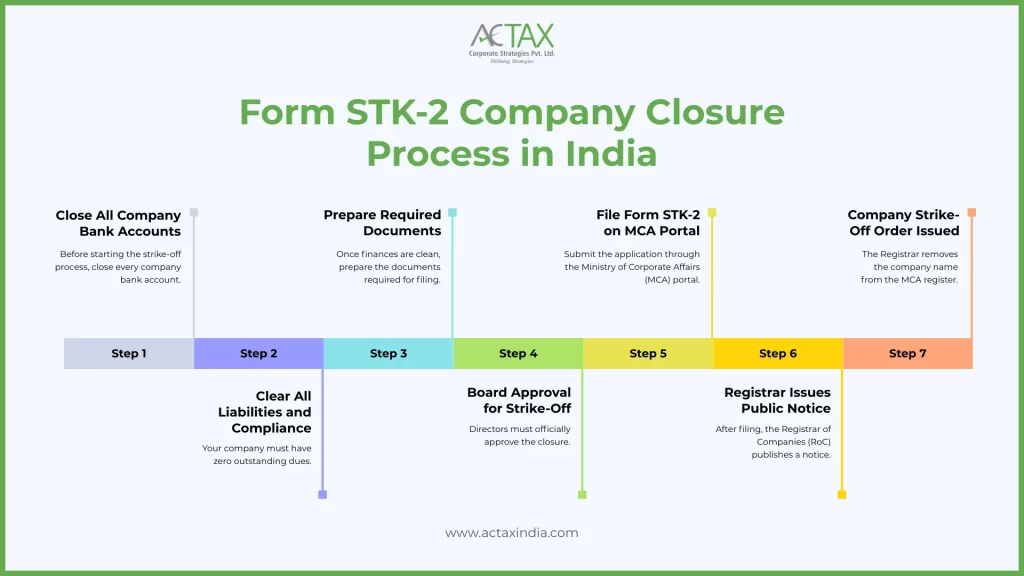
- Conduct Board Meeting: The board resolution needs three things mandatorily –
- The reason for the closure,
- The date the company stopped, and
- The names of the authorised directors. Anything vague gets picked up by C-PACE & might cause a delay in the closure process.
- Get All Members’ Consent: Written consent has to cover 75% of the paid-up share value. Not the number of members who signed, but the value they hold
- Close Bank Accounts: The bank closure certificate has to show three things: account number, the date it was closed, and a confirmation that the balance was zero
- Prepare Accounts: CA certifies within 30 days of the filing date, and numbers must show where the company stood on the day it stopped, not today.
- MCA Portal: Log in to mca.gov.in, go to e-Filing, and upload everything. One thing worth checking before hitting submit is the authorised director’s DSC. If it has lapsed, the portal blocks the form right there
- Pay ₹10,000: Goes at submission and doesn’t come back, even if the application is rejected.
- C-PACE Review: Since May 2023, STK-2 applications no longer go to the ROC — they go to C-PACE. One number off between the affidavit and the statement of accounts, and the whole thing gets rejected. No chance to fix it, no query raised. Files that are in order are cleared within two months.
- Gazette Publication: Thirty days, name on the gazette. Anyone — a creditor, a tax officer, a third party with a pending claim — can step in and stop the process cold.
- Dissolution: Those 30 days pass with no objection, and that’s it. The gazette entry is the only record directors will have that the company is no longer in existence. Nothing else gets issued.
- Conduct Board Meeting: The board resolution needs three things mandatorily –
Form STK 2 Government Fee and Total Cost of Company Strike Off in India
The government fee of Rs. 10,000 is paid on the MCA portal at the time of filing. Same amount for every company, every state.
Professional charges can vary based on Your Situation:
- CA fee for statement of accounts: Rs. 2,000 to Rs. 5,000
- Notarization of bond and affidavits: Rs. 1,000 to Rs. 3,000
- CA or CS certification of the form: Rs. 2,000 to Rs. 7,000
- Clearing pending GST or tax filings: varies.
Total expected cost is Rs. 15,000 to Rs. 30,000. Compare this to the annual compliance costs of keeping a dead company alive, and the strike-off pays for itself in year one. Actax India handles the full process at a transparent fixed price with no surprise charges.
Can a Struck-Off Company Be Restored? Risks Directors Must Know Before Filing
Once your company is struck off, the closure is permanent. Here is what every director needs to know before filing. Can a struck-off company be restored?
- Yes, but directors must apply to the NCLT within 20 years.
- It is a full legal proceeding that costs time and money.
- It is not a quick fix and should never be a backup plan.
What risks do directors face after being struck off?
- Any liability after closure, such as an outstanding tax notice or a GST demand, makes directors personally responsible.
- Clearing dues in Step 2 and getting documents right in Step 3 is your protection long after the company is gone.
If you are not sure whether Form STK 2 is the right path, consider taking help from Actax India advisors to review your situation before you take any step.
To summarize, is Form STK 2 the right choice for closing your company?
Closing a company isn’t giving up. It’s a practical move to save money and energy. Form STK 2 is straightforward if you follow the correct order, provide the required documents, and have no dues pending.
The real mistake most people make is either waiting too long and letting the RoC act first, or rushing in without checking eligibility. Both cost more than doing it right from the start.
Clear the dues, close the accounts, get the documents ready, and file. Once it is done, it is done for good. And if any part feels confusing, Actax India is there to handle everything from the first document to the final strike-off order.