What Should You Do in the First 30 Days of Post-Incorporation Compliance in Bangalore?
This window sets the foundation for everything that follows. Miss it, and every later filing gets harder, since most of them depend on something from this phase being done correctly first.
- Open a current account in the company’s name and deposit the subscribed share capital. This has to happen before you can file INC-20A.
- Hold your first board meeting within 30 days of incorporation, as required under Section 173 of the Companies Act, 2013. This is where you formally appoint your first auditor.
- Appoint your first auditor and file Form ADT-1 with the RoC.
- Register for Karnataka Professional Tax, within 30 days of incorporation, even if you haven’t hired anyone yet. This applies to the entity itself, separate from any registration you’ll later need for employees.
- Set up your statutory registers: register of members, register of directors, and register of charges
What Should You Do Between Day 30 and Day 60?
By now, the bank account is active, and capital is in. This phase is about registrations that depend on where and how you’ll operate.
- GST registration, if you anticipate turnover to exceed ?40 lakhs in case of goods or ?20 lakhs in case of services. A large number of businesses opt to register earlier than required, considering that many customers expect a GSTIN on their invoices.
- Shop and Establishment Registration is compulsory in Karnataka within 30 days from the date of starting operations irrespective of the size of the business entity.
- Share Certificates must be issued to all the shareholders within 60 days after incorporation as per Section 56.
- A BBMP trade license, but only if what you’re doing falls under Schedule X of the Karnataka Municipal Corporations Act.
What Should You Do Between Day 60 and Day 90?
This is where the most consequential filing on this entire list sits. Everything before Day 60 was about setting the company up correctly. This phase is about earning the legal right to actually operate.
- File Form INC-20A, the Declaration for Commencement of Business. The legal deadline is 180 days, but file it the moment your capital is deposited and verified. Waiting serves no purpose and adds risk, since delays beyond 180 days require compounding or additional penalty payments.
- Apply for Udyam (MSME) registration, optional, but it genuinely speeds up loan approvals and opens the door to government tenders.
- Apply for DPIIT Startup India recognition, if you’re eligible, since it unlocks tax benefits under Section 80-IAC.
- Take a look at your compliance calendar for the rest of the year. There’s DPT-3 due by 30 June, DIR-3 KYC by 30 September, and AOC-4 plus MGT-7 once you’ve held your first AGM (Annual General Meeting).

Expert insight: Section 10A of the Companies Act makes the bar on commencing business absolute, not a formality. Until INC-20A is filed and acknowledged, a company can’t legally invoice clients, sign revenue contracts, borrow money, or open a credit line.
And non-compliance isn’t cheap: ?50,000 for the company, plus ?1,000 a day for every defaulting director, up to ?1,00,000. Usually it’s the founders who assumed the certificate alone meant they were open for business who get caught out here.
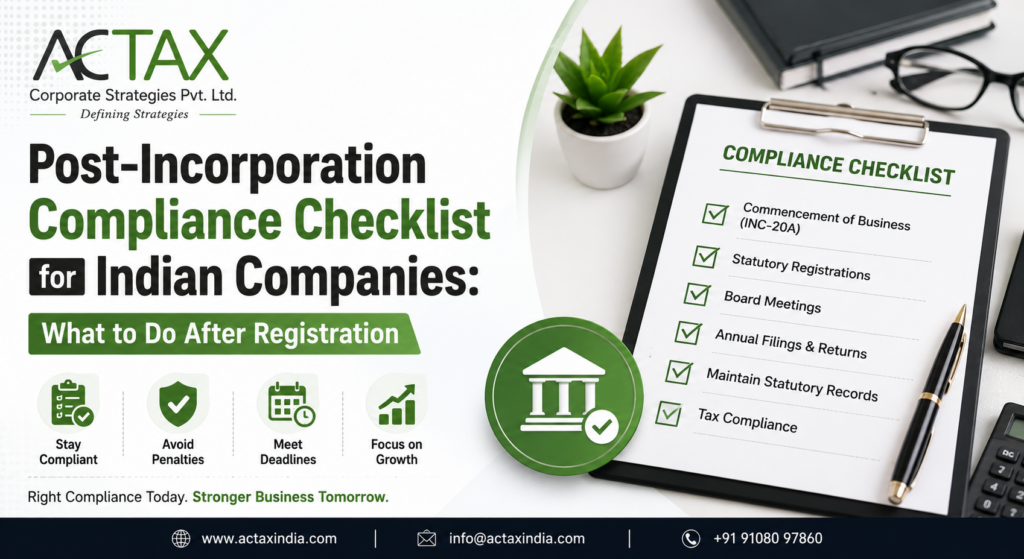
30-60-90 Day Post Incorporation Compliance Checklist for Bangalore Companies
| Timeline | Key actions |
| Day 1 to 30 | Open bank account, deposit capital, first board meeting, appoint auditor (ADT-1), Karnataka Professional Tax registration |
| Day 30 to 60 | GST registration (if applicable), Shops & Establishment registration, share certificates, BBMP trade license (if applicable) |
| Day 60 to 90 | File INC-20A, consider Udyam and Startup India registration, plan the annual compliance calendar |
What Documents Should You Keep Ready for These Filings?
Most delays in the first 90 days come down to missing paperwork. Keep these ready from day one so no filing stalls waiting on a document:
- Certificate of Incorporation, MOA, and AOA issued by the RoC
- PAN and TAN, usually allotted automatically with incorporation, but confirm both are downloaded and linked to your bank account
- Digital Signature Certificates (DSC) for all directors, valid and unexpired
- Registered office proof, a utility bill no older than two months, plus a rental agreement or NOC if the space isn’t owned
- Bank account details and capital deposit proof, needed for INC-20A
- Board resolutions for each major action: auditor appointment, bank account opening, share allotment
Having these organised before day 1 turns most of this checklist into paperwork you file, not paperwork you chase.
What Should Bangalore Companies Know About Local Registrations?
RoC Karnataka rules are the same as the rest of India. A few registrations sit entirely outside that framework and depend on the city you’re operating in.
- BBMP trade license: This is one of the most misunderstood aspects of post-incorporation compliance for businesses operating within BBMP limits in Bangalore. Under Schedule X of the Karnataka Municipal Corporations Act, 1976, a trade license is mandatory for specific categories: food and beverage businesses, manufacturing units, hazardous trades, and godowns, among others.
A pure software or services company operating from commercial hubs like Whitefield, Koramangala, Electronic City, or HSR Layout, with no walk-in customers, no food handling, and no manufacturing, often doesn’t fall under a listed category. Many compliance vendors sell it to every new company regardless. Check your specific trade category against Schedule X before paying for one you don’t need.
- Shops & Establishment certificate: This registration is an important part of company compliance in India for businesses operating in Karnataka. Unlike the trade license, this one applies broadly. Nearly every commercial establishment operating in Karnataka needs it within 30 days of starting business, office-based or otherwise.
- RoC processing speed: RoC Karnataka, based at Kendriya Sadan in Koramangala, has a reputation for processing incorporation and compliance filings faster than several other metro ROCs, which shortens the practical timeline for founders moving through this checklist.
Expert insight: Karnataka’s Professional Tax and Shops & Establishment requirements apply from the date of incorporation or commencement, not from the date you hire your first employee. We’ve seen founders assume these can wait until there’s a team to manage. Both registrations are entity-level obligations, and both accrue late fees the longer they’re ignored, independent of headcount.
Actax India helps founders complete post-incorporation compliance in Bangalore, including first board meeting documentation, GST/PT registration, INC-20A filing, BBMP trade licence guidance, and ongoing company compliance in India.
Do You Need an Import Export Code (IEC)?
If you invoice international clients, even for software or consulting services, this question comes up early. Officially, IEC is not mandatory for pure service exports unless you’re claiming benefits under the Foreign Trade Policy. In practice, most Bangalore SaaS and IT services companies apply for one anyway. Banks routinely ask for it to process foreign currency receipts, and it supports GST zero-rating on export invoices through a Letter of Undertaking.
IEC registration itself is simple: a flat government fee of ?500, same-day issuance in most cases, and lifetime validity once granted.
Expert insight: The lifetime validity has a catch most founders miss. IEC details must be updated annually by 30 June, even if nothing has changed. Skip that update, and DGFT deactivates the code. That can block an international payment at the worst possible moment, usually right when a client is trying to pay an invoice.
Actax India Perspective
Most companies we see fall behind on compliance in the first 90 days, not the first year. It’s rarely one big mistake. It’s a founder assuming the incorporation certificate was the finish line, then discovering six months later that INC-20A was never filed, or that Professional Tax has been accumulating late fees since day one, quietly, without any single event forcing the issue.
The founders who stay ahead of this treat the first 90 days as a fixed project with a checklist, not an ongoing background task. They assign someone, internal or external, to own it, and they check it off deliberately rather than assuming it’s handled because the company technically exists on paper.
Conclusion
Incorporation gets you a legal entity. It doesn’t get you a functioning, compliant business. The first 90 days carry more deadlines than any other stretch in a company’s life, and most of them are one-time filings that are simple to do on schedule and expensive to fix late.
Treat this post-incorporation compliance checklist as your actual starting point in Bangalore, not the paperwork you filed to get here. From the first board meeting and GST/PT registration to INC-20A and Karnataka-specific registrations, every compliance completed on time reduces legal risk.
Ready to get this handled properly? Talk to an Actax India compliance expert and get your first 90 days mapped out before the deadlines start piling up.