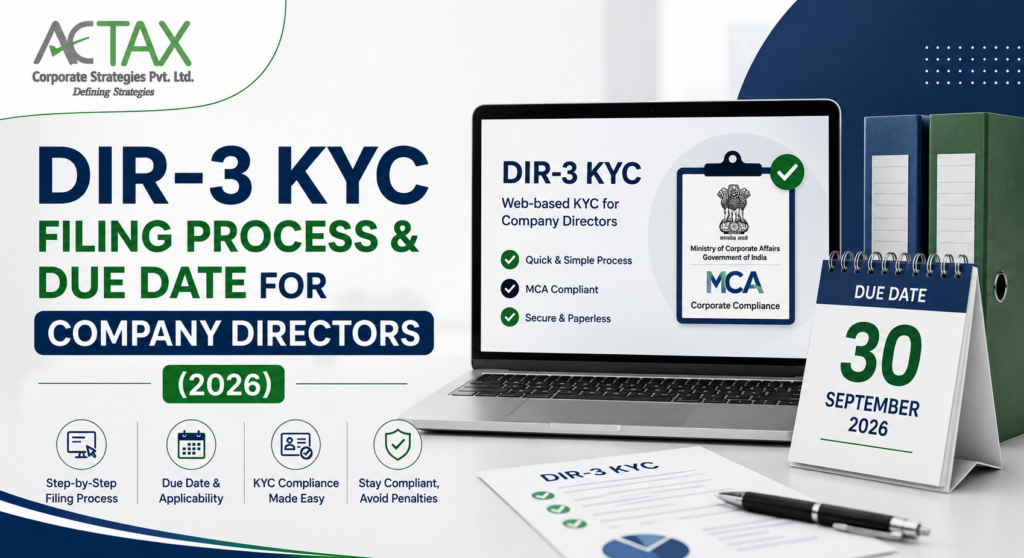
What Is DIR-3 KYC?
Every director in India gets a unique ID called a DIN, short for Director Identification Number. Think of it like a PAN card, but for directors specifically.
DIR-3 KYC is the form you file to prove that the DIN belongs to you and that your details, such as mobile number, email, address, and PAN, are correct and current. It’s a “Know Your Customer” check, done by the Ministry of Corporate Affairs (MCA).
If you don’t file it on time, your DIN gets deactivated. And a deactivated DIN – You can’t legally act as a director until it’s fixed
How Did the DIR-3 KYC Filing Process Work Before 2026?
For several years, this is how it worked:
- You filed DIR-3 KYC every single financial year
- The deadline was 30 September
- There were two versions of the form: a full e-Form and a simpler Web-based one, and which one applied to you came down to whether anything in your details had actually changed since the last filing.
- Missing the deadline meant a Rs. 5,000 penalty to reactivate your DIN
This annual routine is still what most people associate with DIR-3 KYC. That’s exactly why the 2026 change matters.
What Changed in 2026
The MCA introduced new rules: The Companies (Appointment and Qualification of Directors) Amendment Rules, 2025, effective 31 March 2026.
| Old Rule (before 2026) | New Rule (from 31 March 2026) | |
| How often you file | Every year | Once every 3 years |
| Deadline | 30 September | 30 June |
| Forms | Two separate forms | One combined form |
| Changing mobile/email/address | No fixed deadline | Must update within 30 days |
If nothing about you has changed, you don’t need to file every year anymore. You file once every three years instead.
The New Form: DIR-3 KYC Web
Earlier, there were two forms, and picking the right one confused a lot of first-time filers. That confusion is gone now.
As of 2026, they’ve dropped it down to just one form, DIR-3 KYC Web. Pick why you’re filing, right inside it:
- Regular 3-year KYC check (no changes)
- Updating your mobile number or email
- Updating your address
- Reactivating a deactivated DIN
Two Different Timelines And Don’t Mix Them Up
This is the part beginners find most confusing. Two clocks run here, and they’re not the same thing.
- First, the 3-year KYC filing – due every three years, by 30 June.
- Second, a 30-day clock that only starts if you change your mobile number, email, or address – once that happens, you’ve got 30 days to file the update.
Important: Filing an update does not reset your 3-year clock. They run independently. So even if you updated your email last month, your main KYC filing is still due whenever it was originally due.
Who Needs to File DIR-3 KYC?
Anyone who holds a DIN as of 31 March of the year, whether or not they’re currently an active director.
- Directors of private companies, public companies, and OPCs
- Even directors who’ve resigned but still hold a DIN
- Designated Partners of LLPs
- Foreign nationals with an Indian DIN
- Anyone who was ever allotted a DIN, even if they never actually became a director
There’s no exemption just because you’re not currently using your DIN. If it exists, you’re expected to keep it verified.
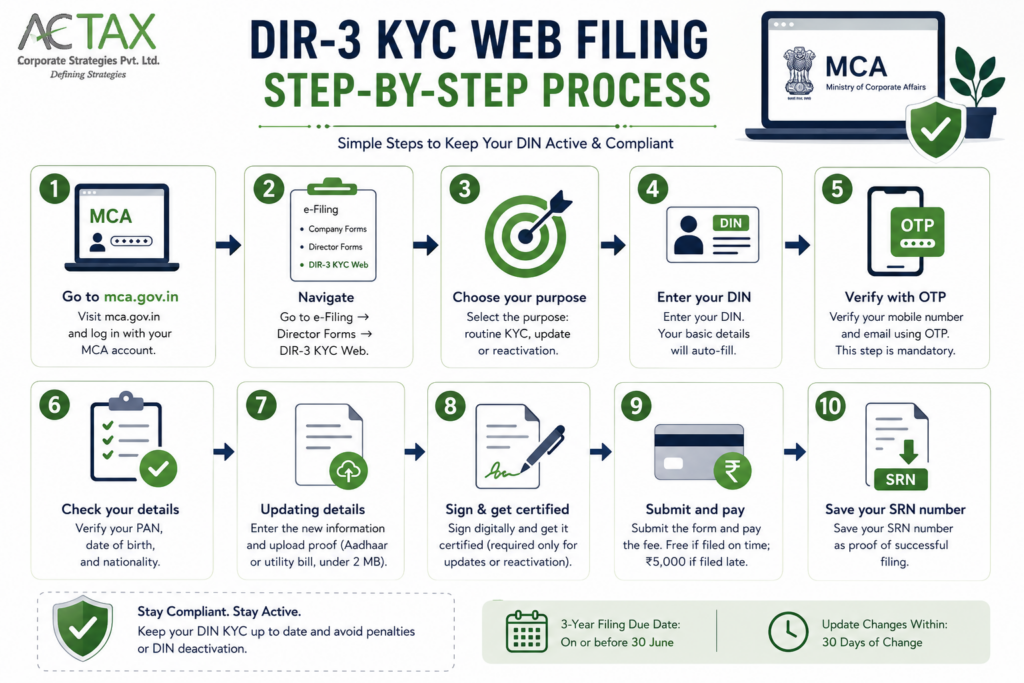
How to File DIR-3 KYC Web: Step-by-Step Process
Here’s the process in simple steps:
- Go to mca.gov.in and log in with your MCA account
- Navigate to e-Filing – Director Forms. DIR-3 KYC Web
- Choose your purpose: routine KYC, an update, or reactivation
- Enter your DIN: your basic details will auto-fill
- Verify your mobile number and email using OTP. This step is required no matter why you’re filing
- Check your PAN, date of birth, and nationality
- Updating details: enter the new info and upload proof (Aadhaar or utility bill, under 2 MB).
- Sign digitally and get it certified, but only if you’re updating details or reactivating your DIN
- Submit and pay. Free if filed on time; Rs 5,000 if late
- Save your SRN number as proof you filed
When Is a Digital Signature Required in the DIR-3 KYC Filing Process?
A quick heads-up before you file: digital signature requirements aren’t the same for everyone. First-timers usually miss this.
| Situation | Digital Signature Needed | CA/CS/CMA Certification Needed |
| Routine KYC, nothing changed | No | No |
| Updating mobile/email/address | Yes | Yes |
| Reactivating a deactivated DIN | Yes | Yes |
If nothing has changed, an OTP on your phone and email is all you need.
DIR-3 KYC Fees: How Much Does the Filing Process Cost?
Here’s what filing actually costs, depending on when you file and why.
| Situation | Fee |
| Filed on time (by 30 June) | Free |
| Filed late | Rs 5,000 |
| Update within 30 days | Small prescribed fee |
| Update after 30 days | Higher fee |
| Reactivating a deactivated DIN | Rs 5,000 |
What Happens If You Don’t File on Time?
Skipping the deadline isn’t a small mistake. Here’s what follows:
- Your DIN gets deactivated automatically
- You can’t legally act as a director anywhere until it’s fixed
- Any company filing that needs your DIN, such as annual returns and resolutions, gets rejected
- You can’t be appointed as a director in a new company either
- Reactivating it means paying Rs 5,000 and refiling with digital signature and certification
If you’re one of two directors in a small private company, your deactivated DIN can stall the entire company’s compliance, not just your own.
Do You Need to Complete the DIR-3 KYC Filing Process If You No Longer Use Your DIN?
DIR-3 KYC isn’t optional just because you’re not actively using your DIN.
If you resigned as a director years ago, or got a DIN for a company that never took off, that DIN doesn’t disappear on its own. It stays in the MCA system, and you’re still expected to file DIR-3 KYC for it forever, once every three years unless you surrender your DIN using Form DIR-5.
Once approved, the DIN is permanently cancelled, and your KYC obligation ends with it. This makes sense if:
- You were a director for a company that’s now closed or struck off
- You obtained a DIN but never actually joined any board
- You have no intention of being appointed as a director again
If none of that applies(if there’s even a small chance you’ll take up a directorship again), it’s usually not worth surrendering. Getting a new DIN later takes longer than just staying compliant on an existing one.
Why Choose Professional DIR-3 KYC Support?
DIR-3 KYC seems simple but manually fixing wrong filing purpose, missing the 30 days update deadline or providing incorrect detail can hold your DIN deactivated and quoted amounts of penalties.
The whole process right from KYC checks, filing timelines to updating details and reactivating a deactivated DIN can be managed seamlessly with Actax India.
Conclusion
We think this change is genuinely good for directors, i.e., less repetitive paperwork, same level of checks. But it also creates a new risk: forgetting. An annual habit is easy to remember. A three-year gap isn’t.
No filing due this year? Still worth two minutes on the MCA portal to check your mobile number, email, and address are up to date. Costs nothing, and you won’t get caught out missing that 30-day update window later.
If you’re unsure which year you’re due to file, or need a hand with an update or reactivation, Actax India can help.