Across India, around the time of each GST filing, finance departments spend a great deal of effort correcting discrepancies in GST compliance paperwork. Manual filing and accounting processes have always been the standard practice but have become much harder to sustain with growing volumes of transactions and stricter compliance requirements.
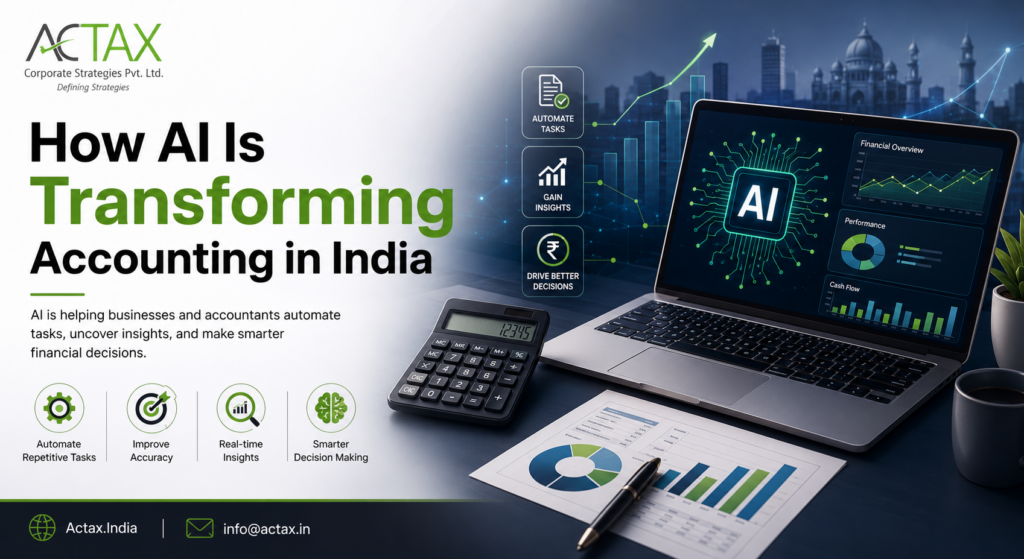
AI in accounting is helping businesses carry out mundane tasks, minimize reconciliation mistakes, and free up more time for accountants to engage in strategizing rather than entering data.
Many businesses are doing accounting the old way. From work to human mistakes to late compliance to high accounting fees, accounting is a problem for many business owners.
That is changing now.
-
- A strong statistic provided by reliable sources (ICAI, Gartner, Deloitte, PwC, EY, etc.)
-
- A stronger hook emphasizing on the effect of AI on the accounting world.
As per industry statistics, accountants are known to invest about 40–60% of their productive hours in menial tasks like data entry of invoices, reconciliations, GST compliance, and preparing reports. AI in accounting is not taking the place of accountants through automation of mundane tasks, but instead, letting the accounting professionals focus on their main job of assisting businesses in their financial decisions.
It is not just the trend of artificial intelligence that is motivating so many entrepreneurs to use this technology in their workplaces; the growing difficulties involved in manual accounting are forcing many to take the plunge. An increase in the number of transactions, updates to GST, deadlines for compliance becoming stricter, as well as increasing demands from customers lead to the need for finance departments to implement quicker and more precise procedures.
At the end of this guide, you will learn:
-
- how AI in accounting functions
-
- the application of AI by Indian companies
-
- what tasks in accounting have to be done by humans
-
- what mistakes are common in the implementation of AI
-
- how businesses can adapt to the use of AI
-
- Developed around practical accounting processes
-
- Discusses both pros and cons
-
- Concentrating on the Indian companies
What Is AI in Accounting?
The rise of AI in the finance sector does not mean that robots will replace all your employees. The modern-day application of AI to the accounting function uses three technologies.
Machine learning is an accounting application that learns from historical data and uses that learning to classify and categorise expenses.
Optical character recognition is used to scan a paper bill or invoice. They are also used to extract specific information, such as disbursement amounts, GST numbers, and transaction dates.
Natural language processing will extract the meaning from written text in documents and transactions, such as bank statements and tax forms, by classifying and categorising it.
Understanding AI’s Functioning in Accountancy
To understand AI in accountancy, let’s see its real-life functioning.
If we assume that a vendor sends an invoice by mail, then AI will use OCR to identify details from the document rather than human operators entering the values. As a result, AI will log the data into the accounting software and compare the invoice with the purchase orders, trace any discrepancies, and prepare the information for GST functioning.
When AI performs all operational work, it allows the accountants to focus on what is more important and strategic rather than performing boring and manual tasks.
-
- Artificial intelligence enhances accounting processes but does not come in place of human understanding.
-
- The human factor in tax planning, compliance, and advisory is still indispensable.
Traditional Accounting vs AI-Powered Accounting
Digital accounting methods are replacing traditional slow, manual accounting processes. Using the automated process for data entry, reconciliation, and reporting is now helping companies achieve greater efficiency and accuracy.
| Feature | Traditional Accounting | AI Accounting |
| Data Entry | The manual method is often prone to errors. | Automated via OCR and integrations. |
| GST Reconciliation | Takes hours every month and is done manually. | Take a few minutes, auto-matched in real time. |
| Bank Reconciliation | Cross-checked manually. | Automated. |
| Invoice Processing | Each invoice is handled individually. | Batch-processed in seconds. |
| Error Detection | Caught during review. | Caught in real time before filing. |
| Financial Reports | Prepared manually, time-consuming. | Generated automatically on demand. |
| Cost to Business | Higher. | Lower over time. |
| Decision Making | Based on reports generated in the past. | Predictive analysis using past data. |
| Compliance Alerts | Via manual reminders. | Via real-time alerts. |
The shift from accounting to smart automated accounting systems is not just about speed. It is about accuracy.
What Biggest Difference AI Makes?
AI can bring big benefits to firms managing a lot of invoicing or a lot of banks. Those firms find higher speed of reconciliations and reporting as well as reduced manual efforts. Conversely, smaller companies start with the basic levels of automation gradually increasing it according to their growing operations.
Why is AI in Accounting Growing So Rapidly in India?
The implementation of AI in the accounting profession is developing. They have introduced AI into their accounting systems to automate repetitive tasks and provide insights into their financial position.
The growth of start-ups and MSMEs, an increase in regulatory complexity, and the establishment of digital infrastructure will continue to evolve accounting services.
1. Complexity of and burden of compliance related to GST
The GST regime imposed by the Government of India has been designed to systematically collect revenue. Its complexity creates significant administrative burdens for businesses of all sizes. Under the GST system, there are multiple return formats, e-way bills, input tax credit reconciliations, and different rules for each.
AI technology is used to analyse and compare sales and purchases. It helps in reducing total accounting and reconciliation effort.
According to an EY Study in India, companies using AI-based solutions for GST reconciliation are saving an average of 55 hours a week in accounting time.
2. Expert Opinion by Actax India
At Actax India, we support our clients with GST reconciliation. We assist them in cleaning up their financial data before implementing the AI-based GST reconciliation.
Many of the businesses have duplicate entries, incorrect GST categories, and inconsistent invoice records. Because of this, the automation proces can be slow. We help identify these main issues to improve reconciliation.
3. Growth of medium-sized businesses and Start-Ups
According to the Ministry of MSME, India has over 63 million small- and medium-sized businesses and is one of the world’s fastest-developing startup markets. Many of these new businesses, due to limited funds, require AI-powered digital accounting software.
Accounting platforms like Vyapar are helping startups. It helps with bookkeeping, invoicing, expense management, and financial reporting.
As companies grow, transaction volume climbs much more quickly than finance teams can expand. In order to avoid recruitment of additional personnel for ordinary bookkeeping tasks, numerous companies employ AI-based accountancy tools to automate repetitive tasks and enable competent accountants to engage in more rewarding work.
4. Cloud Adoption through Digital India
By establishing digital infrastructure, the Indian government provides an excellent platform for AI-based accounting solutions.
Companies using Microsoft Dynamics 365, an AI-based cloud accounting application, can eliminate geographic borders, streamline their processes and integrate with their banking and tax systems.
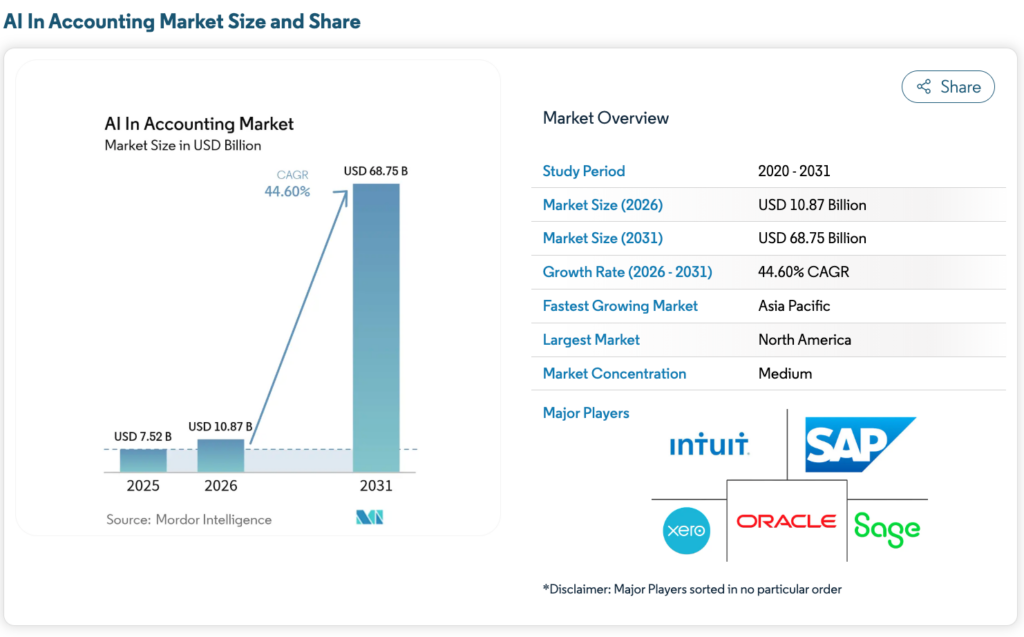
With an estimated CAGR of 44.6%, India dominates the Asia-Pacific region and is the fastest-growing country in the global AI accounting market.
The optimal performance of AI happens when accounting software operates on the cloud. The cloud software automatically gathers data related to transactions from bank sources, billing software, payroll systems, and GST portals. The continuous data flow enables the functioning of the AI to identify trends, create reports, and get insights in real-time without having to wait for manual updates.
5. Cost Reduction Pressure on Accounting Firms
The use of an AI tool helps firms automate repetitive tasks, thereby allowing consulting professionals to assist clients with decision-making.
Due to the challenges faced by accounting firms, it is hard for them to provide great service at an affordable price. Clients need things delivered quickly and accurately, with better business advice.
Zoho Books helps automate the data-entry process, creates invoices, categorises transactions, and monitors bank accounts. Many firms are utilising AI tools to automate repetitive tasks, so that the consulting professionals can assist clients in making decisions.

Key Ways AI Is Transforming Accounting in India
Swift Accounting and Data Input
AI programs will allow you to automatically read invoices for expense tracking and bank reconciliation. The tasks which used to take several days can now be completed in 15-30 minutes.
This technological advancement helps save time and improve accuracy. Tyno’s AI solution uses AI-powered OCR to extract data from invoices and expense reports. Then it posts it directly into Tally.
For Example, a wholesale company receives more than 1,000 purchase orders in a month, which may require a manual entry of invoice information for several days. Thanks to AI-powered optical character recognition, this can now be done in a few hours through automatic processing of invoice information. However, the accountants still check for exceptions, such as handwritten invoices or incomplete supplier records.
Simple GST Submission
Filing GST can be tough. But AI makes the job much easier. AI software recognises the discrepancies in invoices and groups your transactions by HSN/SAC codes. It then provides notifications when GST filings are due, ensuring they are submitted on time.
Clear Tax is also one of the most popular GST compliance platforms in India. It provides full-service annual GST return filing, GST Reconciliation services, HSN/SAC Classification Support & Compliance reminders/alerts.
Accurate Fraud Detection
AI can help detect fraud and irregularities that your business can face. It determines what your normal operations look like and sends you alerts when activity is outside your normal practices.
-
- Reduced Audit Stress
By automatically documenting and organising every transaction, AI has streamlined the auditing process. It allows for faster collection of the documentation required for an audit and the preparation of reports in a shorter period.
According to Frontiers, Artificial Intelligence-based audit assistants can review much larger volumes of transactions than conventional sampling methods would typically permit.
CaseWare AiDA is an AI-based audit platform that automates the review of documentation, the analysis of transactions, and the preparation of the audit.
At Actax, our primary focus is audit readiness. We help clients complete audits quickly and successfully and reduce the time auditors spend waiting for documentation.
AI analysis past spending patterns and flags any abnormal activity, including making the same payment to the same vendor multiple times, sudden changes in payment patterns, or unusually high spending. Though these alerts might not means that fraud has occurred, they allow accountants to identify potential issues much more quickly than they could through traditional review processes.
-
- Automated Payroll Calculation
AI is used to calculate salaries, PF, ESI, TDS, etc. It helps generate payslips and file payroll taxes on behalf of the employer’s payroll system within seconds.
Actax India’s Payroll Management Services help companies move over to AI-powered Payroll technology.
greytHR helps with payroll processing. It helps calculate PF, ESI, and TDS and generate payslips.
Case Study: How a CA Firm in Bangalore Utilised AI to Streamline GST Reconciliation
A medium-sized CA firm with 80+ clients in Bangalore is managing GST compliance. They first tried to perform the process manually, reconciling GST mismatches about three to four times a month. But manual processes led to numerous errors, resulting in clients receiving penalty notices.
To resolve this issue, the firm implemented an AI GST reconciliation process. This solution helps the firm match purchase invoices to suppliers’ GST details. It also helps them identify any mismatches by generating a report.
They realised that earlier, when they did this, it took three to four days to complete the reconciliation. But with the AI system, the reconciliation process was reduced to one day. The firm also reduced errors by almost half and served 30% more clients without increasing staff headcount.
The Future of AI in Accounting
As more businesses join the Goods and Services Tax Network (GSTN), there will be greater digital connectivity between businesses, banks and government entities. This will result in increased use of invoice automation. This process will make a shift away from manual processes.
The new Reserve Bank of India framework on Account Aggregators helps in secure connections for sharing bank data among banks and financial service providers. AI solutions will help accountants improve their productivity. It also helps in providing additional services to clients.
At Actax India, we help businesses with cloud-based accounting systems. We automate the workflows so that they cover both the GST compliance requirements and managerial reporting needs.
Conclusion
AI in Accounting helps in the increase of efficiency and accuracy. But in order for businesses to benefit from it they must have clean financial documents, good workflow and a team of professionals monitoring it.
Actax is here to help you to simplify your accounting process. They help you to grow with confidence and compliance.
Contact Actax India today to schedule a consultation.
FAQs
-
- Will AI replace accountants in India?
AI can help with accounting entries, entering data into system files, matching bank transactions to bank statements, and creating journal entries. However, AI has not been able to fully replace the Accountant. An Accountant is still needed to provide important assistance with tax planning and provide business advice and strategy.
-
- Do small businesses in India use AI accounting?
Many small businesses in India use cloud-based accounting applications that are designed for GST. These applications contain invoicing functionality, can track payroll, and automatically reconcile bank transactions. This provides a more timely and more accurate method of completing bookkeeping.
-
- Is AI Accounting Safe?
Yes, if an organisation uses AI Accounting, it has increased the accuracy of its bookkeeping records. It produces complete records and provides an audit trail, which is important for an Audit.
-
- Will AI reduce my Accounting Costs?
Yes, by automating many routine accounting processes, an organisation will save time and reduce the amount of manual bookkeeping required. This will help companies operate more productively by reducing overall accounting costs over time.