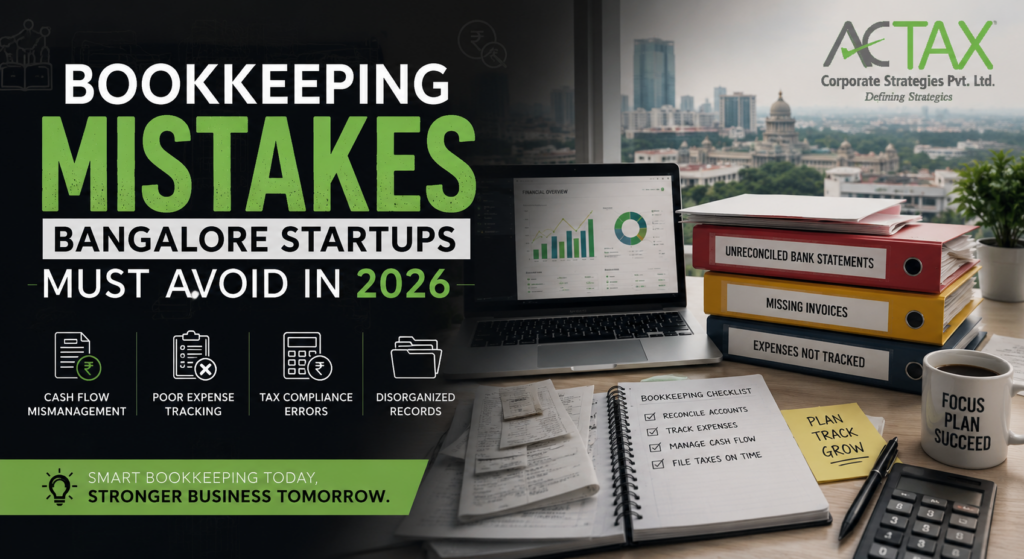
A founder I know in Bangalore once walked into an investor meeting feeling pretty confident. The product was gaining traction, customers were signing up, and things finally seemed to be clicking. Then the investor asked for the financials. That’s where the founder started panicking. Some invoices couldn’t be found, expenses hadn’t been tracked properly, and the numbers in the bank didn’t line up with the books. It wasn’t that the business was failing; it was just poor bookkeeping.
And honestly, this happens to a lot of people. A lot of bookkeeping mistakes that Bangalore startups make aren’t because founders don’t care. It’s usually because they’re busy juggling everything else: sales, hiring, product, operations, and bookkeeping quietly just slips to the bottom of their list.
But do you know the good part? Most of these mistakes aren’t even hard to fix. Only when you catch them early. In this blog, we’ll go through some of the common bookkeeping mistakes startups make, why they happen, and what you can do to keep your finances in order without overcomplicating things.
Why Accurate Bookkeeping Matters for Bangalore Startups?
Whether you’re doing it yourself or hiring bookkeeping services in Bangalore, keeping things in order makes everything else smoother. These are the reasons why bookkeeping is really important for startups:
- Helps in making judgments that are financially responsible.
- The status of being GST and tax compliant is maintained.
- It improves the control of cash flow.
- It creates confidence among the lenders and investors.
- It avoids unnecessary mistakes and penalties.
Quick Look: Typical Bookkeeping Errors and What They Lead To
| Bookkeeping Mistake | Possible Impact |
| Mixing personal and business finances | Confusing financial records and tax complications. |
| Delaying bookkeeping | Missing transactions and inaccurate reports. |
| Poor invoice tracking | Delayed collections and cash flow issues. |
| Missing bank reconciliation | Unmatched transactions and duplicate payments. |
| GST mismatch | Compliance issues and delayed tax credits. |
| Tally errors | Incorrect financial statements. |
| Poor cash flow management | Difficulty managing daily business expenses. |
Top 13 Bookkeeping Mistakes Every Bangalore Startup Must Avoid
1. Combining Personal and Business Finances
At first, it seems easier to have one account doing everything. But it causes misunderstanding over time.
Personal expenses get mixed into business records, and when it’s time for taxes or an audit, separating them becomes a headache. The fix is simple. Use a separate business account and stick to it.
2. Delaying Bookkeeping Updates
You plan to update everything at the end of the month… then it comes the end of the quarter. By then, receipts are missing, invoices are forgotten, and things don’t match.
Doing monthly bookkeeping, or even weekly, can help you keep everything manageable. It also means your reports are always ready whenever you need them.
Expert insight: In ACTAX India’s client work, the “we’ll catch up at quarter-end” pattern is the single most common reason a routine reconciliation turns into a multi-day cleanup. A month of unreconciled entries is an afternoon’s work; a quarter of them is a project. The fix isn’t more effort, it’s moving the review cadence from quarterly to monthly, which is a scheduling decision, not a skills problem.
3. Poor Expense Categorisation
Not all expenses are the same, but many startups treat them that way.
Software, marketing, travel, equipment, they all need to be recorded properly and separately. Otherwise, you won’t even really know where your money is going. Taking a bit of extra time here improves ledger accuracy and gives you clearer insights.
4. Poor Invoice Tracking and Management
Invoices are your revenue, but they’re often not handled properly.
Some are sent late. Some aren’t followed up. Vendor invoices get missed. Sometimes duplicate payments happen.
A good invoice tracking system keeps you on top of all your stuff. You know what you sent, what’s outstanding, what you paid.
2026 Update: As of FY 2026-27, e-invoicing is mandatory once a business’s aggregate annual turnover crosses Rs. 5 crore in any financial year since 2017-18, calculated on a PAN basis, and this remains applicable even if turnover later drops below the threshold. A lot of scaling startups don’t realise they’ve crossed this line until an auditor flags it. If you’re between Rs. 2-5 crore in turnover, it’s worth building e-invoicing-ready habits now rather than scrambling later.
5. Missing Bank Reconciliation
Just because your balance sheet appears good doesn’t mean you’re in good shape. Bank reconciliation is the process of comparing your data to your bank statement. It helps you find missing entries, duplicate payments or mistakes. This can help you keep your books accurate once a month.
6. Ignoring GST Reconciliation
Recording GST isn’t enough, you also need to match your records against what your suppliers have filed. Under the current GST return architecture, monthly filers generally file GSTR-1 by the 11th and GSTR-3B by the 20th of the following month, while QRMP (Quarterly Return Monthly Payment) filers follow a staggered 13th/22nd/24th cycle depending on their state category. If your GSTR-2B doesn’t match what you’ve claimed as input tax credit, it can trigger ITC reversal and compliance flags later. Always verify your specific due dates on the official GST portal, since CBIC does periodically extend or revise them by notification.
Expert Insight: A lot of founders think of the new Income-tax Act and the GST return time-bar as ‘someone else’s problem, something their CA will handle. But bookkeeping is the foundation both sit on top of. If your ledgers, invoices, and reconciliations aren’t clean at the source, no amount of last-minute compliance effort at filing time will fix it.
7. Common Tally Errors That Distort Financial Records
Tally is really popular but it’s simple to get it wrong if you’re not attentive. Wrong ledger selection, multiple entries, wrong GST rates. All these things keep happening. A lot.
Another problem is not backing up data. One system crash can destroy important records.
So regular checkups, good training and backups make a tremendous difference.
8. Not Tracking Cash Flow Regularly
A lot of founders feel good when sales start going up, and it is a good sign. But there’s one thing that gets ignored: Is there actually enough cash in the bank to keep things running?
If your customers take too long to pay, you may still have trouble paying your day-to-day bills, such as rent, wages, and vendor bills.
That’s where cash flow comes in. It shows you what’s coming in, what’s going out, and whether you’re heading into a tight spot. It also helps you understand your burn rate, basically, how long your current funds will last.
9. Ignoring Supporting Documents
Every transaction needs proof. A bill, a receipt, an invoice or something.
A lot of startups just record entries and move on. Documents get saved randomly, or worse, not saved at all. And when it’s time for a GST check, audit, or investor review, suddenly everything is hard to find.
That’s when things get awkward. Even proper expenses can be questioned if you can’t show proof.
Keep digital copies, name them properly, and store them in one place. If you’re using accounting software, attach documents directly to entries.
10. Missing Statutory Compliance Deadlines
As your startup grows, compliance becomes an important part of your routine. And missing deadlines lead to penalties and so much stress.
It is not only GST. You are also tracking TDS, PF, ESIC, and ROC filings with the Ministry of Corporate Affairs depending on your structure. Under the Companies Act, 2013, private limited companies have to file Form AOC-4 (financial statements) within 30 days of your AGM and Form MGT-7 / MGT-7A (annual return) within 60 days of the AGM.
One simple thing that helps a lot is keeping a compliance calendar. Just review it once a month. It sounds basic, but it really does prevent last-minute chaos.
Expert Insight: The uncapped late cost of Rs. 100/day on AOC-4 and MGT-7 is one of the rare compliance fines in India that truly compounds with time. ACTAX India highlights this as a pain point for entrepreneurs who think that a missing ROC file is a little error that can be easily corrected. However, in six months’ time, it becomes a five-figure expense.
11. Not Reviewing Financial Reports Every Month
Some founders only look at their numbers at the end of the year. And that’s actually not a good practice.
If you check your reports monthly – your P&L, balance sheet, and cash flow. You get a much clearer picture of what’s going on.
You’ll notice things like rising costs, slowing revenue, unpaid invoices, or increasing liabilities early. And that gives you time to do something about it.
12. Relying Only on Spreadsheets
Spreadsheets are great when you’re just starting out. They’re simple and flexible.
But as your business grows, there are too many entries, too many versions, and too many chances for mistakes.
Manual entry means errors, wrong formulas, duplicates, accidental deletions. And when multiple people are updating files, that’s where mistakes happen a lot.
Accounting software automates a lot of the work. Pulling the bank data, generating invoices, creating reports, etc.
13. Waiting Too Long to Outsource Bookkeeping
A lot of founders delay outsourcing because they see it as an extra expense. But at some point, it actually saves you time and effort.
If you’re spending hours every week on bookkeeping, missing deadlines, or constantly fixing errors, that’s usually a sign. If your reports are always delayed or unclear, that’s another one.
Startups preparing for funding or scaling operations especially benefit from proper startup accounting support in Bangalore. It allows you to be organized and to focus on the growth of your business rather than being involved in all paperwork.

GST & ROC Compliance Snapshot for 2026 (Verify Before Filing)
| Filing | Typical Due Date | Governing Authority |
| GSTR-1 (monthly filers) | 11th of the following month | GST Portal / CBIC |
| GSTR-3B (monthly filers) | 20th of the following month | GST Portal / CBIC |
| GSTR-1 & CMP-08 (QRMP/composition) | 13th / 18th of the month after the quarter. | GST Portal |
| GSTR-9 / GSTR-9C (Annual Return) | 31 December after FY end (Section 44, CGST Act). | GST Portal |
| AOC-4 (Financial Statements) | Within 30 days of AGM (Section 137, Companies Act, 2013). | MCA |
| MGT-7 / MGT-7A (Annual Return). | Within 60 days of AGM (Section 92, Companies Act, 2013). | MCA |
Bookkeeping Best Practices for Bangalore Startups in 2026
Bookkeeping is not a question of perfection. It is a question of consistency. There are good bookkeeping practices that, once established, improve the quality of record-keeping:
-
- Always maintain a digital record of invoices, receipts, and vouchers.
- Use an invoicing application.
- Perform monthly bank reconciliations.
- Always verify the GST data to avoid mismatches.
- Review your reports monthly. Don’t wait till year-end.
- Back up your Tally or accounting data regularly.
- Get professional help when things start getting complicated.
Monthly Bookkeeping Checklist for Bangalore Startups
| Task | Frequency |
| Record all business transactions | Daily |
| Track customer invoices | Weekly |
| Record vendor invoices | Weekly |
| Perform bank reconciliation | Monthly |
| Complete GST reconciliation | Monthly |
| Review Profit & Loss, Balance Sheet, and Cash Flow Statement | Monthly |
| Back up Tally and accounting data | Monthly |
| Check statutory compliance deadlines | Monthly |
When Should Bangalore Startups Outsource Bookkeeping?
There’s usually a point where doing everything yourself just stops working.
-
- Maybe your revenue is growing fast.
- Maybe you’re hiring more people.
- Maybe GST transactions are increasing.
- Maybe you’re planning to raise funds.
- Or maybe you’re just spending too much time on bookkeeping every week.
That’s a good point to consider outsourcing. Getting someone experienced to handle your books means less mistakes, less stress around compliance and better financial reports when you need them.
If you don’t know where to begin, partnering with a company like ACTAX India might make life a lot easier. They can do the bookkeeping so you get to concentrate on growing and running your business.
Bookkeeping Mistakes Bangalore Startups Can Avoid with the Right Support from ACTAX India
In the early days of your startup, you probably decided to sideline bookkeeping because it’s hard to manage everything at once. Because you’re focused on developing the product and getting your first clients, etc. But, unfortunately, that’s how bookkeeping errors go out of control and become big problems.
Investors like to see well-kept and organized books as a startup grows. If handling it all on your own starts to feel like too much, that’s completely normal. Engaging professional accounting services such as ACTAX India lets the business owner concentrate on scaling with reduced bookkeeping worries.
Disclaimer: This text is for general informational purposes only and does not constitute professional accounting, tax or legal advice. The compliance standards, due dates and penalty structures of GST and the Companies Act are subject to change through government notifications and circulars. Readers are advised to visit the respective official websites of GST Portal, CBIC, Ministry of Corporate Affairs, and Income Tax Department for the latest requirements.