What Is the Core Difference Between an LLP and a Private Limited Company?
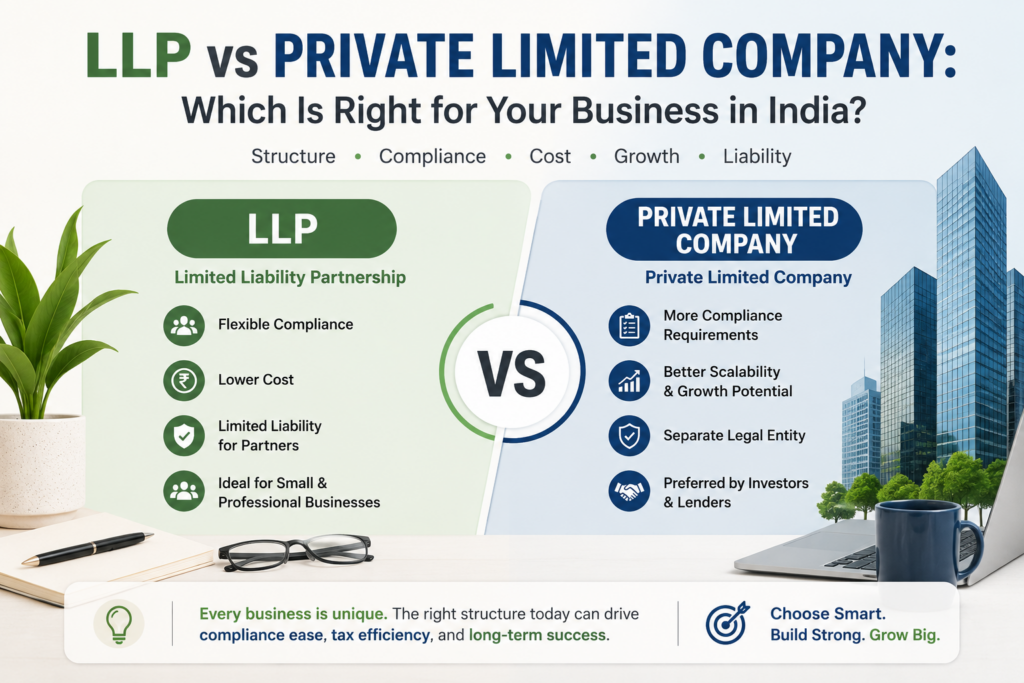
An LLP is a hybrid structure under the LLP Act, 2008. It gives you the flexibility of a partnership with the protection of limited liability. Partners run the business themselves. They split profits however they agree, and they don’t need to separate ownership from management.
A Private Limited Company is incorporated under the Companies Act, 2013. It carries more regulation, but it’s also the structure investors trust and recognise instantly. Shareholders own it. A board of directors runs it. And these can be entirely different people.
This distinction matters more than it looks on paper. An LLP works well when the people running the business and the people who own it are the same. A Private Limited Company works better once you expect that to change, through investors, employee equity, or new co-founders coming in later.
| Feature | LLP | Private Limited Company |
| Governing law | LLP Act, 2008 | Companies Act, 2013 |
| Minimum members | 2 designated partners | 2 directors, 2 shareholders |
| Maximum members | Unlimited | 200 shareholders |
| Ownership unit | Partnership contribution | Equity shares |
| Liability | Limited to contribution | Limited to share capital |
| Can issue ESOPs | No | Yes |
How Does the Compliance Burden Compare?
This is where most founders feel the difference day to day. LLPs file less. Companies file more, and the filings are stricter (Most filings are made through the MCA portal using the company’s Digital Signature Certificate (DSC)).
LLP annual compliance:
- Form 11 (Annual Return), due 30 May
- Form 8 (Statement of Accounts and Solvency), due 30 October
- Income Tax Return via Form ITR-5
- Audit required only if turnover exceeds Rs. 40 lakh or contribution exceeds Rs. 25 lakh
Private Limited Company annual compliance:
-
- AOC-4 (financial statements)
- MGT-7 or MGT-7A (annual return)
- ADT-1 (auditor appointment, within 30 days of incorporation)
- Income Tax Return via ITR-6
- Statutory audit every year, regardless of turnover
- Board meetings and an AGM
A small LLP with modest turnover can run on two annual filings. A Private Limited Company cannot avoid an audit, even in its first year with zero revenue. That single requirement is the biggest driver of the compliance burden gap between the two structures. Founders often underestimate this cost when they incorporate, then feel it every March when audit fees come due regardless of how the year went.

Expert insight: Under Section 2(85) of the Companies Act, a “Small Company” (paid-up capital up to ?10 crore and turnover up to ?100 crore, following a December 2025 notification) is exempt from CARO reporting, mandatory auditor rotation, and the cash flow statement, and needs only two board meetings a year instead of four. The audit itself still applies. But this status covers most new Private Limited Companies and closes a real part of the compliance gap with an LLP, without founders having to apply for it separately.
LLP vs Pvt Ltd: Which Structure Offers Better Funding Readiness?
If funding readiness is a priority, this section matters more than any other. It is also the single biggest reason founders regret choosing an LLP after their business starts growing.
Private Limited Companies can issue equity shares, preference shares, and convertible instruments like CCDs and CCPS. LLPs cannot. Without share capital, an LLP has:
-
- No cap table
- No ESOP pool
- No standard mechanism for a VC fund to take a stake
Most venture capital and angel investors expect startups to be incorporated as Private Limited Companies because LLPs cannot issue equity or maintain a conventional cap table.
Foreign investment follows the same pattern:
| Requirement | LLP | Private Limited Company |
| FDI route | Automatic route, only in sectors with 100% FDI and no performance conditions | Automatic route, broad access across most sectors |
| Can issue equity or ESOPs | No | Yes |
| Preferred by VC and angel investors | Rarely | Standard vehicle |
| Ownership transfer | Requires partner admission, slower | Share transfer, faster |
If funding readiness is part of your long-term plan, even one or two years away, starting as a Private Limited Company avoids a conversion process later, at a point when your time is better spent on the business.
How Does Taxation Differ Between LLP and Pvt Ltd?
Taxation is where the comparison gets less one-sided.
| Item | LLP | Private Limited Company |
| Entity tax rate | Flat 30% (effective ~34.9% above ?1 crore income) | 22% under Section 115BAA (effective ~25.2%), or 25% standard |
| Tax on profit distribution | Exempt for partners under Section 10(2A) | Dividends taxed in shareholders’ hands |
| Minimum Alternate Tax | Not applicable under most regimes | Applies unless 115BAA is chosen |
Here is how the two play out in practice:
-
- An LLP pays more tax at the entity level, but partners take money out without a second layer of tax
- A Private Limited Company pays less at the entity level, but dividends are taxed again when they reach the shareholder
- Founders reinvesting heavily into growth usually come out ahead with a Private Limited Company
- Founders drawing steady profits out each year may find the LLP’s exemption under Section 10(2A) closes some of the tax gap
Which one wins depends on whether you plan to reinvest profits or extract them regularly.
Expert insight: The biggest startup tax benefit, the Section 80-IAC income tax holiday, is not limited to Private Limited Companies. A DPIIT-recognised startup, whether an LLP or a Private Limited Company, can claim a 100% tax exemption on profits for any three consecutive years within its first ten, once approved by the Inter-Ministerial Board. An LLP does lose access to equity-linked benefits, but it is not shut out of Startup India’s core tax holiday the way many founders assume.
What Should Bangalore Founders Know About RoC Karnataka?
RoC Karnataka, which covers all companies and LLPs registered in Bengaluru, operates out of Kendriya Sadan in Koramangala. Your registered office, whether in Koramangala, Indiranagar, Whitefield, HSR Layout, or Electronic City, needs a Karnataka address with proof no older than two months. A residential address is accepted if you don’t have commercial space yet.
Stamp duty is where the two structures diverge locally. A Private Limited Company pays stamp duty on its MOA and AOA under the Karnataka Stamp Act. An LLP pays stamp duty separately on its LLP Agreement, filed as Form 3 within 30 days of incorporation. Karnataka’s stamp duty structure is comparatively predictable, which keeps first-year incorporation costs easier to plan for than in several other states.
One requirement catches almost every new entity off guard: Karnataka Professional Tax registration. Both LLPs and Private Limited Companies must register under the Karnataka Tax on Professions Act within 30 days of incorporation, regardless of whether they have hired anyone yet. This is separate from PF and ESI, and it applies even to a two-person consulting LLP with no employees on payroll.
A pattern we’ve seen in Bangalore:
A founder incorporated an LLP for a consulting practice, assuming Professional Tax registration could wait until the business had staff. An RoC compliance check eighteen months later flagged the gap, along with accumulated late fees. The registration itself took under a week once filed. The delay was the expensive part, not the requirement.
Can You Convert an LLP to a Private Limited Company Later?
Yes. Many Bangalore founders start as an LLP to keep early costs and filings low, then convert once they’re closer to raising a round. The process involves:
-
- Partner consent
- A fresh incorporation filing under the Companies Act
- MCA approval
It typically takes four to six weeks and carries its own cost.
This is a reasonable path if you’re genuinely unsure about funding plans. It is a costly one if you already know you’ll raise within a year or two. In that case, incorporating as a Private Limited Company from day one avoids paying for the same groundwork twice.
If you’ve already decided which structure fits, Actax India handles both LLP registration and Private Limited Company registration in Bangalore end-to-end, including the RoC filing, stamp duty, and Professional Tax steps covered above.
LLP vs Pvt Ltd Bangalore: Which Structure Should You Choose?
| Your situation | Recommended structure |
| Planning to raise VC or angel funding | Private Limited Company |
| Building a professional services or consulting practice | LLP |
| Want to offer ESOPs to early employees | Private Limited Company |
| Low compliance appetite, no external funding planned | LLP |
| Expect foreign investors within sectors outside the automatic route | Private Limited Company |
| Two or three co-founders bootstrapping a services business | LLP |
Actax India Perspective
Most founders we work with in Bangalore ask this question at exactly the wrong time, right before a funding conversation, when converting from an LLP costs weeks they don’t have. The ones who get this right decide early, based on where the business is actually headed, not on which structure has fewer forms to file this year.
Compliance burden is a real cost, but it is a manageable one. A missed funding round because your structure doesn’t support equity issuance is not something you can fix in a week. If there’s a real chance you’ll raise money or bring on a co-founder through equity, that consideration should outweigh the appeal of lighter compliance.
Conclusion
There’s no universally correct choice between an LLP and a Private Limited Company. There is a correct choice for your specific plans. If funding, ESOPs, or foreign investment are anywhere on your roadmap, a Private Limited Company saves you a conversion later. If you’re building a lean, founder-funded services business with no plans to raise equity, an LLP keeps your compliance burden light.
When comparing LLP vs Pvt Ltd in Bangalore, choose the structure that supports your business two or three years from now, not just the one that’s easier to manage today.
Still deciding? Talk to an Actax India registration expert before you file, not after.