
What Are Virtual CFO Services in Bangalore?
A Virtual CFO, also known as a fractional CFO or outsourced CFO, is senior financial leadership you hire on a part-time or retainer basis instead of a full-time hire. You get the strategic thinking of a CFO, like cash-flow forecasting, MIS reporting, fundraising prep, and financial decision support, without a six- or seven-figure annual salary sitting on your books.
Here’s a useful way to see where this fits:
| Function | Bookkeeper | Accountant | Virtual CFO |
| Recording transactions | Yes | Yes | Oversight only |
| Tax and compliance | – | Yes | Strategic oversight |
| Monthly MIS reporting | Limited | Yes | Yes, board-ready |
| Cash-flow forecasting | – | Rarely | Yes |
| Fundraising support | – | Limited | Yes |
| Scenario and unit-economics modelling | – | Limited | Yes |
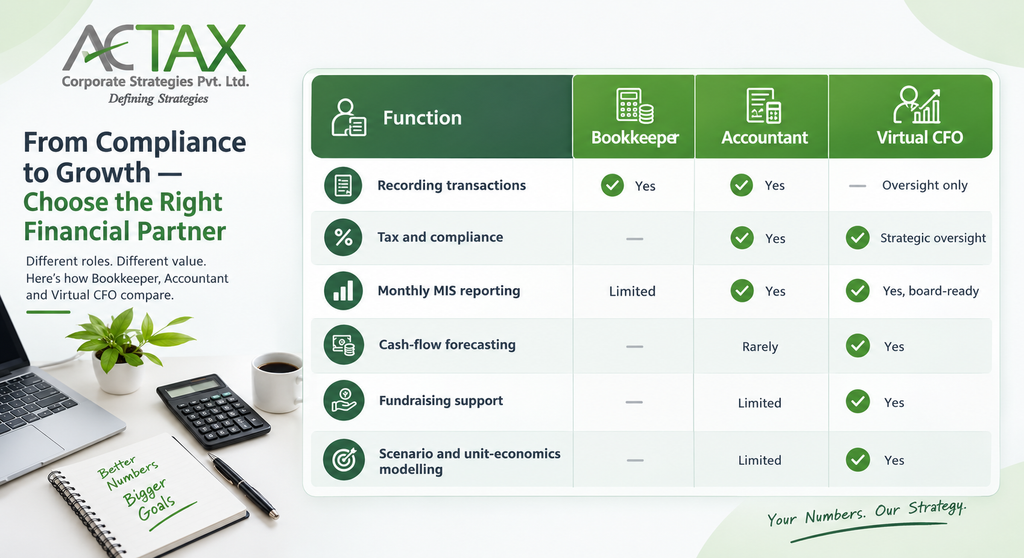
Think of it as a ladder: bookkeeping records the past, accounting keeps you compliant, and CFO-level work tells you what to do next. Most Bangalore businesses climb the first two steps on their own. The third step is where a Virtual CFO comes in.
When Does a Bangalore Startup Actually Need One?
Revenue Is Growing, But Cash Keeps Disappearing
Revenue, profit, and cash are three different things. A startup can double its topline and still run out of money if receivables stretch out or inventory ties up cash faster than sales bring it in.
Financial Decisions Are Being Made By Checking The Bank Balance
A healthy bank balance today says nothing about payroll three months out, or a big vendor payment due next quarter.
You’re Preparing To Raise
Investors expect a clean financial model, defensible unit economics, and a data room that doesn’t need three weeks of scrambling to assemble. Bengaluru’s funding cycles move fast; the city pulled in roughly $2.7 billion across 165 deals in just the first half of 2026, more than half of all startup funding in India for that period, according to Inc42’s Indian Tech Startup Funding Report, H1 2026, and diligence teams here have little patience for messy numbers.
Bengaluru was also the only Indian city to make Startup Genome’s Global Startup Ecosystem Report 2026, ranking 15th worldwide with an ecosystem valued at roughly $153 billion, as the Karnataka government and Startup Genome announced at VivaTech Paris, so the bar for what counts as “investor-ready” here keeps moving up.
Expert insight (Vivek Bhat, Founder, Actax India):
Working with Bangalore startups day to day, the pattern is always the same: founders wait until a term sheet is on the table to build a real financial model. By then it’s rescue work, not strategy. The founders who treat CFO-level reporting as infrastructure from day one raise faster, on better terms, with far less due diligence back-and-forth.
You’ve Got More Than One Product Or Customer Segment, And You Genuinely Don’t Know Which One Is Profitable.
This is where contribution margin and segment-level reporting start to matter.
Compliance Is Fine, But Strategy Is Missing
Plenty of Bangalore businesses are audit-ready and GST-compliant, and still directionless on pricing, hiring pace, or where to cut costs.
The Founder Has Become The Accounts Department
If you’re the one reconciling invoices at 11 pm, that’s time not spent on product or customers.
You’re Hiring Fast, Opening A New Office, Or Entering A New Market
Each of those moves changes your cost structure and cash needs in ways that are hard to model in a spreadsheet you built yourself.
The Actax 7-Signal Outgrown Test
Has your startup outgrown basic accounting? Check how many of these seven signals apply:
- You don’t have a rolling cash-flow forecast.
- You can’t state your true monthly burn without checking with three people.
- Financial reports arrive too late to change any decision.
- You can’t forecast the next 6-12 months with any confidence.
- You don’t know which customers or products are actually profitable.
- Your fundraising numbers change every time someone asks for them.
- Every major financial call still runs on the founder’s gut feel.
If three or more of these sound familiar, it’s worth a conversation.
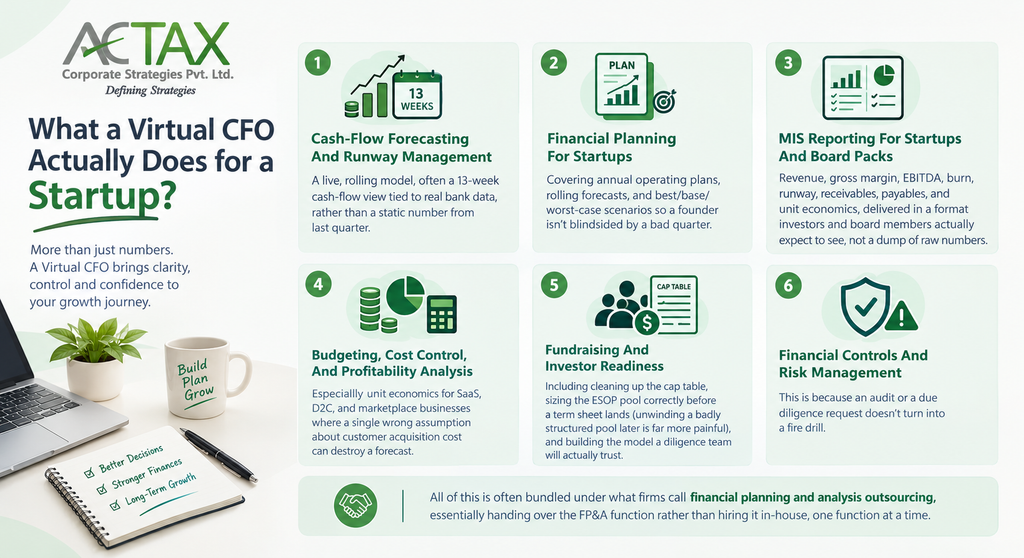
What a Virtual CFO Actually Does for a Startup?
Cash-Flow Forecasting And Runway Management
A live, rolling model, often a 13-week cash-flow view tied to real bank data, rather than a static number from last quarter.
Financial Planning For Startups
Covering annual operating plans, rolling forecasts, and best/base/worst-case scenarios so a founder isn’t blindsided by a bad quarter.
MIS Reporting For Startups And Board Packs
Revenue, gross margin, EBITDA, burn, runway, receivables, payables, and unit economics, delivered in a format investors and board members actually expect to see, not a dump of raw numbers.
Budgeting, Cost Control, And Profitability Analysis
Especially unit economics for SaaS, D2C, and marketplace businesses where a single wrong assumption about customer acquisition cost can destroy a forecast.
Fundraising And Investor Readiness
Including cleaning up the cap table, sizing the ESOP pool correctly before a term sheet lands (unwinding a badly structured pool later is far more painful), and building the model a diligence team will actually trust.
Financial Controls And Risk Management
This is because an audit or a due diligence request doesn’t turn into a fire drill.
All of this is often bundled under what firms call financial planning and analysis outsourcing, essentially handing over the FP&A function rather than hiring it in-house, one function at a time.
How Much Do Virtual CFO Services in Bangalore Cost?
There’s no single “average” number worth quoting, because scope varies too much. But across the market in 2026, monthly retainers for Virtual CFO services in India broadly range from roughly ?35,000 for a smaller business needing MIS and compliance oversight, up to ?2-2.5 lakh or more for a funded, growth-stage company needing full strategic support and investor reporting, a range echoed across multiple 2026 industry write-ups on outsourced CFO cost in India.
Compare that to a full-time CFO, whose salary alone commonly runs ?22 lakh to ?1 crore a year depending on experience, per AmbitionBox’s crowd-sourced CFO salary data for India, often at the higher end in Bangalore’s tech-heavy market, before PF, gratuity, ESOPs, or other benefits are added.
A quick disclaimer: these are indicative ranges from public market data, not a quote. Actual retainer pricing depends on your transaction volume, industry, and scope, and this section is informational, not financial or tax advice. Speak to a qualified CA or advisor for numbers specific to your business.
| Factor | Full-Time CFO | Virtual CFO |
| Employment | Full-time, on payroll | Fractional, retainer-based |
| Annual cost | ?30–50 lakh+ | Often 10–30% of that |
| Flexibility | Low | High, scale up or down |
| Best suited for | Large, complex organisations | Startups, SMEs, growth-stage companies. |
Ask any provider exactly what’s included before comparing headline rates. A cheaper retainer that excludes board reporting or fundraising support can end up costing more once those get billed separately.
Virtual CFO vs Accountant vs CA Firm: What’s the Difference?
An accountant asks: what happened?
A traditional CA firm handles: Are we compliant?
A Virtual CFO asks a different question entirely: what should we do next?
None of these replace each other. A Virtual CFO usually works alongside your existing accountant and CA, not instead of them, reviewing their output and adding the layer of judgment neither role is set up to provide.
How to Choose the Right Virtual CFO in Bangalore?
- Look past general accounting experience: Ask specifically about startup-stage work, fundraising rounds handled, and industry fit; SaaS, D2C, and services businesses each need different reporting.
- Ask exactly what reports you’ll receive, and how often.
- Check what technology they use: Can they work with your existing accounting software, ERP, or dashboards, or are you rebuilding from scratch?
- Ask for relevant examples: Don’t ask for case studies from an unrelated industry.
- Understand the engagement model: Retainer, project-based, or hourly, and what happens when your needs change.
- Verify credentials: In Bangalore specifically, if you operate under STPI or SEZ registration, or run cross-border SaaS billing, ask whether they’ve actually handled that compliance layer before, not just standard GST filing.
2026 Regulatory Shifts Every Bangalore Virtual CFO Should Already Be Tracking
A good Virtual CFO earns their fee not by knowing accounting, but by staying ahead of the changes before they hit your payroll or your credit line.
- RBI raised the collateral-free MSME loan limit to ?20 lakh: As of the RBI’s February 2026 notification (Circular RBI/2025-26/206, FIDD.MSME & NFS.BC.No.12/06.02.31/2025-26, dated 09 February 2026), banks can no longer insist on collateral for MSME loans up to ?20 lakh, with room to extend that to ?25 lakh at a bank’s discretion, effective for loans sanctioned or renewed from April 1, 2026. If your business is MSME-registered, this changes what a Virtual CFO should be pushing your bank relationships toward this year.
- GST e-invoicing rules keep tightening, even at the same ?5 crore threshold: The turnover threshold itself hasn’t moved since August 2023, but from April 2025, Multi-Factor Authentication becomes mandatory for every GST-registered business generating e-invoices or e-way bills, and the 30-day invoice-reporting window now applies to businesses with turnover of ?10 crore and above. Miss these, and your input tax credit chain can break. Exactly the kind of compliance detail a Virtual CFO should be flagging before your accounting team stumbles into it.
- The new Labour Codes change how CTC gets split: The four Labour Codes took effect on 21 November 2025; most Bangalore payroll teams are only now catching up as the April 2026 financial-year reset forces the change. Basic pay plus dearness allowance must make up at least 50% of total CTC. If allowances exceed 50%, the excess gets added back for PF, gratuity, and bonus calculations. That quietly changes your payroll cost and statutory liability, especially if your salary structures lean heavily on allowances the way many Bangalore tech companies do.
Expert insight (Vivek Bhat, Founder, Actax India:
Most founders think the Labour Codes are an HR problem. They’re not; they’re a cash-flow problem,’ says Vivek Bhat, Founder of Actax India. ‘A CTC structure that leaned on allowances just got more expensive to run, and that hits payroll cash the very next cycle.
- Karnataka is actively subsidising this ecosystem: As per the same Inc42 data cited earlier, the Karnataka Startup Policy 2022–27 targets 25,000 registered startups by 2027 and backs it with a dedicated ?100 crore venture fund for AI, ML, EV, and deeptech companies, with a quarter of it ring-fenced for women-led ventures. A Virtual CFO who tracks state-level schemes like this can spot funding or subsidy eligibility a general accountant might miss.
None of this replaces a proper compliance review for your specific business; treat it as the list of questions to bring to whoever handles your finance function next.
Is a Virtual CFO Worth It Right Now?
- Consider one if: Revenue is growing quickly, cash visibility is poor, you’re fundraising, financial decisions are getting complex, or the founder is buried in finance instead of the business.
- You may not need one yet if: The business is small and simple, transaction volume is low, and basic bookkeeping plus compliance genuinely covers everything you need today. Not every business is ready for a Virtual CFO, and that’s a fair thing to be.
The Bottom Line: Virtual CFO Services in Bangalore
Bookkeeping tells you what happened. A Virtual CFO helps you understand what it means and what to do about it next. If your biggest problem right now is recording transactions correctly, you need accounting support. If it is deciding what the numbers mean and what to do next, you are already in CFO territory.
Not sure which one you actually need? A quick assessment based on your current stage, cash position, and growth plans can make the answer clearer. Actax India can help you understand where you are and bring together accounting, reporting and financial advising as your needs expand.