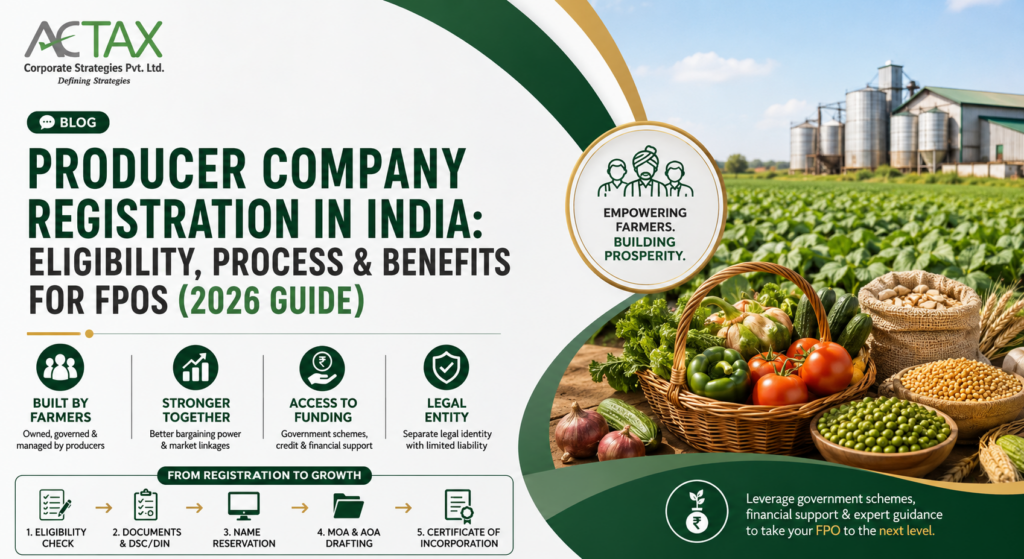
What Is a Producer Company?
A Producer Company refers to a company that has been registered as per Chapter XXIA (Sections 378A–378ZU) of the Companies Act, 2013. It can be formed only by those producers or suitable producers, like farmers, dairy producers, craftsmen, etc.
Through the Producer Company registration process, it is essential to decide upon members and directors, obtain DSC and DIN, and choose and reserve a suitable company name. It also involves preparing the producer company’s MOA and AOA and applying by filing the required forms with the Ministry of Corporate Affairs (MCA).
It can conduct various operations, including the production, collection, grading, processing, packaging, promotion, selling, and exporting of products.
Who Is Eligible for Producer Company Registration?
A Producer Company must meet the minimum requirement of individual producer members or affiliated producer institutions according to Section 378B of the Companies Act.
They must have the required number of directors. It is also good to have at least one of the directors with some experience in farming, dairy, poultry, fishing, or a related activity.
People who produce the goods can become members. Farmers, Dairy producers, Poultry farmers, Fishermen, and other primary producers can become members. Those who only sell the products or have anything to do with those products should avoid being added as members.
Expert Insight from Actax India
At Actax India, we have seen that during the registration, every producer company drafts an MOA that is based only on current farming activities. We have also noted that later on, when they want to begin food processing, their clause does not permit them to do so. So we advise our clients that they should have a draft of broader business objectives so that they don’t have any issues with future amendments. The formulation of the business model will determine the content of the objects clause in the MOA, which may call for additional registrations with extra expenses in the process.
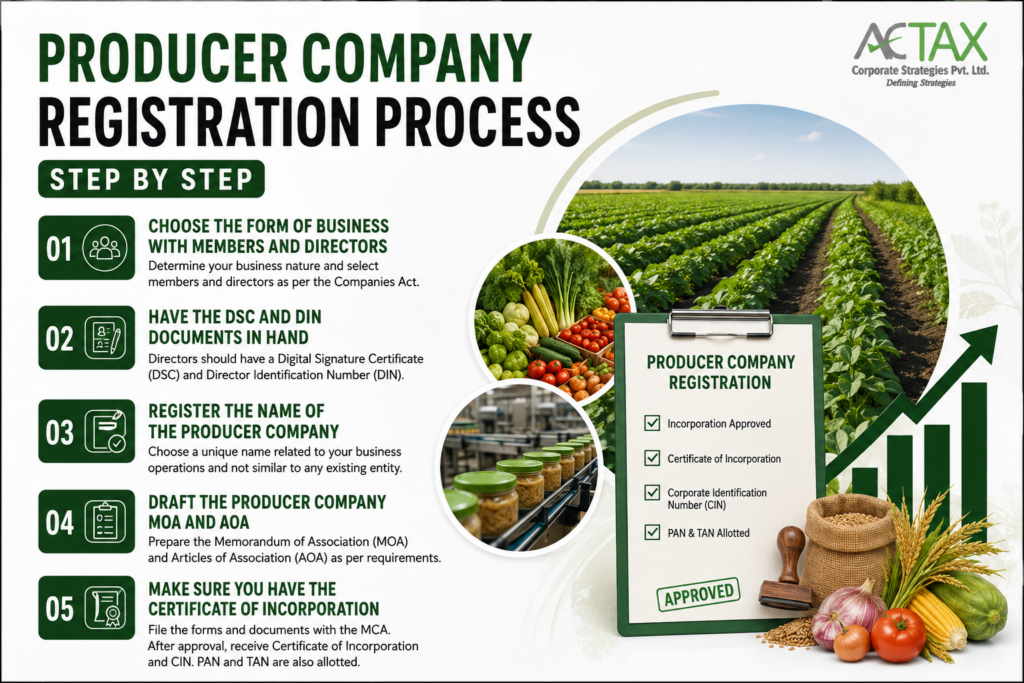
Producer Company Registration Process: Step by Step
1. Choose the form of business with members and directors
To begin with, you should determine the nature of your business. Your business could either deal with raw agricultural produce or include any processing, packaging, branding, and exporting of products. Also, select your members and directors of the company as per the Companies Act.
2. Have the DSC and DIN documents in hand
Before the directors fill out the documents electronically with the MCA, they should have a Digital Signature Certificate (DSC) and a Director Identification Number (DIN) with them.
3. Register the name of the producer company
Select the desired name of your producer’s business. The name should have a certain relation to the producer entity’s operations and not be similar to the name of another organization already registered.
4. Draft the producer company MOA and AOA
Draft the Memorandum of Association (MOA) that must outline the main business activities of the company, along with any other activities, and the capitalization of the business.
The Articles of Association (AOA) must lay down the general rules and procedures that cover matters such as membership, voting rights, transfer of shares, powers of directors, etc.
5. Make sure you have the Certificate of Incorporation.
Follow the incorporation steps to send all essential documents and forms to the Ministry of Corporate Affairs (MCA).
After approval, the business will get the Certificate of Incorporation and Corporate Identification Number (CIN). Besides, PAN and TAN are also allocated through the incorporation process. Now the Producer Company will become an independent legal entity.
After completing the registration process, you need to follow up with your post-registration procedures, which have to be done depending on the requirements of your business. The process involves getting an FSSAI or food license, registering for GST, opening a current bank account, securing an Import Export Code if selling goods internationally, etc.
Expert Opinion
Based on our experience at Actax India with FPO registration, it is important to formulate your MOA and compliance plan in such a way that the FPO is prepared for future expansions into processing, branding, or selling goods to major institutions.
If you are someone confused about a producer company vs. a cooperative society, before going for FPO registration in India, you should look at its business model, governance requirements, financing plans, and long-term objectives.
Government Schemes and Financial Support
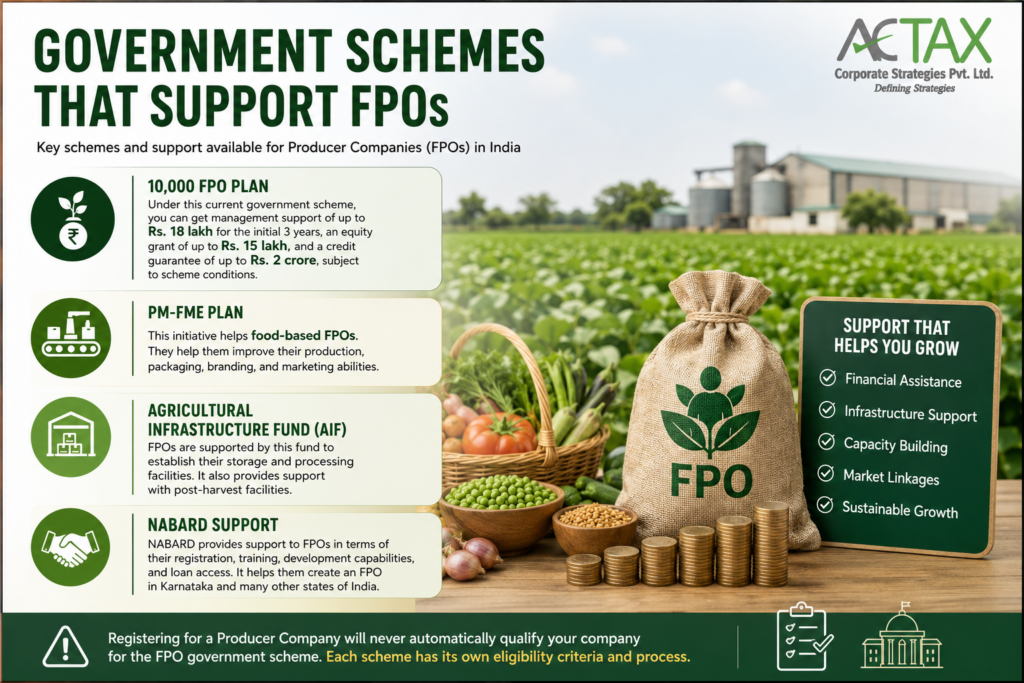
10,000 FPO plan
Under this current government scheme, you can get management support of up to Rs. 18 lakh for the initial 3 years, an equity grant of up to Rs. 15 lakh, and a credit guarantee of up to Rs. 2 crore, subject to scheme conditions.
PM-FME Plan
This initiative helps food-based FPOs. They help them improve their production, packaging, branding, and marketing abilities.
Agricultural Infrastructure Fund (AIF)
FPOs are supported by this fund to establish their storage and processing facilities. It also provides support with post-harvest facilities.
NABARD
NABARD provides support to FPOs in terms of their registration, training, development capabilities, and loan access. It helps them create an FPO in Karnataka and many other states of India.
Registering for a Producer company will never automatically qualify your company for the FPO government scheme. Each scheme has its own eligibility criteria and process.
Compliance After Registration
The incorporation of a business gives it legal standing, but constant compliance make it credible in business.
In the case of Producer Company/FPO, it means:
- Providing annual filings to the ROC, including the profit and loss statement and annual return.
- Conducting regular board meetings.
- Having an external auditor perform an audit.
- Maintaining correct books of account.
- Conducting an internal audit, which is compulsory for Producer Companies under Chapter XXIA of the Companies Act.
If the specified requirements are neglected, the company will face fines and loss of credibility. Institutional buyers and banks usually look for records that are clean and well audited before giving loans or entering into supply contracts.
Taxation: Clearing Up a Common Misconception
A Producer Company is not automatically exempt from income tax.
In some cases, the agricultural income can be free from taxation.
The income that is generated from the trade, processing, or delivery of services is liable to tax. The application of GST is based not only on being an FPO but also on what is sold or performed. There are agricultural activities that do not attract GST, while others do.
Grants and subsidies do not have a blanket exemption from tax. FPOs should keep accounts for transactions carried out between their members and the third party separately.
Key Takeaway
If you are going to register a Producer company, it does not only mean completing legal formalities. You made certain decisions in the beginning to prepare an MOA, choose the management, and then plan your compliance. All this not only affects the company’s funding and growth but also what the day-to-day operations will be. So, good planning from the beginning will make the process easier without any further problems.
Conclusion
Producer Company registration involves a number of things, including taxation, company law, and regulations. The most important factor in avoiding mistakes and correcting them. This involves keeping all the documents, like the MOA, the details of the members, and the tax processes, prepared properly from the very beginning.
At Actax India, we help with document preparation, company formation, and tax registration related to FPO registration.
If you are in search of FPO registration in India and are looking to register a Producer Company, contact Actax India for assistance.