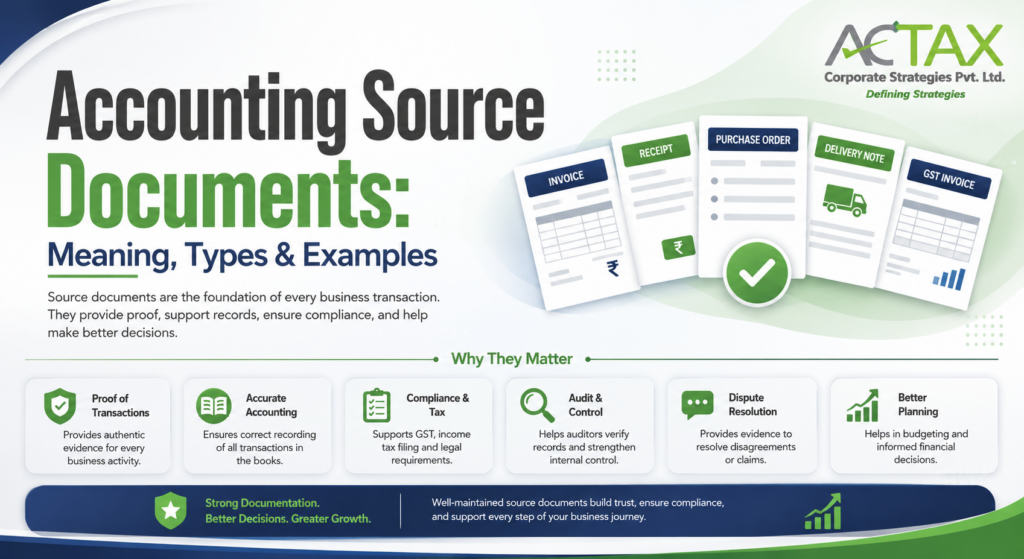
Accounting Source Documents: Meaning, Types & Examples

Accounting documents and their importance

Every number in your financial statements traces back to a piece of paper or a PDF that proves it happened. That proof is an accounting source document, and getting it wrong is one of the fastest ways a business runs into GST notices, failed audits, or a rejected loan application.

Accounting source documents are internal records that provide proof of business transactions. They serve as a reference for bookkeeping and contribute to an accurate financial audit trail. They’re also what protects your business if a dispute arises with a customer, supplier, or tax authority.

In simple words, an accounting source document refers to the record that provides evidence of a financial activity that has taken place in a business. The documents can be generated by the business, received from suppliers or customers, or come from financial institutions or government agencies. Moreover, the source documents present evidence required to record financial transactions in the books of a company.

For example, a sales invoice supports a sales activity, a supplier invoice supports purchases, the bank statement verifies payments received or made, and a Goods Receipt Note verifies goods received.

In this guide, we’ll cover what accounting source documents are, every major type used by Indian businesses, and why keeping them in order matters more than most founders realize.

Table of Contents

What Are Accounting Source Documents?

Accounting source documents are the original records that prove financial transactions in a business. These documents include the transaction date, type, amount, and the parties involved.

For instance, when a company makes a sale, the issued invoice is the source document. Similarly, when salaries are paid, payroll records act as evidence.

Keeping clean source documents ensures transparency and smooth financial operations and it’s the first thing a chartered accountant will ask for when preparing your books or your GST return.

What Makes a Document a Source Document?

A document is typically considered a source document if it serves as evidence for a financial transaction and provides details that should be recorded in the ledger. The information included depends on the type of transaction but can include the date, amount, parties involved, description of the exchange, payments, and taxes paid.

Both internally generated and externally produced documents can serve as source documents. Moreover, the list of required documents may vary depending on the type of business, its accounting procedures, and legal requirements.

Source Document

What It Proves

Example

Sales Invoice

A sale of goods or services

Invoice issued to a customer

Purchase Invoice

A business purchase

Supplier invoice for raw materials

Receipt

Payment received

Customer payment receipt

Bank Statement

Money received or paid through a bank account

Customer payment credited

Purchase Order

Goods or services ordered

PO issued to a supplier

GRN

Goods received by the business

Inventory received against a PO

Credit Note

A reduction or adjustment to an earlier invoice

Goods returned by a customer

Debit Note

A debit adjustment relating to a transaction

Additional amount payable

GST Invoice

Taxable supply and applicable GST

Invoice showing CGST/SGST or IGST

Types of Accounting Source Documents

Here’s the complete list of accounting source documents used in Indian businesses, grouped by what they’re used for.

1. Purchase & Sales Documents

These are the evidence documents for buying and selling transactions between businesses and customers.

  • Purchase Orders (POs) – A purchase order is an order form filled out to purchase goods or services. It’s generally used to finalize a purchase before delivery.
  • Quotes – A quote is the price estimation issued by a supplier before confirming a deal. Customers typically collect quotes from different suppliers to compare which one offers the best deal at the lowest cost.
  • Sales and Purchase Invoices – This is a detailed sales document containing all specifics of the item purchased. If full payment isn’t required before delivery, the invoice must state payment terms and how long the buyer has to pay.

2. Payment & Banking Documents

These documents are proof of payment, deposits, and financial transactions.

  • Receipts – Receipts confirm that a customer has paid an invoice. They’re issued automatically once payment for the purchased goods is completed.
  • Cheques – A cheque is a bank instrument that represents cash and facilitates customer transactions. It’s generally used for non-cash payments through authorized banks. To process the cheque, it must be signed by the authorized signatory, and its unique number should be recorded in your accounting software.
  • Deposit Slips These slips are issued to customers who make payments through cash or cheque to the bank. The total amount of cash and cheques deposited together with their respective amounts is specified in the slip. The bank then updates the records of both the payee and the payer
  • Payment and Remittance Advice – This is mostly used by customers to notify the suppliers that they have paid their bills. It contains information about the payment and the invoice numbers. In case of net banking, the remittance is sometimes attached to the cheque or sent separately.

Note: Many invoices are created with a pre-printed remittance section for easy processing.

3. Payroll & Employee Related Documents

Payroll documents serve as evidence of salary and employee-related transactions recorded in the books of account. The documents may include payroll registers, salary statements, attendance records, employee payment records, and cleared cheques depending on the requirements of a business and statutory requirements. The documents are used to clear amounts payable to employees in the payroll account and as evidence in supporting the accrual of salaries in the books of account.

4. Delivery & Shipping Documents

These documents track the movement of goods from suppliers to buyers.

  • Delivery Dockets – Delivery dockets are issued by the suppliers to signify that the goods have been delivered to the customer.

When goods arrive, are posted, or delivered, the seller often issues a docket indicating the items ordered. Thus, with the delivery docket, the customer can cross-verify the received items with the ones they ordered.

  • Consignment Note – A consignment note is issued together with the transported goods specifying the shipping details.

It carries all the necessary information about the shipment from the point of origin to the destination while tracking them down effortlessly.

  • Goods Receipt Note (GRN) – A GRN is issued to verify that the seller has delivered the order and the buyer has received it. 

It’s generally used after verifying that the received goods match the purchase order.

Note: If a delivery dispute arises later, the goods receipt note provides solid proof of delivery.

5. Adjustment & Tax Compliance Documents

These documents explain the process of tax adjustments, refunds, tax compliance, and other procedures required for filing GST and income tax regulations.

  • Credit Notes: A credit note may be issued by a seller to adjust the amount charged to a buyer, such as in the case of a sales return, overcharging, or any other similar scenarios, and it depends on tax and accounting laws.
  • Debit Notes: A debit note may be issued to adjust the amount of money owed or inform the buyer of a debit, which may include additional information about an amount due, and it depends on tax and accounting laws.

In terms of accounting and GST, the above notes have to be dealt with according to the situation and laws, which means that businesses need to make sure that everything is documented and taxed properly.

  • GST Invoices Description: A GST invoice is issued upon the sale of taxable goods or services. The invoice records the GST rate and amount. Additionally, it contains information on the amount of CGST, SGST, and IGST payable. A GST tax invoice is issued for taxable supplies by a taxpayer to another recipient as mandated by the GST law. It comprises details stipulated by the GST rules including the invoice number and date, supplier and recipient’s information, description of goods and/or services, taxable value, and other mandated details.

Businesses must ensure that all invoice particulars mandated by the GST law are present in the invoices issued and that the documents are compliant with the current GST requirements.

Important: GST invoicing requirements may vary depending on the nature of supply and the taxpayer’s situation. Please consult the latest GST and CBIC guidelines or a tax expert for clarification.

  • TDS Certificates: A TDS certificate is evidence that the payer deducted Tax at Source before making a payment. Under the Income Tax Act, certain payments require TDS deduction professional fees, rent, and commissions among them.

Maintaining these accounting source documents is the basis of bookkeeping, tax, and audits. According to the Income Tax Act, businesses that are mandatory to maintain books of account, under section 44AA, should be kept for a minimum of six years after the relevant assessment year has ended (or until the conclusion of any assessment, reassessment, or appeal that may be pending)

Are Accounting Source Documents Internal or External?

Accounting source documents may be either internal or external to a business.

  • Internal documents are sales invoices, purchase orders, payroll, and internal cash disbursements.
  • External source documents include supplier invoices, bank statements, remittance advice from customers, and other documents created by third parties such as financial institutions or government agencies.

However, what matters most is not the source of the document but its ability to serve as a reliable piece of evidence about the transaction.

We Handle Your Accounts Better Than Anybody Else!

With 20+ years of experience in Accounting, we excel in basic to advanced accounting strategies, crafting insightful financial statements & maintain accurate records helpful for business.

Source Documents vs Supporting Documents: What's the Difference?

Source documents usually provide evidence of a transaction and may be used as a basis for recording the transaction in the accounting system. Supporting documents, on the other hand, provide evidence or information that may be used to support the transaction.

An example of this is illustrated by the supplier’s invoice, purchase order and the goods receipt note. While the invoice provides evidence for recording a purchase, the other two documents provide supporting evidence that the purchase was actually made. It is recommended that businesses maintain their supporting documents together with the relevant source documents instead of using one as the basis for the other.

Document

Primary Purpose

Invoice

Records the sale or purchase

Purchase Order

Shows what was ordered

GRN

Confirms what was received

Bank Statement

Shows the movement of funds

Payment Advice

Communicates payment details

Delivery Document

Supports movement or delivery of goods

Practical Uses of Accounting Source Documents in Business

Accounting source documents can be categorized according to the transaction types that a business records. The most common categories are sales and purchases, payments and banking, inventory and delivery, and tax and compliance. Additionally, some documents can be categorized in more than one category based on the transactions and the accounting processes in a specific business. Here’s where they matter most:

  1. Proof of Financial Transactions: Source documents provide verifiable proof of a business’s financial activities, ensuring every transaction is authentic and properly recorded.
  2. Basis for Bookkeeping and Accounting: All accounting entries in the books of accounts are done based on these documents. This helps to record the transactions accurately.
  3. GST and Tax Compliance: To maintain compliance with GST laws, income tax rules and other financial regulations, the businesses have to store these documents. The significance of source documents includes: Easy filing of GST returns, Filing of ITR, and claiming of ITC (Input Tax Credit).
  4. Audit and Internal Control: To ensure that the financial statements are reliable and free from fraud, the auditors refer to these records. It becomes possible to develop internal control procedures with documentary evidence.
  5. Evidence in Case of Dispute: In case of any dispute, the businesses can rely on these documents for supporting evidence. It can help when a disagreement takes place with customers, suppliers, and government officials.
  6. Budgeting and Financial Planning: The organization requires all the details of income and expenses in order to prepare a proper budget. It becomes easier to maintain financial planning and control with the help of source documents.
  7. Bank Reconciliation: To reconcile the bank balances, the businesses need bank statements, cheque, and deposit slips among others. It enables the entity to compare the bank records with the financial statements.
  8. Supported Loan Applications: Organizations must present financial documents to banks and investors as proof of revenue while applying for business loans or funding.


What are the Things That Trip Businesses on Source Documents?

The single thing that triggers most complaints about source documents is a document that is present but not found when an auditor or GST officer asks for it. The fact that a GST invoice exists but lives in someone’s spam folder three months later is no less burdensome than a document that was never created in the first place.

The businesses that avoid these issues are usually the ones that make source-document filing a monthly discipline, not a quarterly sprint. Every invoice and note is reconciled against bank and GST statements in the same month in which they are issued, not filed away with the best intentions in the week before a tax deadline.

Some of the most useful rules of thumb to avoid problems with source documents are listed below:

  • Reconcile your source documents to your GST filings and bank accounts every month and not once a quarter. This keeps potential problems small and usually confined to one area.
  • Always retain digital and physical copies of any documents connected to a GST or TDS claim. While a scanned copy of the invoice might be acceptable as evidence, these must be available for production at all times.
  • Designate someone in the company to take ownership of document filing, as “everyone has responsibility” is often the reason why nothing gets done.

Summing Up

Accounting source documents cover all the paperwork required to prepare a company’s financial statements. Retaining these records for the legally required period is necessary for every business, since tax authorities and auditors can request them at any time.

Whether you run a startup or an established business, make sure to record, categorize, and manage your source documents efficiently, it’s one of the cheapest forms of insurance your business can carry.

Frequently Asked Questions

How long should I keep accounting source documents?

As per section 44AA of the I T Act whoever is required to maintain books of account should generally be maintained for a period of at least 6 years from the end of the relevant assessment year and till the completion of any assessment or reassessment or appeal against it.

Is a digital copy or scanned invoice a valid source document?

Yes, if it is legible, not altered, and readily available for production upon Tax Authority demand, GST and income tax law allow the maintenance of electronically stored records.

What happens if a source document is lost?

You should recreate the transaction record from the next best evidence available (bank statement, supplier confirmation, duplicate invoice) and raise the discrepancy to your accountant’s notice. An apparently vanished document can make an audit or a GST assessment problematic.

Do small businesses and freelancers need to keep source documents too?

If your income or turnover is below the limits specified under section 44AA, you are not strictly required to maintain books of account. However, for the purpose of GST, loan applications, and dispute resolution, it is advisable to maintain some source documents.

Scroll to Top

Start Your Company The Right Way!

Get Expert Help with Registration

From choosing right business structure to getting fully registered

Book Expert Consultation Now

We help you with the Perfect Package!

You've to just help us with a few details about your requirements...

Scan This QR Code

Virtual Business Card - Vivek Bhat

Point your camera towards the above code

Graphic design

Start Your Business in Bangalore!

Hassle Free & Quick Process!

Expert Guidance, Lowest Fees & 100% Compliant!

Pop Up image - Business consultation - Actax India

Book A Call With Our Experts!

Stay 100% Compliant, Avoid Large Penalties & Get Free 30 minutes consultation

Get Expert Led Guidance for Startups & Businesses!