What a Real-Time Dashboard Actually Shows You?
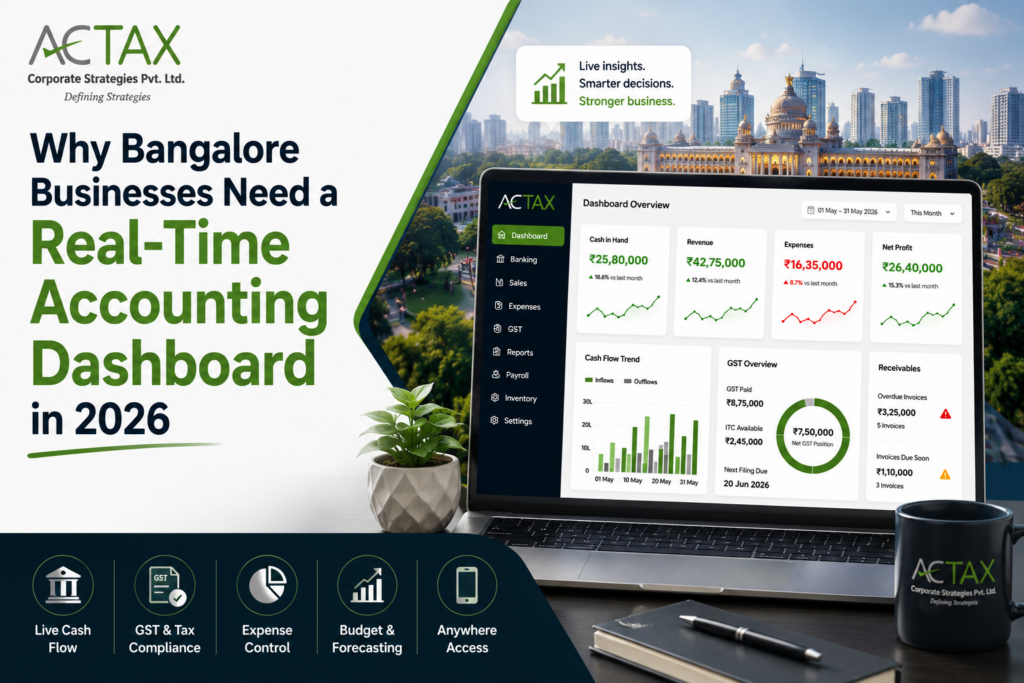
What to put in it: a simple list of the actual numbers a business owner would see live cash in hand, GST liability due, outstanding invoices, monthly burn. Right now if the page is talking generically about accounting software benefits, this is what makes it specifically about real-time dashboards.
What Is a Real-Time Accounting Dashboard?
A real-time accounting dashboard is an additional feature of your accounting software that works by linking your accounting platform to bank feeds, invoices, GST reports, and payroll information. Thus, instead of gathering data by hand once a month, it continuously updates your dashboard so that you can see data in the form of graphs, summaries, etc.
From a practical perspective, it means that whenever you log in to your dashboard or its mobile application, you’ll see how much money you have, how many invoices remain unpaid, how much tax you owe currently, and how much profit you’ve received so far, among other things.
Why Bangalore Businesses Can’t Afford to Wait Until Month-End
The change is not merely a matter of convenience; it reflects the rapid pace of change in the marketplace. The majority of the new accounting software implemented in India is now cloud based, and cities with improved technology infrastructure such as Bangalore, Mumbai, and Delhi NCR are in the forefront of this transition (Cloud-Based Accounting Adoption among SMEs, ResearchGate).
At the same time, businesses are forced to comply with ever-increasing regulations. As more GST and e-invoicing standards come into effect, businesses will have to follow additional compliance rules regarding the growing use of accounting software (India Accounting Software Market Outlook). According to the studies, the rise in demand for such software will continue even through the following years.
Benefits of Real-Time Accounting Dashboards for Bangalore Businesses
- See Cash Flow in Real Time
A cash flow issue rarely happens overnight; rather, it develops over time due to overdue payments from clients, increased expenses, and hidden debts. A dashboard providing real-time accounting information makes it possible for business owners to notice this development and take necessary remedial actions before it is too late.
- Make Your Business Decisions Faster
With real-time financial information, you can quickly decide on hiring new employees, how much to spend on advertising, or if you should expand. You no longer have to wait for a month-end report that is three or four weeks outdated.
- Strengthen GST and Income Tax Compliance
Real-time visibility keeps you ahead of GST and Income Tax deadlines. Your dashboard shows GST paid, input tax credit claimable, and current filing status reducing the risk of an incorrect return or a late-filing penalty.
- Minimizing Accounting Mistakes
Automation eliminates human errors during data entry and delays in balances reconciliation. The coupling of accounting software to banks and invoice systems allows for accuracy without manual auditing involved.
- Speeding Up Investor Reporting
Thanks to real-time reporting, startups have the ability to create their investor updates within a few hours, not days, ensuring higher levels of trust amongst investors while freeing up management from spending too much time on reporting.
- Get Budgets and Forecasts Done in Real Time
Being able to see the expenses against the budget while it happens allows for quick adjustments of forecasts and helps to avoid problems related to overspending.
- Give Every Department the Same Financial Picture
Having one view of expenses, approvals, and budgets means there is a consistent view of finances rather than each department owning a unique interpretation of those numbers.

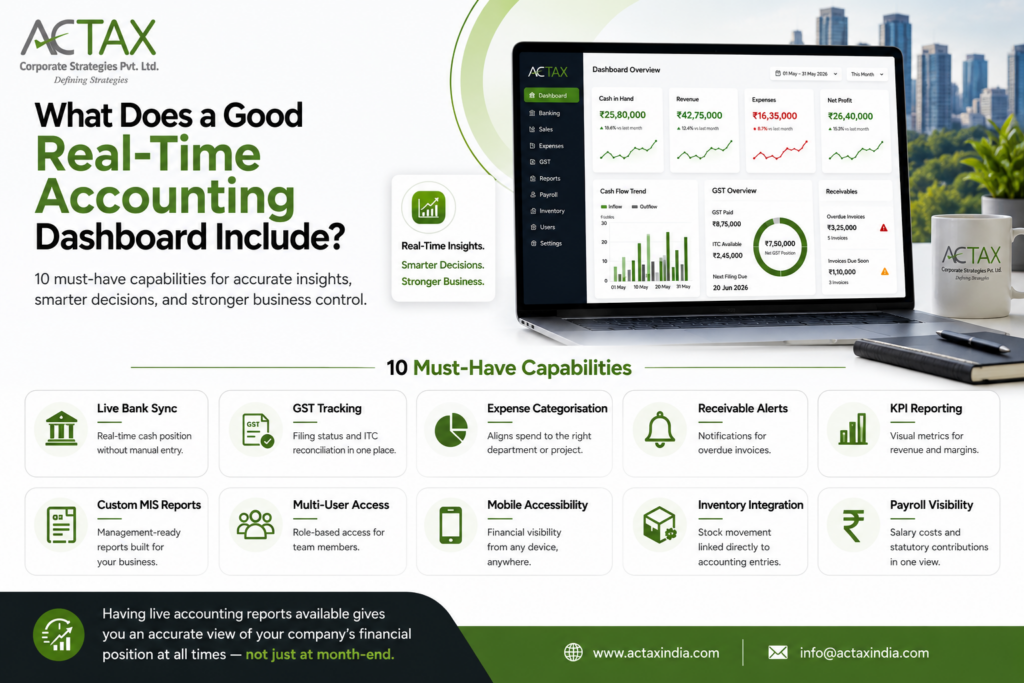
What Does a Good Real-Time Accounting Dashboard Include?
When evaluating accounting software or a dashboard setup, look for these ten capabilities:
| Feature | Why It Matters |
| Live Bank Sync | Real-time cash position without manual entry. |
| GST Tracking | Filing status and ITC reconciliation in one place. |
| Expense Categorisation | Aligns spend to the right department or project. |
| Receivable Alerts | Notifications for overdue invoices. |
| KPI Reporting | Visual metrics for revenue and margins. |
| Custom MIS Reports | Management-ready reports built for your business. |
| Multi-User Access | Role-based access for team members. |
| Mobile Accessibility | Financial visibility from any device, anywhere. |
| Inventory Integration | Stock movement linked directly to accounting entries. |
| Payroll Visibility | Salary costs and statutory contributions in one view. |
Having live accounting reports available gives business owners and finance teams an accurate view of the company’s financial position at all times — not just at month-end.
How to Choose and Implement a Real-Time Dashboard Without Disrupting Operations
Implementing a live financial dashboard is a significant change management as well as software process. There are four steps to the implementation process:
- Take stock of the data you have: bank statements, invoices, payroll, and GST returns, and check that every source is able to connect with an API or banking feed.
- Choose software that fulfills the compliance needs first (GST, TDS, e-invoicing) and reporting requirements second.
- It is prudent to run the interface alongside your current system for the duration of one entire GST cycle before making a full switch to the new system, as this way you will get to learn of any discrepancies while still having access to the old records..
- It is important to make assignments with definite tasks, such as who is responsible for daily exception reconciliation and who audits the dashboard on a weekly basis to ensure that the data is being read properly.
Most start-ups and SMEs don’t have to have the dashboards developed and integrated by themselves. The process can be sped up in case you acquire the services of an accounting partner that is already experienced in running live dashboards for companies of your scale.
Case Study: How a Bangalore SaaS Startup Improved Financial Visibility
A 35-employee SaaS startup in Bangalore was struggling with cash flow visibility and the timing of revenue and expense tracking.
They closed their books once a month, tracked payments manually in spreadsheets, and filed GST at the last minute. The result: unclear profitability, overdue client payments, recurring GST errors, and investor updates that arrived far later than founders wanted.
Working with an accounting firm, they moved to cloud-based accounting on Zoho Books. Bank feeds were connected for live balances, invoices went out automatically with payment reminders, and GST reconciliation moved to a weekly cycle instead of a monthly scramble.
Within three months:
- Investor report preparation dropped from 3–4 days to under 4 hours.
- Overdue payments fell by 60%.
- GST filing errors dropped significantly.
- Founders had real-time visibility into cash flow, burn rate, and runway.
That visibility lets the startup make faster, more confident financial decisions while actively raising its next round of funding.
Conclusion
Using monthly reports and manual spreadsheets to make fast-paced decisions is counterproductive. With a real-time accounting dashboard, all involved parties, be they the founders, finance teams or investors, will have real-time information about cash flow and GST compliance, so that decisions can be based on current numbers not those from the month that went by.
Financial records should help to foresee the upcoming steps rather than only record the facts of the past. In the present-day business world, you may not need access to a greater quantity of financial information in order to have a competitive edge over rivals but rather the right information at the appropriate time. The introduction of real-time accounting dashboards helps businesses to transition from reacting to financial events to anticipating them and transform financing activities into a growth-contingent process instead of a mere function of reporting.
Frequently Asked Questions
Is a real-time accounting dashboard expensive for a small business?
The majority of cloud accounting applications charge for how many users and modules you have, not based on how much data you have, so small companies tend to purchase a small business level (approximately one part-time bookkeeper fee) instead of an enterprise fee. The main cost driver is actually the setup and bank integration process, which firms like ACTAX can complete in just a few weeks.
Is my financial data secure on a cloud accounting dashboard?
Venues reputed in their fields have employed both bank-type encryption techniques and controls based on people’s positions, while GST Network of India now demands Two-factor authentication. As a result, the minimum security level in the market has significantly improved. As a provider, one needs to clarify what encryption, access logs, and backup frequency mean.
Can a real-time dashboard replace my accountant?
The delay is replaced, not the skill. The dashboard brings out real-time figures, but there is a need for a qualified accountant or chartered accountant to interpret these figures, file returns, and give advice on compliance and tax planning.
How long does it take to set up a real-time accounting dashboard?
Most small and medium enterprises (SMEs) that already have digital records can complete the process of syncing their bank accounts with the software and setting up their dashboard in just one to three weeks. However, businesses that are completely moving away from manual record keeping will need four to six weeks to clean their existing data.
Which accounting software do Bangalore startups use most for real-time reporting?
Bangalore SMEs and startups primarily prefer using Zoho Books, Tally Prime, and QuickBooks. However, the dominance of either Zoho Books or Tally Prime is due to the better assistance offered by these two in terms of local GST compliance.