Are you aware that small mistakes in payroll can result in heavy revenue loss for your business?
After conducting an internal payroll audit, the Bengaluru-based Retail chain discovered that some housekeeping staff were being paid at the previous year’s VDA rates.
The per-employee difference was small. However, the total underpayment each month exceeded 2 Lakh. To remedy these issues, the company had to repay employees, correct the payroll records, and update vendor contracts.
The error also brought compliance issues and employee disputes, leading to a loss of money and reputation for the company. Therefore, today they take the Karnataka Minimum Wages 2026-27 seriously, making sure that there is no more error or labour violation from their end.
Through this blog, all the companies can learn how to avoid payroll errors and what are the new minimum wages and VDA rates in Karnataka.
Understanding Karnataka Minimum Wages 2026–27
As of April 1st, 2026, there will be a new minimum wage rate that includes an increase in the VDA based on the most recent CPI. These revisions are applicable to the Karnataka Government’s minimum wage rates for the 2026-27 financial year.
|
Factor |
Update |
|
Notification Number |
|
|
Issued by |
Government of Karnataka, Department of Labour |
|
Valid Until |
March 31, 2027 |
|
Revised VDA (Monthly) |
Rs 4,549.20 per month (Rs 174.97 per day) |
|
VDA Increase This Year |
Rs 435.60 per month |
|
CPI Points (2025) |
10,328 points |
|
CPI Increase Over 2024 |
+363 points (from 9,965) |
|
Wage Range |
Rs 14,559 to Rs 19,972 per month |
|
Applicable Industries |
Shops & Establishments, Manufacturing, Security, Housekeeping, Hotels, and Logistics. |
The new minimum wage regulations will remain in effect until March 31st, 2027.
Why does the Variable Dearness Allowance get revised every year?
Variable Dearness Allowance (VDA) to reflect changes in the Consumer Price Index (CPI), which measures the rate of inflation experienced by an economy, VDA has undergone periodic revision. This ensures that the purchasing power of minimum wages is maintained despite the growing cost of living essentials.
One of the key reasons driving this decision is to allow workers in Karnataka to manage their increasing expenses while simultaneously giving employers some leeway in meeting statutory wage compliance obligations. In other words, we want to ensure that our workers can cope with rising prices without being burdened beyond what they can handle financially.
What Does the Karnataka Minimum Wage in 2026 Include?
According to the Government of Karnataka’s Department of Labour Notification No. KAE 20 LMW 2017, as well as the recent announcement of the annual Variable Dearness Allowance (VDA) revision for FY 2026-27, employers are required to ensure that employees get paid a minimum wage based on their skill group and wage zone.
Let’s look at the salary structure breakup that companies have to include:
Basic Pay: It is a fixed wage that depends on the work location and skillset of the employees.
VDA (Variable Dearness Allowance): The employer pays a variable amount so the employee’s cost of living isn’t affected due to inflation.
The VDA rate is Rs 174.97/day or Rs 4,549.20/month right now, depending on the employee salary.
Gross Salary: The base pay along with allowances like HRA, medical insurance, and transport reimbursement.
Note: Startups generally have a low pay scale but higher allowances so they can control their provident fund obligations.
Latest Karnataka Revised Minimum Wages & VDA Rates for 2026–27
Below is a category-wise wage table for shops & commercial establishments.
The revised minimum wages in Karnataka 2026 are valid from April 1, 2026, to March 31, 2027, as per Employment No. 68.
Highly Skilled workers include Pharmacists, Chemists, Technical Supervisors, and others.
|
Zone |
Basic Wage Per Month in Rs |
VDA Per Month in Rs |
Total Minimum Wage Per Month in Rs |
|
Zone I |
15,423 |
4,549 |
19,972 |
|
Zone II |
14,689 |
4,549 |
19,238 |
|
Zone III |
14,000 |
4,549 |
18,549 |
|
Zone IV |
13,500 |
4,549 |
18,049 |
Skilled workers include salesmen, compounders, photographers, watch/radio/TV repairers, air conditioning plant operators, hairdressers, furniture polishers, etc.
|
Zone |
Basic Wage Per Month in Rs |
VDA Per Month in Rs |
Total Minimum Wage Per Month in Rs |
|
Zone I |
14,700 |
4,549 |
19,249 |
|
Zone II |
14,000 |
4,549 |
18,549 |
|
Zone III |
13,300 |
4,549 |
17,849 |
|
Zone IV |
12,700 |
4,549 |
17,249 |
Semi Skilled
|
Zone |
Basic Wage Per Month in Rs |
VDA Per Month in Rs |
Total Minimum Wage Per Month in Rs |
|
Zone I |
13,700 |
4,549 |
18,249 |
|
Zone II |
13,000 |
4,549 |
17,549 |
|
Zone III |
12,500 |
4,549 |
17,049 |
|
Zone IV |
11,900 |
4,549 |
16,449 |
Unskilled workers include general workers, loading and unloading workers, drying/storing/washing workers, messengers, etc.
|
Zone |
Basic Wage Per Month in Rs |
VDA Per Month in Rs |
Total Minimum Wage Per Month in Rs |
|
Zone I |
10,000 – 10,500 |
4,549 |
14,549 – 15,049 |
|
Zone II |
9,500 |
4,549 |
14,049 |
|
Zone III |
9,000 |
4,549 |
13,549 |
|
Zone IV |
8,500 |
4,549 |
13,049 |
Zone-Wise Wage Classification in Karnataka
Wage Zones in Karnataka have been classified by the nature of cities and their cost of living. An individual’s wage zone is determined by his/her workplace, not by the organization’s office.
Zone I – Bengaluru (BBMP areas)
Pays the highest minimum wage as the cost of living is high in this region.
Zone II – Other City Corporations
For example, Mysuru. Slightly lower wages when compared to Zone I.
Zone III – District Headquarters
Main towns of districts not included in Zones I & II.
Zone IV – Other Areas
Rural areas. Pays the lowest wage.
The payroll has to be adjusted as per the zonal wage policies if the employer has offices in multiple states/cities.
Why Are the Wages Increased in 2026–27?
There is a constant jump in the inflation rate, and the cost of living for the service class isn’t the same anymore. Therefore, state governments have increased the minimum wage for the current financial year.
Currently, the Consumer Price Index (CPI) of Karnataka has increased the wage by more than 5%, i.e., from 9.965 in 2024 to 10.328 in 2025.
An increase in wage is also the result of the following:
- Worker welfare policies
- Union representative demands to address employee concerns
- Wage codes that are constantly updated
These annual changes reflect the state’s efforts to find the right equilibrium between supporting workers’ well-being while accounting for shifts in its economy.
For businesses, staying ahead of such regulations means taking this moment to re-evaluate their own payroll practices, how they compensate contractors, and ensure regulatory adherence as another pay period commences.
How Can You Apply the Karnataka Minimum Wages 2026–27 to Your Payroll
Below is a step-by-step process to apply minimum wage to your company’s payroll:
Step 1: Classify Skill Level
Classify your employee on the basis of skill levels: Highly Skilled, Skilled, Semi-Skilled, or Unskilled, according to their job.
Identify your employees based on their skill set:
- Highly-skilled
- Skilled
- Semi-skilled
Step 2: Determine the Applicable Minimum Wage Zone
Be sure to determine where your employee actually works, not where your company is located.
Step 3: Determine Correct Minimum Wage
You will then refer to the appropriate column and row on the publication of wages for that employee’s skill and respective zone. The number provided to you is the minimum wage to be paid to your employee since it includes Basic Pay + VDA.
Step 4: Verify Minimum Basic Wage is Equal to or Greater Than Employee’s Basic Pay
Your employee’s Basic Pay component must not be less than the Basic Wage that is published in the Karnataka Government’s Minimum Wage notification. Other allowances like, H.R.A., Conveyance, or Food) are not considered as part of this calculation.
Step 5: Specify Gross Salary
By the end, the total of basic pay and VDA should be at least equal to the minimum hourly wage fixed by the state government.
Step 6: Update the Records
Your payslips and records should indicate that you comply with the current minimum wages policy. They will be proof and save you from legal trouble.
Example:
Ramesh is a salesman, classified under the “skilled” category in the BBMP Zone 1 area of Bengaluru. Below is his salary breakdown:
The basic minimum monthly wage is Rs. 13,700.
VDA is Rs 4,549.
The minimum salary Ramesh must receive every month is Rs 18,249.
Currently, he is working at a CTC of Rs 22,000 per month.
But his basic monthly wage is still Rs 12,500, which is under the minimum set limit.
As a result, the payroll is still non-compliant as per the revised norms, and his basic wage should be increased to at least 13,700.
As we can see here, this shows another one of our principles relating to compliance. It doesn’t matter whether your employee’s CTC is higher than the statutory minimum wages.
You will have to ensure that you are compliant with your prescribed basic wages along with the applicable VDA for your job role.
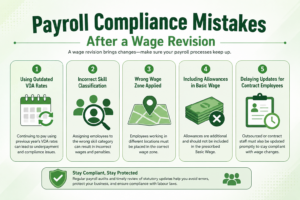
Common Payroll Compliance Mistakes After a Wage Revision
Some organisations have well-established payroll processing but still experience problems when there’s a change to the minimum wage.
We’ve compiled some of the most common mistakes below:
- Continuing Payroll Using Previous Year’s VDA Rates
- Classifying employees under the wrong skill category
- Applying an incorrect wage zone to employees that work in different locations.
- Treating allowances as part of the prescribed Basic Wage.
- Delaying payroll updates on outsourced/contract employees
By conducting periodic payroll audits and by regularly reviewing their statutory notifications, employers should be able to identify such issues in a timely manner and ensure labour law compliance.
What Labour Inspectors Usually Check During Wage Compliance Audits?
During Routine Labour Inspections by Authorities, They check if Employers are implementing Latest Minimum Wage Notification properly.
Key Records which will be checked:
- Wage Register
- Attendance Register
- Payslips
- Employee Skill Classification
- Applicable Wage Zone
- Basic Wage & VDA Calculation
- Contractor Payroll Records (if applicable)
Hence Maintain Updated Payroll Documentation to show during Labour Inspection to avoid wage related disputes
Labor Law Updates Relevant to 2026–27
In addition to the current minimum wage established in Karnataka, businesses will be required to comply with other changes in labor law throughout the year:
- Labor Welfare Fund (LWF): Employers must contribute to the LWF if they have 10 or more employees. The LWF contributions must be remitted by January 15, 2026.
- Rules for Gig Workers: Companies working with freelancers through any platform must register them with the state welfare board. They have to hire them for a specific fee and cannot appoint them as unpaid workers.
- Menstrual Leave: Female workers are allowed to take one paid leave per month during menstruation.
Most of the current labor laws in Karnataka focus on showcasing state’s support towards workers. As a result, employers have to follow strict compliance to boost employee productivity and support the entrepreneurial community.
Penalties for Non-Compliance with Karnataka Minimum Wages
Employees will also have the right of making wage recovery claim against employers that are non-compliant with implementation of notified minimum wages. Also there would be directives by the Labour Authorities to pay up wage arrears as per the law and such penalties.
Henceforth businesses must keep updating their payroll system immediately on each revision of wage rate and need to maintain appropriate wage records to show proof of compliance when being inspected.
How Does the New Minimum Wage in Karnataka Affect Businesses?
The amended minimum wage rules by the Karnataka government may not have a significant impact on high-end tech professionals. However, it still has implications on employer compliance and adds to the business cost.
Regardless of the type of business, the new wage rules can support employees in an economy that is continuously inflating.
Impact on IT Companies
The majority of the software and technology departments do not feel the affect of the changes in minimum wages. However, these revised rates can help the following:
- Administrative employees
- Housekeepers
- Security guards
- Drivers
- Contract and outsourcing workers
Employers are also responsible for ensuring that their vendor partners comply with the new wage rules and regulations.
Impact on E-Commerce Businesses
The new regulations cause a significant difference in the lives of:
- Warehouse Personnel
- Packing and Sorting Staff
- Delivery Staff
- Customer Support Staff
- Logistics and Fulfillment Personnel
E-commerce companies have an increased responsibility for wage compliance.
Impact on Startups How the Revised Karnataka Minimum Wages Affect on Startups?
Here is how the revised Karnataka minimum wages affect new-age companies:
- Increasing Cost: A jump in staff wages directly increases the operating expenses.
- Increasing Vendor Price: A rise in staffing, logistics, facility management, and security costs affects what you charge your vendors.
- Compliance: Updated payroll contracts make sure that companies comply with the labour laws, or they will result in a penalty.
- Financial Planning: Startup founders have to adjust their finances and runway estimates to not enter a debt loop.
What Can Employers Do? How can employers follow the rules for minimum wages in Karnataka?
Employers can comply with the updated policies by:
- Reviewing employee classifications and wage structures.
- Verifying compliance of contractor/vendor.
- Updating payroll systems.
- Maintaining correct compliance documents
- Periodically reviewing employee classifications, wage structures, and payroll records for continued compliance during labor inspections and statutory audits.
- Tracking notifications from the Labor Department.
Every company depends on their staff to keep the productivity going. So, they must comply with Karnataka’s Minimum Wage Revision norms to avoid getting in trouble.
Conclusion
With the update in the Karnataka Minimum Wages 2026, employees are getting better salaries and benefits. By implementing the payrolls correctly and complying with the norms, you can resolve any issues going forward.
Not sure how to proceed? Actax India supports companies in fulfilling their payroll duties and complying with the labour law.
Frequently Asked Questions (FAQs)
Is VDA mandatory under Karnataka Minimum Wages?
Yes. Variable Dearness Allowance is compulsory under Karnataka Minimum Wages. Employers are required to pay both the Basic Wage and Variable Dearness Allowance to their employees wherever it is applicable.
Does paying a higher CTC automatically mean compliance?
No. The company is only complying with the regulations if it pays in accordance with the rules of payment of Basic Wages and Variable Dearness Allowances.
How often is VDA revised in Karnataka?
The Karnataka Government revises the variable dearness allowance periodically. The periodic revision is made on the basis of the changes of Consumer Price Index.
Who is covered under the revised Karnataka Minimum Wages?
The revised Karnataka Minimum Wages usually apply to employees who are employed in scheduled employments. Scheduled employments include shops, commercial establishments, security services, housekeeping and hospitality, logistics, manufacturing, and similar industries.
Where can employers check the wage notifications?
Employers can check the latest wage notification by looking into the latest notification issued by the Government of Karnataka, Labor Department, and in the Gazettes.