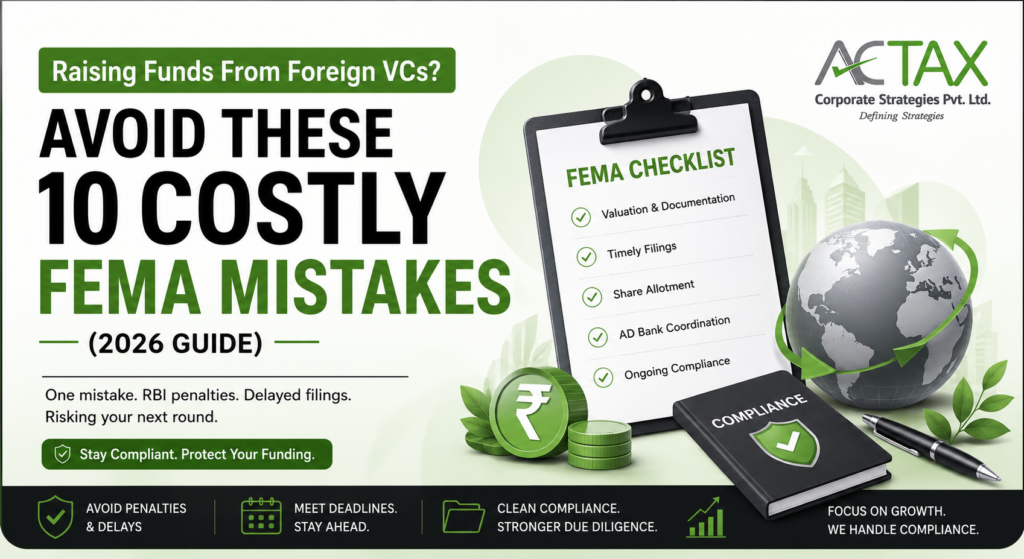
Your foreign investor is ready to wire the money, the term sheet is signed, and the round finally feels done. Then one FEMA filing error, one valuation report that’s a few days too old, or one missed 60-day allotment deadline turns a clean fundraise into a compliance mess, RBI penalties, stalled due diligence, and sometimes a Series A investor who quietly walks away.
This is the pattern we see most often: founders treat FEMA guidelines for VC funding as paperwork to hand off to a CA after the money lands, when it’s actually a set of binding timelines that start the moment a foreign investor commits capital. This guide breaks down the 10 FEMA mistakes that cost Indian startups the most time and money, the exact formulas and deadlines regulators use to calculate penalties, and a founder-ready checklist for keeping your next round clean.
Why FEMA Compliance Matters When Raising Foreign VC Funding
What Is FEMA, and Why Does It Matter for Startups?
The Foreign Exchange Management Act, 1999 (FEMA) is the primary law governing foreign currency inflows into India, administered by the Reserve Bank of India (RBI). The moment an investor based outside India puts money into your startup whether that’s a US venture fund, a Singapore-based angel, or a UK family office FEMA governs how that transaction must be structured, reported, and documented.
Most founders’ compliance errors cluster around three areas: FC-GPR filings, share valuation, and allotment timing. Each is fixable with the right process which is exactly what this guide covers.
Automatic Route vs. Approval Route
Foreign investment into an Indian startup happens through one of two routes:
| Route | How It Works | Applies To |
| Automatic Route | No prior government approval needed before receipt of funds only post-facto RBI reporting. | Most startup sectors (software, SaaS, e-commerce marketplaces, most services) |
| Approval Route | Requires prior government approval before the investment can be accepted. | Defence, media & broadcasting, and sectors involving investors from bordering countries (see Press Note 3 below) |
The FIRMS Portal: Your Single Reporting Gateway
All foreign investment transactions must be reported through the RBI’s FIRMS portal, the centralised platform for:
- FC-GPR filings (reporting share allotment to foreign investors)
- FC-TRS filings (reporting transfer of shares between resident and non-resident)
- LLP reporting for foreign investment into LLPs
- Downstream investment reporting
Every founder should personally hold onto FIRMS login credentials and acknowledgment receipts auditors and future investors will ask for them during due diligence.
The Legal Framework Behind FEMA Compliance
Beyond the headline Act, several linked regulations shape what’s actually required:
- The Foreign Exchange Management Act, 1999
- The Foreign Exchange Management (Non-Debt Instruments) Rules, 2019
- RBI’s Master Directions on Reporting under FEMA
- The FIRMS Reporting Framework issued by RBI
Every startup receiving foreign investment is bound by all four simultaneously not just the headline Act.
What Happens If You Don’t Comply
FEMA’s compliance timelines are strict, and the consequences of missing them compound quickly:
- Penalties and daily fines from RBI
- Complications in future fundraising rounds, since investors run FEMA checks during due diligence
- RBI restrictions on receiving further foreign investment until the contravention is resolved
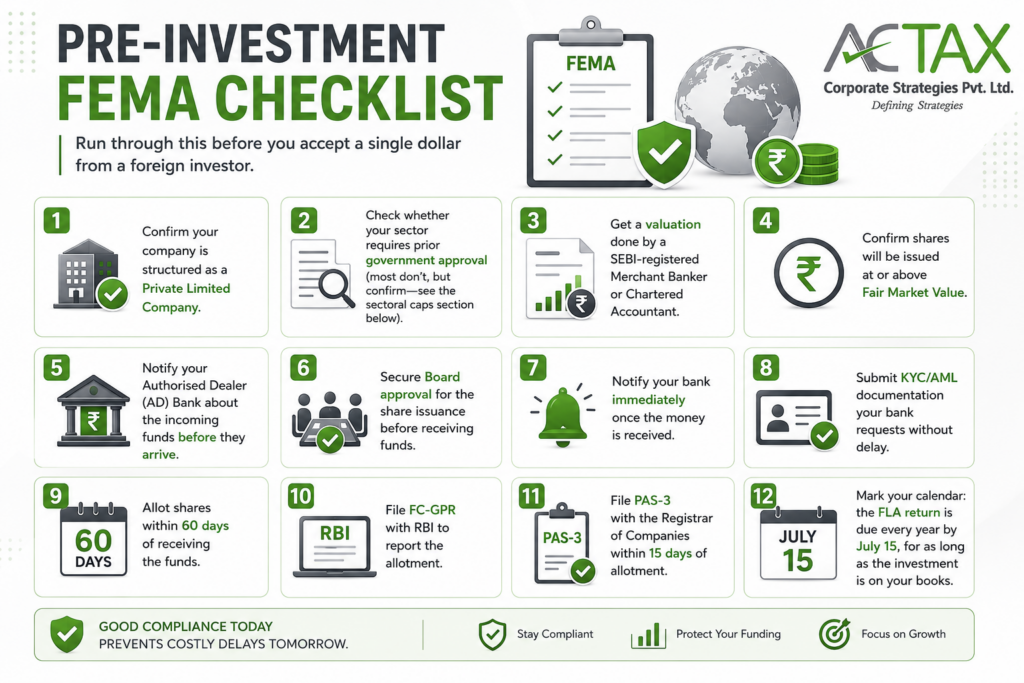
Pre-Investment FEMA Checklist
Run through this before you accept a single dollar from a foreign investor:
- Confirm your company is structured as a Private Limited Company.
- Check whether your sector requires prior government approval (most don’t, but confirm see the sectoral caps section below).
- Get a valuation done by a SEBI-registered Merchant Banker or Chartered Accountant.
- Confirm shares will be issued at or above Fair Market Value.
- Notify your Authorised Dealer (AD) Bank about the incoming funds before they arrive.
- Secure Board approval for the share issuance before receiving funds.
- Notify your bank immediately once the money is received.
- Submit KYC/AML documentation your bank requests without delay.
- Allot shares within 60 days of receiving the funds.
- File FC-GPR with RBI to report the allotment.
- File PAS-3 with the Registrar of Companies within 15 days of allotment.
- Mark your calendar: the FLA return is due every year by July 15, for as long as the investment is on your books.
FEMA Compliance Timeline at a Glance
| Compliance Requirement | Timeline |
| Share allotment | Within 60 days of receipt of funds |
| FC-GPR filing | Within 30 days of allotment |
| PAS-3 filing | Within 15 days of allotment |
| Annual FLA return | By July 15 every year |
| Refund if shares not issued | Within 15 days after the 60-day window expires |
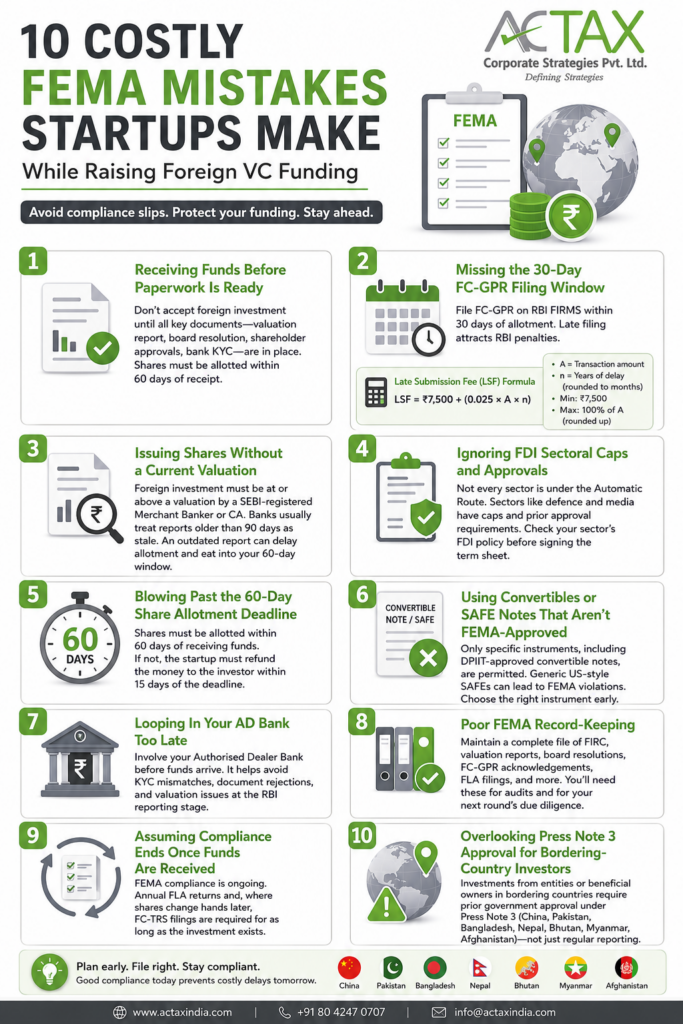
10 Costly FEMA Mistakes Startups Make While Raising Foreign VC Funding
Mistake 1: Receiving Overseas Funds Before the Paperwork Is Ready
Many startups accept foreign investment before completing the necessary documentation a valuation report, a Board Resolution approving the issuance, shareholder approval, and bank KYC. Because shares must be allotted within 60 days of receipt, starting the clock without the paperwork in place puts that deadline at risk from day one.
Mistake 2: Missing the 30-Day FC-GPR Filing Window
A large share of startups miss the deadline to file FC-GPR on the RBI FIRMS portal within 30 days of allotment. Miss it, and RBI’s Late Submission Fee (LSF) mechanism kicks in filed late, but still accepted, at a cost.
How the Late Submission Fee Is Calculated
RBI applies a uniform formula across all late FEMA reporting:
LSF Amount = 7,500 + (0.025 × A × n)
- A = the total transaction amount involved in the delayed reporting
- n = the number of years of delay, rounded up to the nearest month and expressed to two decimal places
- Minimum LSF: ?7,500, even if the formula produces a smaller number
- Maximum LSF: capped at 100% of the transaction amount (A), rounded up to the nearest hundred
Mistake 3: Issuing Shares Without a Current Valuation
FEMA requires foreign investors to subscribe to shares at or above a valuation set by a SEBI-registered Merchant Banker or Chartered Accountant. The detail founders miss: banks generally treat any valuation report older than 90 days as stale. Submit an outdated report and expect the AD Bank to ask for a fresh one, which can quietly eat into your 60-day allotment window.
Mistake 4: Ignoring FDI Sectoral Caps and Approval Requirements
Founders often assume every startup automatically qualifies for the Automatic Route. It’s a reasonable assumption most of the time and a costly one in sectors like defence and media, where caps and prior approval requirements apply. Confirm your sector’s status before, not after, you sign the term sheet.
Mistake 5: Blowing Past the 60-Day Share Allotment Deadline
Startups must allot shares to foreign investors within 60 days of receiving funds. There’s no informal extension, if allotment isn’t completed in time, the startup is required to refund the investor’s money within 15 days of the deadline expiring.
Mistake 6: Using Convertibles or SAFE Notes That Aren’t FEMA-Approved
Not every instrument that’s standard in Silicon Valley is legally valid under FEMA. Only specific instrument types including DPIIT-approved convertible notes are permitted for foreign investment. A generic US-style SAFE, used without adaptation, can trigger a FEMA violation. Pick the right instrument at the term-sheet stage, not after funds arrive.
Mistake 7: Looping In Your AD Bank Too Late
Most startups contact their Authorised Dealer Bank only after the investment is complete and then find their documents rejected or delayed at the RBI reporting stage. Coordinating with your AD Bank before funds arrive heads off KYC mismatches, incomplete documentation, and valuation disputes before they cost you time.
Mistake 8: Poor FEMA Record-Keeping
Many startups don’t keep a clean, organised file of FIRC certificates, valuation reports, board resolutions, FC-GPR acknowledgments, and FLA filings. This becomes a real problem during audits and during due diligence for your next round, when investors ask for exactly these documents on short notice.
Mistake 9: Assuming Compliance Ends Once Funds Are Received
It’s common for founders to think FEMA obligations end once funds land and FC-GPR is filed. They don’t. FEMA compliance is an ongoing obligation annual FLA returns and, where shares change hands later, FC-TRS filings, are required for as long as the investment exists on your cap table.
Mistake 10: Overlooking Press Note 3 Approval for Bordering-Country Investors
Under the 2020 update to Press Note 3, investment from entities in countries that share a land border with India requires prior government approval, not just standard FEMA reporting. The bordering countries are:
- China
- Pakistan
- Bangladesh
- Nepal
- Bhutan
- Myanmar
- Afghanistan
The rule extends beyond the investing entity’s registered address: it also applies where the beneficial owner ultimately resides in one of these countries, even if the investing fund itself is domiciled elsewhere. Skip this check and you risk a violation of both FEMA and FDI policy, one that surfaces, almost without exception, during a later round’s due diligence.
Already Slipped Up? How RBI Compounding Works
Some FEMA violations can be regularised through RBI’s compounding mechanism a process where a company voluntarily discloses a contravention and requests regularisation, along with payment of a compounding fee.
Common violations that go through compounding include:
- Significant delays in filing compliance forms (like FC-GPR)
- Improper issuance of shares
- Contraventions of pricing/valuation rules
- Delayed share allotment
The timing of a compounding application matters beyond the immediate fee; an open or recent compounding case can extend due diligence timelines for your next funding round or an acquisition.
Case Study: How One FEMA Slip Delayed a SaaS Startup’s Series A
A Bengaluru-based SaaS startup raised $800,000 in seed funding from a US-based angel investor. As the founders scaled the team ahead of a planned 2024 Series A, Series A due diligence surfaced a problem: the FC-GPR for that seed round had never been filed.
The startup had to go through RBI’s compounding process to regularise the error, a process that took roughly three months. During that window, one prospective Series A investor withdrew, citing unresolved compliance risk, and the startup paid a fine of more than ?3.5 lakh.
The lesson: don’t assume your CA, co-founder, or bank has filed FC-GPR on your behalf. Verify it yourself, and keep the FIRMS acknowledgment on file; it’s the one document every future investor’s counsel will ask for.
What’s Changing in 2026: ECB Rules and the PRAVAAH Portal
The FEMA (Borrowing and Lending) Amendment and the ECB Framework
RBI’s rules on External Commercial Borrowing (ECB) have recently been simplified, affecting how Indian companies borrow short-term funds from overseas lenders. Venture capital typically comes in as equity, not ECB but if your startup is also exploring foreign debt financing, it’s worth confirming with your bank whether the amended framework opens up options that weren’t available before.
RBI’s PRAVAAH Initiative
RBI continues to build out PRAVAAH (Platform for Regulatory Application Validation and Authorization), its unified gateway for regulatory submissions and approvals. Expect further consolidation of FEMA-related filings onto this platform; startups that stay ahead of PRAVAAH updates will have an easier time than those that wait for a filing deadline to find out what’s changed.
Conclusion
Foreign funding can accelerate a startup’s growth but FEMA guidelines for VC funding are not the part of the round to handle informally. The founders who avoid these 10 mistakes share one habit: they treat FEMA timelines as part of the term sheet, not paperwork that starts after the money lands.
At ACTAX, we manage end-to-end foreign investment compliance for Indian startups FEMA filings, FC-GPR and FC-TRS reporting, valuation coordination, and RBI compounding where needed so your funding round stays clear of compliance risk.
Have you recently received foreign investment, or are you unsure about your compliance status? Speak to an ACTAX expert we’re here to help your business grow, cleanly.
Frequently Asked Questions
What is FEMA compliance for startups?
It’s the set of RBI-administered rules under the Foreign Exchange Management Act, 1999 that govern how a startup accepts, reports, and documents investment from non-resident investors covering valuation, share allotment timelines, and ongoing reporting like FC-GPR and FLA returns.
What happens if FC-GPR is not filed on time?
RBI accepts late FC-GPR filings under its Late Submission Fee mechanism, calculated as ?7,500 + (0.025 × transaction amount × years of delay), subject to a ?7,500 minimum and a cap of 100% of the transaction amount.
Can foreign investors use SAFE notes to invest in an Indian startup?
Only specific instrument types are valid under FEMA, including DPIIT-approved convertible notes. A standard US-style SAFE agreement, used without adaptation to Indian rules, can create a FEMA compliance issue.
What is RBI compounding under FEMA?
It’s a voluntary process where a company discloses a FEMA contravention to RBI and pays a compounding fee to regularise it, rather than facing enforcement action. It’s commonly used for late filings, valuation errors, and delayed share allotment.
Do startups need government approval for investment from bordering countries?
Yes. Under Press Note 3 (2020), investment from entities based in or with beneficial owners based in China, Pakistan, Bangladesh, Nepal, Bhutan, Myanmar, or Afghanistan requires prior government approval, not just standard RBI reporting.
What is the RBI FIRMS portal?
It’s RBI’s centralised platform for reporting foreign investment transactions, including FC-GPR, FC-TRS, LLP reporting, and downstream investment reporting.